
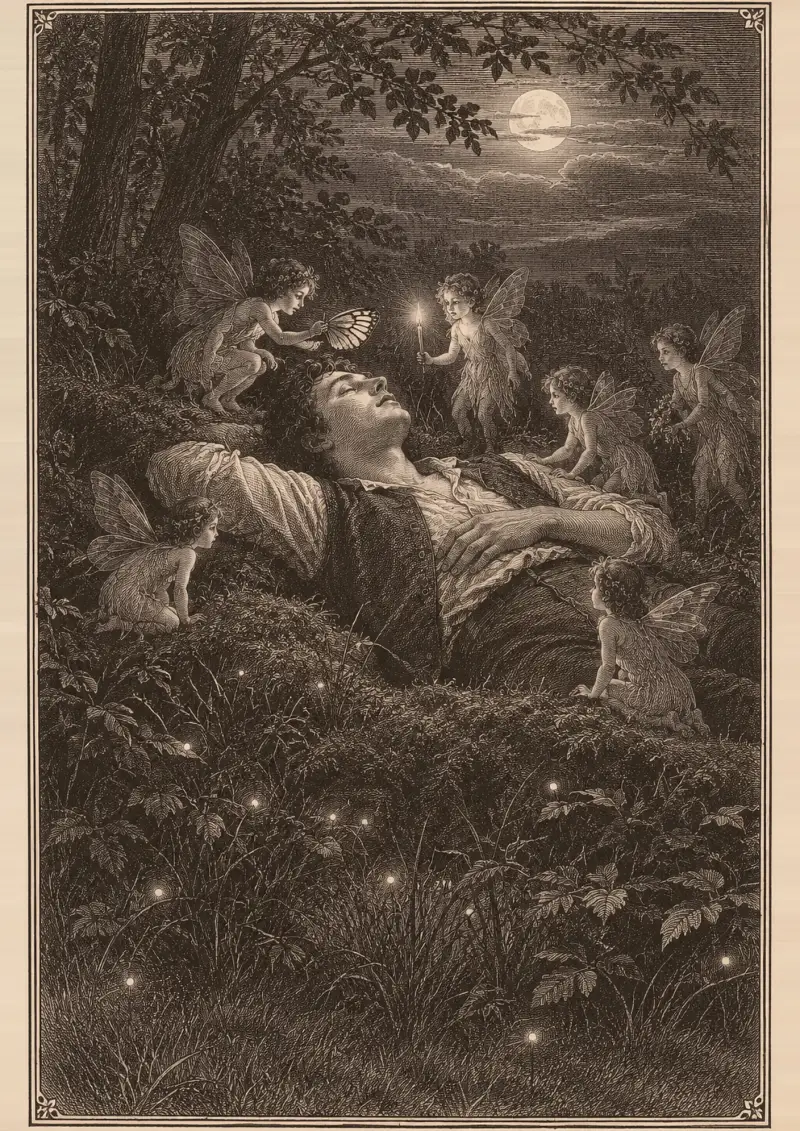
A Midsummer Night’s Dream: key quotes and analysis (PDF)
PDF, 11 pages, 827 KB. Free, no sign-up, made to be printed.
The ten core quotations for A Midsummer Night’s Dream, each with plain English, analysis and a fill-the-gap test. Or read the full study guide.
Dreams and illusion in A Midsummer Night’s Dream
The play argues that a dream is not the opposite of the truth: what its characters dismiss as dreaming really happened, and love, sleep and theatre all work in the same way, by getting a mind to complete what the eye is given. The word changes its value as the play goes on. In the first minute Hippolyta uses it for time that passes without effort: Four nights will quickly dream away the time
. By Act 4 it has become a way of managing an experience too strange to keep, as when Oberon plans that the night will be remembered only as the fierce vexation of a dream
.
The audience knows better. We saw the flower applied and the queen in the weaver’s arms. So when a character calls the night a dream, we hear an error and a kind of accuracy: it happened, but with the logic of dreams, sudden, vivid and impossible to explain in daylight.
The last act turns the question on the theatre. Theseus, who distrusts imagination, defends a bad play on the grounds that The best in this kind are but shadows
. Then Robin offers the audience the same excuse the fairies gave the lovers. Whether to accept it is the play’s final test.
Key quotations about dreams and illusion
The ten quotations are in play order: follow the word “dream” from the first to the last and you have the outline of an essay.
Swift as a shadow, short as any dream,
Lysander · Act 1, Scene 1 1.1.146-147
Brief as the lightning in the collied night,
Plain English: As quick as a shadow, as short as a dream, as brief as lightning in a coal-black night.
Context: Lysander is alone with Hermia after Theseus’s ruling. He is listing what destroys love even where the lovers agree: war, death and sickness.
Methods: Three similes (comparisons using “like” or “as”) in a row each name something that vanishes. Sibilance (repeated “s” sounds) in Swift as a shadow, short
hurries the line along. This is the play’s starting definition: a dream is what does not last. But the third image says more than Lysander intends. Lightning unfolds both heaven and Earth
before The jaws of darkness do devour it up
, so a brief vision can still reveal something. The nouns shadow
and dream
both return in the epilogue.
In an essay: Use it as the baseline. At the start, dream means brevity and loss. Our essay on “The course of true love” reads the whole speech.
The juice of it on sleeping eyelids laid
Oberon · Act 2, Scene 1 2.1.176-178
Will make or man or woman madly dote
Upon the next live creature that it sees.
Plain English: Put this flower’s juice on a sleeper’s eyelids and he or she will fall madly in love with the next living thing seen.
Context: Titania has refused to give up the changeling boy. Oberon sends Robin for a flower once struck by Cupid’s arrow, called love-in-idleness
.
Methods: Illusion enters through the eye and during sleep. The phrase sleeping eyelids
matters because the victim never knows anything was done, and so wakes sure that the new feeling is their own. The alliteration of make or man or woman madly
binds love to madness, a pairing Theseus will repeat in Act 5. In the next live creature
the object of love is left to chance.
In an essay: Treat the flower as a stage picture of an idea already stated in Act 1, that lovers see what the mind supplies. It also shows that illusion in this play is something the powerful do to others. For that side of it, see order and misrule.
Methought a serpent ate my heart away,
Hermia · Act 2, Scene 2 2.2.156-157
And you sat smiling at his cruel prey.
Plain English: I dreamed a snake was eating my heart while you sat by and smiled.
Context: Lysander, with the juice on his eyes, has just left the sleeping Hermia to follow Helena. She wakes from a nightmare and calls to him.
Methods: This is the only sleeping dream anyone recounts in the play, and it is true. While she slept, Lysander wished her hated, but the most of me
. The dream reports the betrayal in images, with the serpent as the old emblem of treachery. There is dramatic irony (the audience knows what the character does not): she tells the dream to an empty space. Methought
, the dreamer’s verb, will come back when Titania and Bottom wake.
In an essay: A quotation that complicates the theme. Hermia’s dream is more accurate than her waking belief in the next act that Lysander was as true as The sun
is to the day
.
And, for the more better assurance, tell them that I, Pyramus, am not Pyramus, but Bottom the weaver.
Bottom · Act 3, Scene 1 3.1.19-21
Plain English: To make quite sure, tell the audience that I am not really Pyramus but Bottom the weaver.
Context: At the rehearsal in the wood, Bottom worries that the ladies will be upset when Pyramus kills himself. He proposes a prologue to reassure them.
Methods: The workmen speak prose, and their logic is comic because it is backwards. They assume stage illusion will be total and must therefore be broken. I, Pyramus, am not Pyramus
is, by accident, a definition of acting: being someone and not being them at once. Minutes later Bottom really is transformed, and he alone does not notice.
In an essay: Use it to connect dreams to theatre. The workmen do not trust an audience to imagine, while Shakespeare’s own play builds a moonlit wood out of words.
My Oberon, what visions have I seen!
Titania · Act 4, Scene 1 4.1.77-78
Methought I was enamored of an ass.
Plain English: Oberon, what strange sights I have seen. I dreamed I was in love with a donkey.
Context: Oberon has obtained the boy and released Titania with a second herb. Bottom is asleep beside her, still wearing the ass’s head.
Methods: visions
and Methought
file a real event under dreaming. Oberon’s answer, There lies your love
, is a blunt correction that points at the evidence. The rhyme is shared between the speakers: her seen
completes the couplet (a pair of rhymed lines) he began with my sweet queen
, so her waking is fitted back into his pattern.
In an essay: Show that “dream” is a label that suits the powerful. Oberon wants the night remembered as a dream. Titania asks how these things came to pass and is told Silence awhile
.
Are you sure
Demetrius · Act 4, Scene 1 4.1.201-203
That we are awake? It seems to me
That yet we sleep, we dream.
Plain English: Are you certain we are awake? It feels to me as if we are still asleep and dreaming.
Context: Theseus has found the four lovers, overruled Egeus and left. They are alone for the first time since the night.
Methods: A question and short, broken phrases replace the confident couplets of the night. The lovers settle the matter by comparing memories of the Duke’s visit, and conclude Why, then, we are awake
. Reality is what several people agree they saw. The irony is that the speaker is the one lover still enchanted. For Demetrius, the dream never ends.
In an essay: Use it to argue that waking does not restore certainty.
I have had a dream past the wit of man to say what dream it was. Man is but an ass if he go about to expound this dream.
Bottom · Act 4, Scene 1 4.1.215-217
Plain English: I have had a dream beyond anyone’s power to describe. A man would be a fool to try to explain it.
Context: Bottom wakes last and alone. For a moment he thinks he is still at rehearsal, waiting for his cue.
Methods: Bottom says dream
three times in two sentences and refuses to interpret it. Man is but an ass
is a pun he cannot hear: he nearly names what he was. His sentences then break off, as in Methought I was
, and his senses cross: The eye of man hath not heard, the ear of man hath not seen
. This muddle echoes a passage in St Paul’s first letter to the Corinthians about things beyond human sense, so the comedy carries a hint of real wonder. He wants the dream turned into a ballad, named because it hath no bottom
.
In an essay: Bottom is the counterweight to Theseus. He treats the dream as beyond reason, not beneath it, and his instinct is to make art from it.
And as imagination bodies forth
Theseus · Act 5, Scene 1 5.1.15-18
The forms of things unknown, the poet’s pen
Turns them to shapes and gives to airy nothing
A local habitation and a name.
Plain English: Imagination gives a body to things that do not exist, and the poet’s pen gives this empty air a shape, a place to live and a name.
Context: After the weddings, Hippolyta remarks that the lovers’ story is strange. Theseus dismisses it, grouping lovers with madmen and poets.
Methods: The verbs are verbs of making: bodies forth
, Turns
, gives
. An antithesis (two opposed ideas set in balance) places airy nothing
against A local habitation and a name
, the abstract against the solid. Theseus intends contempt, yet he describes exactly what Shakespeare has done in giving a fairy the name Peaseblossom and a wood near Athens. The irony runs deeper. A man who rejects antique fables
is a figure from one.
In an essay: Do not quote this as the play’s view. Argue that Shakespeare lets a sceptic give the best account of art, and that the audience, having seen the fairies, knows he is wrong about the night.
But all the story of the night told over,
Hippolyta · Act 5, Scene 1 5.1.24-27
And all their minds transfigured so together,
More witnesseth than fancy’s images
And grows to something of great constancy,
Plain English: But the whole story, and the way all their minds were changed together, is evidence of more than fantasy, and adds up to something solid.
Context: Hippolyta’s reply to Theseus. The lovers enter immediately afterwards, so he never answers her.
Methods: She opens on But
and reasons like a judge. witnesseth
is a word from the law: four accounts that agree are evidence. together
is the key adverb, since one mind can be deceived but a shared experience needs explaining. The organic verb grows
leads to constancy
, meaning consistency, which is also the name of the virtue the lovers lacked all night.
In an essay: The essential counter-quotation to Theseus. The structure gives the woman the last word in the argument, and the play’s events side with her.
If we shadows have offended,
Robin · Act 5, Scene 1 5.1.440-443
Think but this and all is mended:
That you have but slumbered here
While these visions did appear.
Plain English: If we actors have displeased you, just imagine that you fell asleep here and dreamed all this.
Context: The fairies have blessed the house and gone. Robin stays behind and speaks the epilogue directly to the audience.
Methods: Robin makes the audience the offer Oberon made the lovers: let it seem a dream
. The vocabulary gathers up the play. shadows
is Theseus’s word for actors and Lysander’s word for what is brief; visions
is Titania’s word on waking. The four-beat rhymed lines are the metre of the fairies’ spells, so the apology is itself a charm. To accept it would be to repeat Theseus’s mistake about the lovers.
In an essay: End on this to show the theme reaching the audience. Shakespeare returns to the idea in Prospero’s “such stuff as dreams”, where the comparison turns from a play to life itself.
How the theme develops
| Where | What happens to the theme | Quotation to know |
|---|---|---|
| Act 1 | Dream is a figure of speech for what is short and insubstantial. Love is already linked to fancy and to faulty seeing. | short as any dream |
| Act 2 | Illusion becomes a physical thing, a juice laid on sleeping eyes. The one true dream, Hermia’s, tells her what waking hid. | Methought a serpent ate my heart away |
| Act 3 | Illusion multiplies: an ass’s head, false voices in the fog, and amateur actors afraid of being believed. Oberon decides how the night will be remembered. | Shall seem a dream and fruitless vision |
| Act 4 | The waking. Titania, the lovers and Bottom each call the night a dream, and each means something different by it. | I have had a most rare vision |
| Act 5 | The debate. Theseus dismisses, Hippolyta defends, a bad play shows illusion failing, and the epilogue hands the question to the audience. | you have but slumbered here |
The turn comes in Act 4, when the word “dream” stops meaning something unreal and starts meaning something real that cannot be explained. Oberon intends the dream as a means of forgetting. Bottom and Hippolyta refuse to forget, and the play ends on their side: the fairies Theseus does not believe in walk through his house while he sleeps.
Model paragraph
Question: How does Shakespeare use dreams to explore the difference between illusion and truth?
Why it works: It answers the question in its first sentence and then proves it from one moment read closely, down to a pun and a broken sentence. It sets two characters against each other, uses what the audience knows as evidence, and closes with context that extends the argument.
Practice questions
- Read Bottom’s speech on waking in Act 4, Scene 1. How does Shakespeare make it both comic and serious?
- How does Shakespeare use sleeping and waking to shape the structure of the play?
- Compare the presentation of illusion in A Midsummer Night’s Dream with magic and illusion in The Tempest. Who controls what others see, and to what end?
- “Theseus’s speech on imagination is refuted by the play in which he speaks it.” Discuss, with attention to the play within the play and the epilogue.
Check the plot of each act with the questions and answers, and see the themes section of the study guide for how imagination fits with the play’s other concerns. The illusions here are mostly illusions of desire, so the next page to read is quotes about love.