
The passage
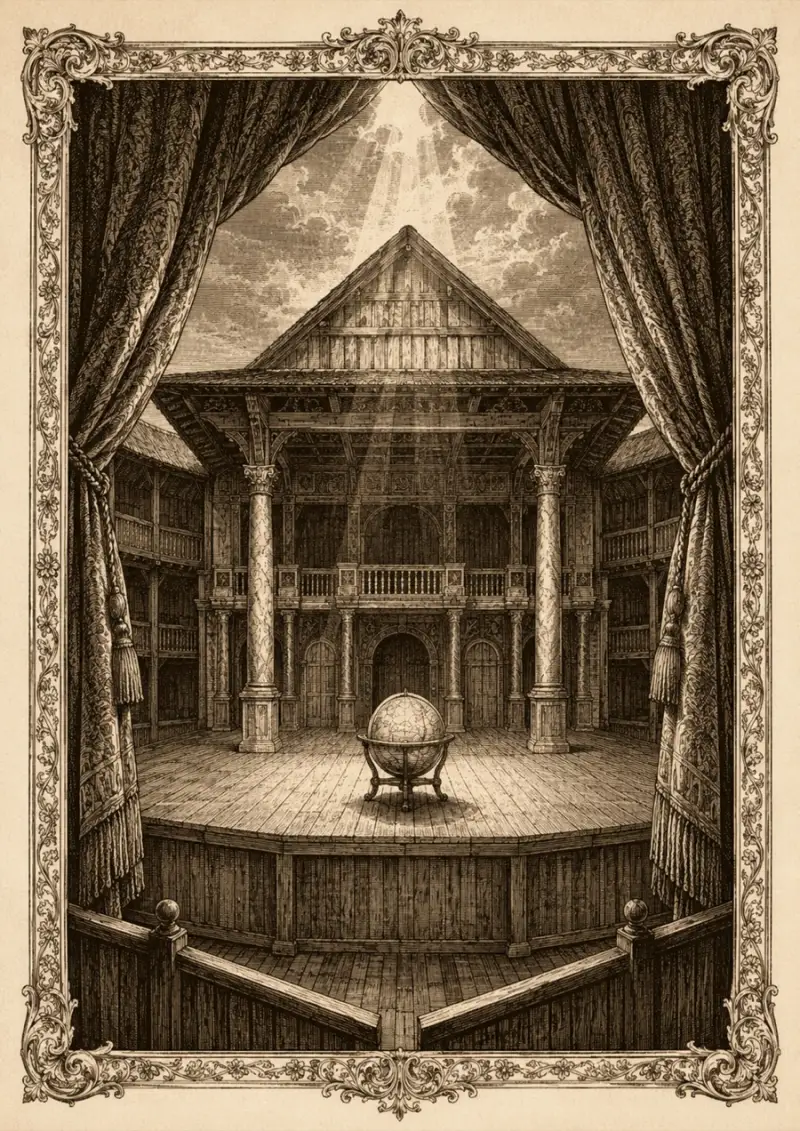
All the world’s a stage,
As You Like It · Act 2, Scene 7 2.7.146-160
And all the men and women merely players.
They have their exits and their entrances,
And one man in his time plays many parts,
His acts being seven ages. At first the infant,
Mewling and puking in the nurse’s arms.
Then the whining schoolboy with his satchel
And shining morning face, creeping like snail
Unwillingly to school. And then the lover,
Sighing like furnace, with a woeful ballad
Made to his mistress’ eyebrow. Then a soldier,
Full of strange oaths and bearded like the pard,
Jealous in honor, sudden and quick in quarrel,
Seeking the bubble reputation
Even in the cannon’s mouth.
In plain English
The whole world is a theatre, and every man and woman is nothing more than an actor. They come on and they go off, and each person plays many roles in a lifetime, which falls into seven acts. First the baby, crying and being sick in its nurse’s arms. Then the complaining schoolboy, face scrubbed, crawling to school as slowly as a snail. Then the lover, sighing like a furnace and writing a mournful song about his lady’s eyebrow. Then the soldier, swearing exotic oaths, whiskered like a leopard, touchy about his honour and quick to fight, chasing a reputation as fragile as a bubble even into the mouth of a cannon.
Line by line
This table goes through the whole Seven Ages speech a line at a time, from the first line to the last. Read the left column aloud, then the right.
| The line | What it means |
|---|---|
All the world’s a stage, | The whole world is a theatre stage, |
And all the men and women merely players. | and all men and women are only actors. |
They have their exits and their entrances, | They have their moments to go off and to come on, (The exits and entrances are also deaths and births.) |
And one man in his time plays many parts, | and each person plays many roles in the course of a lifetime, |
His acts being seven ages. At first the infant, | the acts of his play being the seven stages of life. First comes the baby, |
Mewling and puking in the nurse’s arms. | whimpering and being sick in the arms of its nurse. |
Then the whining schoolboy with his satchel | Then the complaining schoolboy with his school bag |
And shining morning face, creeping like snail | and his bright, freshly washed morning face, crawling as slowly as a snail |
Unwillingly to school. And then the lover, | and against his will to school. Then the lover, |
Sighing like furnace, with a woeful ballad | sighing as hard as a furnace puffs out smoke, with a mournful love song |
Made to his mistress’ eyebrow. Then a soldier, | written in praise of his lady’s eyebrow. Then a soldier, |
Full of strange oaths and bearded like the pard, | full of outlandish swear words, and whiskered like a leopard, |
Jealous in honor, sudden and quick in quarrel, | touchy about his honour, hasty and quick to pick a fight, |
Seeking the bubble reputation | chasing fame, which is as empty and short-lived as a bubble, |
Even in the cannon’s mouth. And then the justice, | even in front of the muzzle of a cannon. Then the judge, |
In fair round belly with good capon lined, | with a fine round belly stuffed with good chicken, (Some editors hear a hint of bribery, since a capon was a familiar gift to a magistrate.) |
With eyes severe and beard of formal cut, | with stern eyes and a beard trimmed in a sober, respectable style, |
Full of wise saws and modern instances; | full of wise old sayings and commonplace examples; |
And so he plays his part. The sixth age shifts | and that is how he plays his role. The sixth age changes, like a change of scene, |
Into the lean and slippered pantaloon | into the thin, foolish old man in his slippers, |
With spectacles on nose and pouch on side, | with glasses on his nose and a purse hanging at his side, |
His youthful hose, well saved, a world too wide | the breeches he wore as a young man, carefully kept, now far too wide |
For his shrunk shank, and his big manly voice, | for his shrunken legs; and his deep man’s voice, |
Turning again toward childish treble, pipes | going back towards the high pitch of a child, squeaks |
And whistles in his sound. Last scene of all, | and whistles as he speaks. The last scene of all, |
That ends this strange eventful history, | which ends this strange story so full of events, (A historyis also a kind of play.) |
Is second childishness and mere oblivion, | is a second childhood and complete forgetfulness, |
Sans teeth, sans eyes, sans taste, sans everything. | without teeth, without sight, without the sense of taste, without anything. |
Words to know
- merely
- Only, nothing more than. In Shakespeare’s English the word could also mean entirely, and both senses fit: people are actors and nothing else.
- players
- Actors.
- mewling
- Crying feebly, whimpering like a kitten.
- ballad
- A song. Here it is a love song written by the lover himself, not a story in verse.
- strange oaths
- Foreign or outlandish swear words, of the kind a soldier brings home from the wars. Strange often means foreign.
- pard
- A leopard, or any big spotted cat. The soldier’s bristling whiskers look like the animal’s, and he is as fierce.
- jealous in honor
- Quick to suspect an insult and to defend his good name. Jealous here means anxiously protective, not envious.
- bubble reputation
- Fame that is as empty and as easily burst as a bubble. Bubble works as an adjective.
- justice
- A judge or magistrate, a justice of the peace. It is the man, not the idea.
- capon
- A cock that has been neutered and fattened for the table: rich food.
- saws
- Sayings, proverbs. It is related to the word say and has nothing to do with the tool.
- modern instances
- Commonplace examples. Modern in Shakespeare means ordinary or everyday, not up to date. An instance is an example offered as proof.
- pantaloon
- A foolish old man. Pantaloon was the stock figure of the thin, miserly old man in Italian comedy, who wore slippers and spectacles.
- hose
- Breeches or close-fitting leg coverings, the lower half of a man’s dress. Shank, in the next line, is the leg from knee to ankle.
- mere oblivion
- Total forgetfulness. Mere means utter or complete. Oblivion is both forgetting everything and being forgotten.
- sans
- Without. It is a French word that English had borrowed, and it is said as one syllable.
Where it comes in the play
As You Like It (c. 1599) is a comedy. Duke Senior has been driven from court by his brother and lives with a band of loyal lords in the Forest of Arden. Among them is Jaques, a traveller with a reputation for melancholy, who enjoys finding fault with everything and envies the licence of a professional fool.
Just before the speech, the young hero Orlando bursts in on the exiles’ meal with his sword drawn, demanding food for his old servant Adam, who is collapsing from hunger. The Duke answers with kindness and Orlando, ashamed, goes to fetch Adam. While they wait, the Duke remarks that they are not the only unhappy people: This wide and universal theater / Presents more woeful pageants than the scene / Wherein we play in
. Jaques seizes the metaphor and runs with it. So the speech is not a soliloquy and not a sermon. It is an after-dinner turn, performed to an audience of lords to fill a pause, by a man who likes the sound of his own disenchantment.
Close reading
“Merely players”
The idea that the world is a theatre was an ancient commonplace long before Shakespeare used it, and the scheme of dividing life into ages was equally familiar. What is distinctive is the tone. The key word is merely
. People are not noble actors in a divine drama; they are only actors. Life is reduced to exits
and entrances
, and note the order: exits come first.
Seven caricatures
Each age is a quick, unkind sketch, and each is defined by a noise or a costume. The infant is Mewling and puking
: two ugly participles, the first a cat-like whimper. The schoolboy is whining
, and the simile creeping like snail
drags out his journey; the enjambment (the sense running over the line end) into Unwillingly to school
makes the sentence itself arrive late.
The lover is treated with open mockery. He is Sighing like furnace
, all hot air, and his poem is addressed not to his mistress but to her eyebrow
. This is bathos, a sudden drop from the grand to the trivial, and it laughs at the fashion for love poetry that praised a lady feature by feature.
The soldier is all show: Full of strange oaths and bearded like the pard
. His honour is something he is Jealous
about, and what he risks his life for is the bubble reputation
. The metaphor is exact. A bubble is bright, empty, and gone at a touch, and he seeks it Even in the cannon’s mouth
.
The justice comes next, In fair round belly with good capon lined
, full of wise saws and modern instances
, that is, stock sayings and commonplace examples. Jaques sums him up: And so he plays his part
.
The last two ages
With the sixth age the comedy darkens. The old man is a lean and slippered pantaloon
, named after the foolish old man of Italian comedy. His stockings, carefully kept from his youth, are a world too wide / For his shrunk shank
. His big manly voice
turns again toward childish treble
. Life is a circle, and it is closing.
The final lines complete it: Last scene of all, / That ends this strange eventful history, / Is second childishness and mere oblivion, / Sans teeth, sans eyes, sans taste, sans everything
. Here mere
means utter or complete. The French word sans
(without) is repeated four times, a use of anaphora that strips the body one faculty at a time, and the last term swallows the rest. A list that began with a baby ends with nothing.
What it tells us about the play
Look at what Jaques leaves out. There are no women after the first line. There is no friendship, no loyalty, no marriage, no work done well, no faith. The lover is ridiculous and the old man is helpless. It is a picture of life with everything that makes it bearable removed, and it tells us more about the speaker than about humanity.
Shakespeare answers him at once, and without a word. The stage direction that follows the speech brings on Orlando carrying Adam. Here is an old man who is not a pantaloon but a faithful servant, and a young man who is not a posing lover or a hothead but someone bearing another person’s weight. The Duke greets them: Set down your venerable burden
. venerable
means worthy of reverence. Jaques has just said old age is mere oblivion
; the play shows it being honoured.
The rest of the comedy takes the same side. Rosalind is as sceptical as Jaques about romantic clichés, telling Orlando that Men have died from time to time and worms have eaten them, but not for love
, yet she loves wholeheartedly all the same. The play prefers her warm realism to his cold one. At the end, when four couples marry, Jaques walks away from the celebration.
The theatre metaphor itself runs all through Shakespeare. Macbeth gives it its bleakest form in “Tomorrow and tomorrow and tomorrow”, where life is a poor player
, and Prospero its gentlest in “We are such stuff as dreams are made on”.
What people get wrong
- “This is Shakespeare’s view of life.” It is Jaques’s. A dramatist gives speeches to characters, and this character is a known cynic whom the play immediately contradicts.
- “It is a soliloquy.” It is spoken to Duke Senior and his lords as part of a conversation.
merely
andmere
are mild words. In Shakespeare’s English they are stronger, closer to “entirely” and “utter”.
Using it in an essay
Credit comes from reading the speech dramatically: who speaks, to whom, and what the play does next. Then show how the language creates the mocking tone. The close reading toolkit offers a step-by-step way to move from a word to an effect to an argument, and the guide to Shakespeare’s language will help with vocabulary such as pard
and saws
.
Fragments worth memorising:
merely players
- the reductive adverb sets the cynical tone.Sighing like furnace
- the lover as comic exaggeration.the bubble reputation
- honour as something bright, empty and brief.second childishness and mere oblivion
- life as a circle that closes on nothing.sans everything
- anaphora that ends in total loss.
When you turn this into a full answer, the essay planner will help you build the argument paragraph by paragraph. If you are studying comedy alongside this play, the A Midsummer Night’s Dream study guide covers the genre’s conventions, and “The course of true love never did run smooth” makes a good companion passage on how comedy treats lovers, as does “If music be the food of love”.
Famous speeches are easy to recognise and hard to know. The Daily Bard app helps you meet them slowly: one passage a day on iPhone and iPad, with no account and no ads. If you find yourself wanting to return to a page, the Full Edition of Daily Bard keeps each one in your Commonplace Book and lets you add margin notes of your own.