
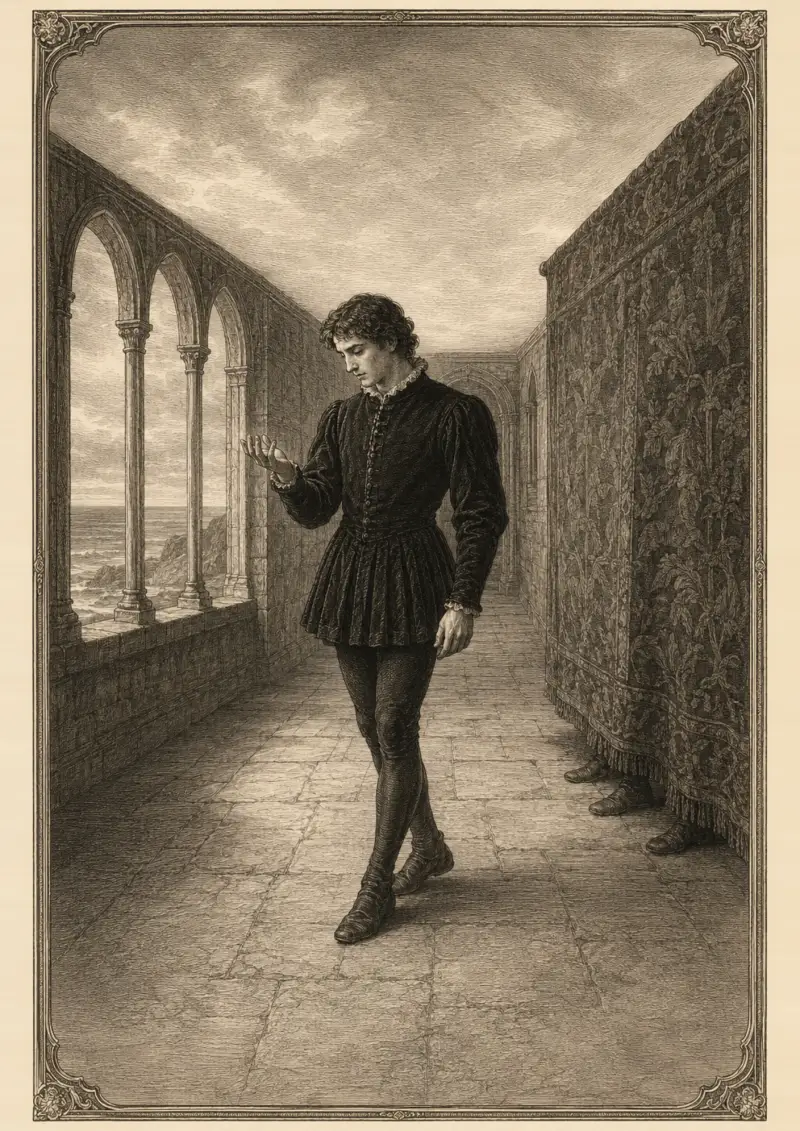
The passage
To be or not to be, that is the question:
Hamlet · Act 3, Scene 1 3.1.64-76
Whether ’tis nobler in the mind to suffer
The slings and arrows of outrageous fortune,
Or to take arms against a sea of troubles
And, by opposing, end them. To die, to sleep,
No more, and by a sleep to say we end
The heartache and the thousand natural shocks
That flesh is heir to, ’tis a consummation
Devoutly to be wished. To die, to sleep,
To sleep, perchance to dream. Ay, there’s the rub,
For in that sleep of death what dreams may come,
When we have shuffled off this mortal coil,
Must give us pause.
In plain English
To exist or not to exist: that is the issue. Is it more honourable to endure whatever a cruel fortune throws at us, or to fight back against an ocean of troubles and, by fighting, finish them? Dying is only sleeping. If sleep could end the heartbreak and the countless blows that come with having a body, that would be an ending to pray for. But sleep brings dreams. The thought of what we might dream in death, once we have thrown off the turmoil of this life, is what makes us hesitate.
Line by line
This table goes through the whole soliloquy one line at a time, from the opening question to the moment Hamlet notices Ophelia. Read the left column aloud, then the right. The paraphrase runs on from row to row, as the sentences do.
| The line | What it means |
|---|---|
To be or not to be, that is the question: | To exist or not to exist, to go on living or not: that is the question to be settled. |
Whether ’tis nobler in the mind to suffer | Is it more honourable to endure, in patient silence, |
The slings and arrows of outrageous fortune, | the stones and arrows that a cruel, violent fortune shoots at us, |
Or to take arms against a sea of troubles | or to pick up weapons and fight an ocean of troubles |
And, by opposing, end them. To die, to sleep, | and, by fighting, finish them? To die is to sleep, (end themhas two senses: to defeat the troubles, or to end them by dying in the fight.) |
No more, and by a sleep to say we end | nothing more than that; and if by that sleep we could say that we end |
The heartache and the thousand natural shocks | the heartbreak and the countless blows of ordinary life |
That flesh is heir to, ’tis a consummation | which everyone with a body inherits, then that is an ending |
Devoutly to be wished. To die, to sleep, | to be prayed for with all one’s heart. To die is to sleep. |
To sleep, perchance to dream. Ay, there’s the rub, | But to sleep is perhaps to dream. Yes, that is the obstacle, |
For in that sleep of death what dreams may come, | because the thought of what dreams may come in the sleep of death, |
When we have shuffled off this mortal coil, | once we have thrown off the turmoil of this mortal life, |
Must give us pause. There’s the respect | is bound to make us stop and think. That is the consideration |
That makes calamity of so long life. | that makes misery last so long: it is why people live on through a long life of suffering. |
For who would bear the whips and scorns of time, | For who would put up with the lashes and insults of life in this world, |
Th’ oppressor’s wrong, the proud man’s contumely, | the injustice done by the powerful, the scornful rudeness of the arrogant, |
The pangs of despised love, the law’s delay, | the pain of love that is rejected, the slowness of the law, |
The insolence of office, and the spurns | the arrogance of people in official positions, and the kicks and insults |
That patient merit of th’ unworthy takes, | that deserving people quietly take from those who are worth less than they are, |
When he himself might his quietus make | when he could settle his own account once and for all |
With a bare bodkin? Who would fardels bear, | with nothing more than a dagger? Who would carry heavy loads, (barecan mean both mere and unsheathed.) |
To grunt and sweat under a weary life, | groaning and sweating under the weight of an exhausting life, |
But that the dread of something after death, | if it were not that the fear of something after death, |
The undiscovered country from whose bourn | that unexplored country from whose border |
No traveler returns, puzzles the will | no traveller comes back, bewilders the will until it cannot choose |
And makes us rather bear those ills we have | and makes us prefer to put up with the troubles we have |
Than fly to others that we know not of? | than rush off to others that we know nothing about? |
Thus conscience does make cowards of us all, | In this way reflection makes cowards of every one of us, (consciencemeans both the moral sense and consciousness, the habit of thinking things over.) |
And thus the native hue of resolution | and in this way the natural, healthy colour of determination |
Is sicklied o’er with the pale cast of thought, | is covered over with the pale, sickly tinge of thinking, |
And enterprises of great pitch and moment | and undertakings of great height and importance, |
With this regard their currents turn awry | because of this consideration, are turned off course like streams that have been diverted |
And lose the name of action. Soft you now, | and can no longer be called action. But quiet now: |
The fair Ophelia. Nymph, in thy orisons | here is the beautiful Ophelia. Lady, in your prayers |
Be all my sins remembered. | may all my sins be remembered. |
Words to know
- outrageous
- Violent and cruel beyond all limits. The modern sense, shocking or absurd, is too weak here.
- consummation
- A final ending or completion. Hamlet means death as the finish of everything.
- rub
- An obstacle. In the game of bowls, a rub is any unevenness in the ground that knocks the bowl off its course.
- mortal coil
- The turmoil and bustle of mortal life. Many readers also hear a coil of rope, something wound around us that death lets us slip out of, and the phrase can carry both pictures.
- respect
- A consideration, a thing to be taken into account. It does not mean admiration here.
- contumely
- Insulting, contemptuous treatment. It is a noun, despite the ending.
- office
- People who hold official positions: those with a little authority, and the way they treat everyone else.
- spurns
- Kicks, and so contemptuous rejections. To spurn is literally to strike with the foot.
- quietus
- The settling of a debt. It was the word written on an account to show it had been paid in full, so to make one’s quietus is to be released from life as from a debt.
- bodkin
- A small dagger. The word could also mean a long pin or a tool for piercing holes, which makes the instrument sound slighter still.
- fardels
- Burdens or bundles, the packs a porter carries on his back.
- bourn
- A boundary or frontier. Death is pictured as a country with a border that can be crossed in one direction only.
- puzzles
- Bewilders completely, brings to a standstill. The word was stronger than it is now.
- conscience
- Both the moral sense of right and wrong and consciousness, the inward habit of reflection. Editors differ over which sense leads here. The lines that follow, about thought, favour the second.
- pitch and moment
- Height and importance. Pitch is the highest point of a falcon’s flight. Some other editions print pith, meaning strength, in place of pitch.
- orisons
- Prayers.
Where it comes in the play
The speech stands at the centre of Hamlet. Hamlet has been told by his father’s ghost that Claudius is a murderer, has sworn revenge, and has done nothing. At the end of the previous act he seemed to find a way forward: he will stage a play to test the King’s guilt. Yet he walks on next thinking about death.
He is also not alone, though he believes he is. Claudius and Polonius have just hidden themselves to spy on him, and Ophelia has been placed in his path as bait. The audience watches a man reasoning in what he takes to be solitude while knowing that the two most powerful men in Denmark are listening. Even the soliloquy (a speech in which a character voices their thoughts alone) is no longer private.
Close reading
A question without an “I”
The first thing to notice is a word that is missing. Hamlet never says “I” or “my” in the body of the speech. His first soliloquy was painfully personal: O, that this too, too sullied flesh would melt
. This one is written in infinitives and plurals: to suffer
, to say we end
, makes us rather bear those ills we have
. There is no mention of his father, of Claudius, or of revenge. Hamlet has turned his own situation into a philosophical problem that applies to everybody, and that move is itself the subject of the speech. He escapes from his task into thought.
The opening line sets out the problem as a formal debating question. It is built on antithesis (two opposed ideas set in balance), and the grammar keeps offering pairs: to suffer or to take arms, to be or not to be. The line has eleven syllables rather than the ten of a regular iambic pentameter, so it ends on an extra unstressed syllable, called a feminine ending. So do the next three lines, on suffer
, fortune
and troubles
. The verse keeps trailing away instead of closing firmly, which suits a mind that cannot settle.
Metaphors that undo themselves
Hamlet’s image of action is strange. To take arms against a sea of troubles
is to fight the tide with a sword. The metaphor quietly admits that resistance is hopeless, and the phrase by opposing, end them
is ambiguous in a way that matters: the troubles may end because we defeat them, or because fighting them kills us.
Death, by contrast, is made gentle. To die, to sleep
turns dying into the most ordinary thing we do, and No more
shrugs at it. Then Hamlet repeats himself, and the repetition trips him: To die, to sleep, / To sleep, perchance to dream
. If death is sleep, sleep has dreams. Ay, there’s the rub
uses a term from the game of bowls, where a rub is an unevenness in the ground that sends the ball off its line. The thought is knocked off course by a full stop in the middle of the line, a caesura that makes the actor halt exactly where the argument does.
The list and the conclusion
Later the speech becomes a catalogue of everyday injustice: Th’ oppressor’s wrong, the proud man’s contumely, / The pangs of despised love, the law’s delay, / The insolence of office
. These are not a prince’s troubles but anyone’s, and they widen the speech from one man to a whole society. Against them Hamlet sets a brutally simple remedy: a man might his quietus make / With a bare bodkin
. A quietus is the settling of a debt; a bodkin is a small dagger.
What stops us is the dread of something after death, / The undiscovered country from whose bourn / No traveler returns
. A bourn is a border: death is a land nobody comes back from. Then comes the verdict: Thus conscience does make cowards of us all
. For Shakespeare’s audience conscience
could mean both moral sense and consciousness, the act of reflecting. The final image is medical: the native hue of resolution / Is sicklied o’er with the pale cast of thought
. Resolve has a healthy, ruddy colour; thinking makes it sick and pale.
What it tells us about the play
The speech states the play’s central problem in general terms. Its last sentence says that great enterprises lose the name of action
once they are thought about too much. Hamlet does not say he is describing his own delay, but the audience can hardly miss it. Coleridge saw in Hamlet a man in whom thought had outgrown the power to act, and A. C. Bradley traced the delay to a deep melancholy. This speech is the main evidence for both readings, and you can use it to weigh one against the other.
It also exposes a contradiction. Hamlet calls death a country from which no traveller returns, yet he has spoken to his father’s ghost. Either he doubts the Ghost, which is exactly why he needs the play he has just planned, or, in the grip of the argument, he has put it out of mind.
Finally, the speech begins a journey that ends in Act 5. Here the unknown paralyses him. By the last scene he can say The readiness is all
and then, simply, Let be
, which answers the opening question with a calm he does not have here. Compare how differently a later tragic hero meets the same thoughts in Macbeth’s “Tomorrow and tomorrow and tomorrow”, where life is a story that means nothing, and how gently Prospero imagines the sleep of death in “We are such stuff as dreams are made on”.
What people get wrong
- The skull. Hamlet does not hold a skull during this speech. Yorick’s skull belongs to the graveyard scene in Act 5, Scene 1.
- “He is deciding whether to kill himself.” That is too narrow. He asks why anyone endures life, and concludes with a claim about action in general. Suicide is one case of the larger question.
Using it in an essay
Examiners reward students who treat the speech as drama: say where it falls and who is listening, then analyse two or three short phrases closely. The close reading toolkit sets out a method, the guide to Shakespeare’s language glosses the older vocabulary, and the Hamlet quotation sheet gathers the other lines you will want beside it.
Fragments worth memorising:
that is the question
- the speech is framed as a debate, not a confession.a sea of troubles
- a metaphor in which action is already futile.Ay, there’s the rub
- the turn of the argument, marked by a mid-line pause.The undiscovered country
- death as unknowable, despite the Ghost.the pale cast of thought
- reflection imagined as an illness that weakens resolve.
If you are teaching the scene, the Hamlet lesson plans build a full sequence around the soliloquies, and the essay planner helps students turn a reading like the one above into an argument. For keeping lines in your head, the Daily Bard app puts one passage on your iPhone or iPad each day, and the Full Edition keeps every page you have seen in a Commonplace Book you can browse again.
If you would like the habit made easy, get Daily Bard for iPhone and iPad; it is a companion to reading the play, not a replacement for it.