
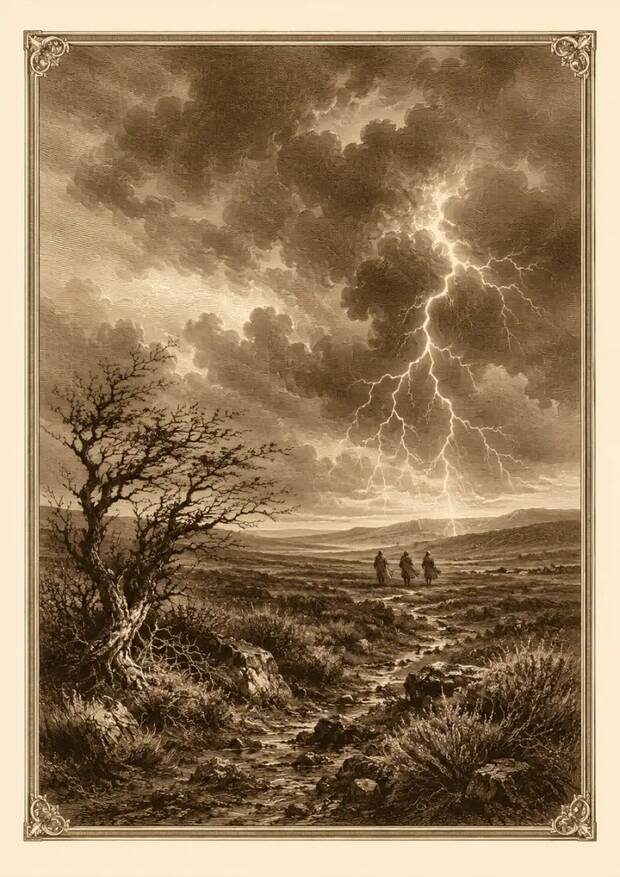
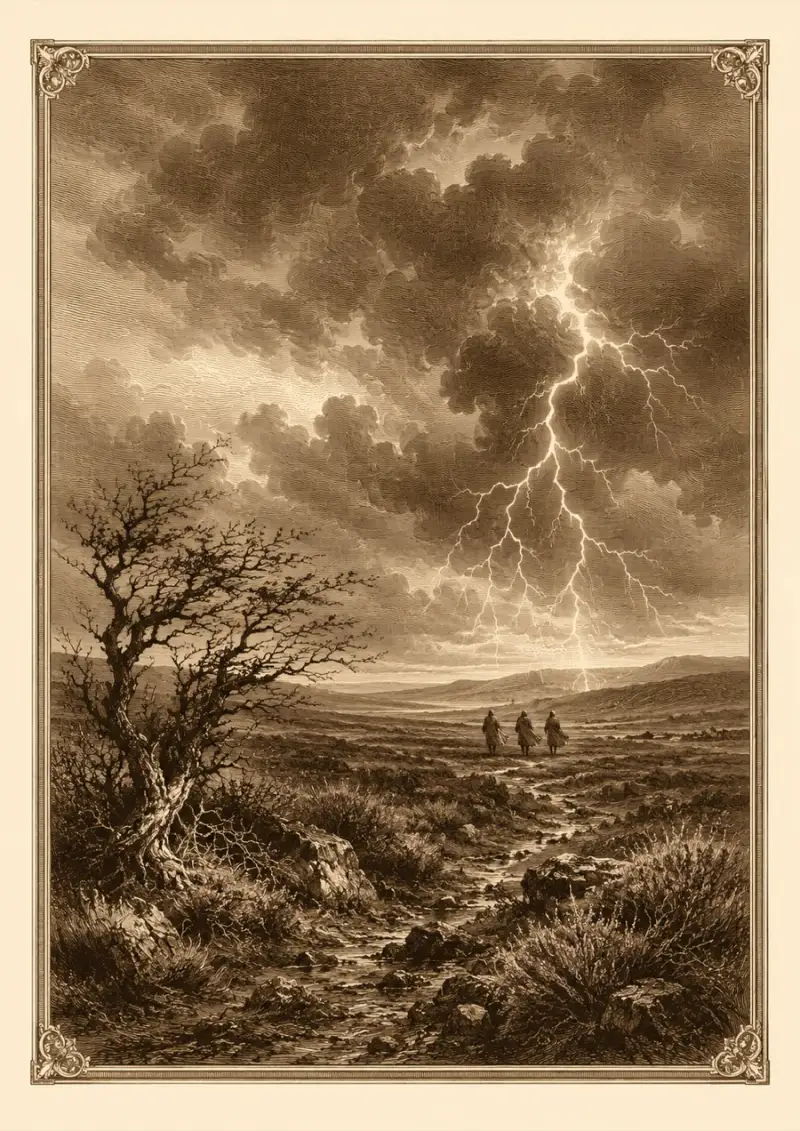
Macbeth: study cards (PDF)
PDF, 17 pages, 1.1 MB. Free, no sign-up, made to be printed.
Also for Macbeth: the study guide and the quotation sheet (PDF).
How to use the cards
Each card has one quotation from Macbeth on the front. Say who speaks it, where it comes in the play, and what it means, then turn the card to check. Mark the ones you know and the deck will skip them next time on this device; keep turning the rest until they stick.
Every card comes from the study guide and the quotes-by-theme pages, so each one links back to the full analysis. On paper, print the PDF, cut along the dashed lines and fold each strip down the middle.
The cards
-
Card 1 of 59
Fair is foul, and foul is fair;
Hover through the fog and filthy air.Who says it, when, and what does it mean?
Card 1 of 59
Witches · Act 1, Scene 1
Good is bad and bad is good; let us fly off through the murk.
-
Card 2 of 59
For brave Macbeth (well he deserves that name),
Disdaining Fortune, with his brandished steel,
Which smoked with bloody execution,
Like Valor’s minion, carved out his passageWho says it, when, and what does it mean?
Card 2 of 59
Captain · Act 1, Scene 2
Brave Macbeth, who has earned that word, scorned luck and, with his sword steaming with blood, cut his way through like the favourite of Courage itself.
In an essay: Use it to complicate the contrast of good king and tyrant. Duncan’s gentle rule is defended by exactly the violence that later destroys it. Compare
carved
here with Malcolm’sbutcher
in the last speech.Quotes about power
-
Card 3 of 59
If good, why do I yield to that suggestion
Whose horrid image doth unfix my hair
And make my seated heart knock at my ribs
Against the use of nature?Who says it, when, and what does it mean?
Card 3 of 59
Macbeth · Act 1, Scene 3
If this news is good, why am I giving way to an idea so horrible that my hair stands on end and my heart pounds as it never normally does?
In an essay: Use it to argue that ambition in this play begins inside Macbeth, not with the Witches. It is felt as horror, never as pleasure.
Quotes about ambition
-
Card 4 of 59
Though his bark cannot be lost,
Yet it shall be tempest-tossed.Who says it, when, and what does it mean?
Card 4 of 59
First Witch · Act 1, Scene 3
I cannot sink his ship, but I can make sure it is battered by storms.
In an essay: Quote this whenever you argue that the Witches do not control Macbeth. If they cannot sink one sailor’s boat, they cannot make a man kill a king.
Quotes about the supernatural
-
Card 5 of 59
What are these,
So withered, and so wild in their attire,
That look not like th’ inhabitants o’ th’ Earth
And yet are on ’t?Who says it, when, and what does it mean?
Card 5 of 59
Banquo · Act 1, Scene 3
What are these creatures, so shrivelled and so wildly dressed, that do not look like anything living on the earth and yet are standing on it?
In an essay: Use it to show that the supernatural is defined by uncertainty from its first meeting with the human world. Banquo’s cool curiosity is also the standard against which Macbeth’s eagerness is measured.
Quotes about the supernatural
-
Card 6 of 59
This supernatural soliciting
Cannot be ill, cannot be good.Who says it, when, and what does it mean?
Card 6 of 59
Macbeth · Act 1, Scene 3
This prompting from beyond nature cannot be evil, and cannot be good.
In an essay: Use it for the first stage of temptation. The supernatural supplies a fact; Macbeth supplies the
suggestion
of murder that follows in the next lines. Banquo, who heard the same words, draws no such conclusion.Quotes about the supernatural
-
Card 7 of 59
All hail, Macbeth! Hail to thee, Thane of Glamis!
All hail, Macbeth! Hail to thee, Thane of Cawdor!
All hail, Macbeth, that shalt be king hereafter!Who says it, when, and what does it mean?
Card 7 of 59
The Witches · Act 1, Scene 3
Hail, Macbeth, Thane of Glamis. Hail, Macbeth, Thane of Cawdor. Hail, Macbeth, who will be king in time to come.
In an essay: Use it to establish what the Witches do and do not say. Then use Macbeth’s start: a man is only frightened by good news if it touches a thought he already has.
Quotes about fate
-
Card 8 of 59
If you can look into the seeds of time
And say which grain will grow and which will not,
Speak, then, to me, who neither beg nor fear
Your favors nor your hate.Who says it, when, and what does it mean?
Card 8 of 59
Banquo · Act 1, Scene 3
If you can see into the seeds of the future and tell which will grow and which will not, then speak to me, who neither asks for your favour nor fears your hatred.
In an essay: Banquo is the control in the experiment. Two men hear prophecies in the same minute; only one acts. Whatever fate is in this play, it does not work on everyone alike. See the Banquo page.
Quotes about fate
-
Card 9 of 59
If chance will have me king, why, chance may crown me
Without my stir.Who says it, when, and what does it mean?
Card 9 of 59
Macbeth · Act 1, Scene 3
If fortune means me to be king, then fortune may crown me without my doing anything.
In an essay: The single most useful quotation for free will. Macbeth sees that he can wait and chooses not to, so nothing after this can be blamed on prophecy alone.
Quotes about fate
-
Card 10 of 59
Stars, hide your fires;
Let not light see my black and deep desires.Who says it, when, and what does it mean?
Card 10 of 59
Macbeth · Act 1, Scene 4
Let the stars go dark so that no light can reveal what I secretly want.
-
Card 11 of 59
The Prince of Cumberland! That is a step
On which I must fall down or else o’erleap,
For in my way it lies.Who says it, when, and what does it mean?
Card 11 of 59
Macbeth · Act 1, Scene 4
Malcolm as heir is a step in my path: I must either trip on it or jump over it.
In an essay: This is the moment patience ends. Macbeth turns towards murder when the lawful route to the crown closes, and before his wife has said a word to him.
Quotes about ambition
-
Card 12 of 59
Come, you spirits
That tend on mortal thoughts, unsex me here,Who says it, when, and what does it mean?
Card 12 of 59
Lady Macbeth · Act 1, Scene 5
Come, spirits that serve murderous thoughts, and strip away my womanhood.
-
Card 13 of 59
Look like th’ innocent flower,
But be the serpent under ’t.Who says it, when, and what does it mean?
Card 13 of 59
Lady Macbeth · Act 1, Scene 5
Appear harmless, but be the snake hidden beneath.
-
Card 14 of 59
Thou wouldst be great,
Art not without ambition, but without
The illness should attend it.Who says it, when, and what does it mean?
Card 14 of 59
Lady Macbeth · Act 1, Scene 5
You want greatness and you have ambition, but you lack the wickedness that ought to go with it.
In an essay: Use it to define the theme precisely: ambition alone is not the crime; the crime is what she proposes to add to it. For her own part in it, see the analysis of Lady Macbeth.
Quotes about ambition
-
Card 15 of 59
Come, thick night,
And pall thee in the dunnest smoke of hell,
That my keen knife see not the wound it makesWho says it, when, and what does it mean?
Card 15 of 59
Lady Macbeth · Act 1, Scene 5
Come, dense night, and wrap yourself in the darkest smoke of hell, so that my sharp knife cannot see the wound it makes.
In an essay: Evidence that evil in this play is invited. For a Jacobean audience the speech resembles a witch’s invocation and links her to the Weird Sisters. See the Lady Macbeth page.
Quotes about the supernatural
-
Card 16 of 59
All that impedes thee from the golden round,
Which fate and metaphysical aid doth seem
To have thee crowned withal.Who says it, when, and what does it mean?
Card 16 of 59
Lady Macbeth · Act 1, Scene 5
Everything that keeps you from the crown, which fate and supernatural help seem to intend you to have.
In an essay: Use it to show how the Macbeths use fate: as permission. Prophecy lets her treat the crown as already his, so that murder looks like collecting a debt. See the Lady Macbeth page.
Quotes about fate
-
Card 17 of 59
I have no spur
To prick the sides of my intent, but only
Vaulting ambition, which o’erleaps itselfWho says it, when, and what does it mean?
Card 17 of 59
Macbeth · Act 1, Scene 7
Nothing drives me on except ambition, which jumps too high and comes crashing down.
In an essay: The central quotation for the theme. It proves Macbeth understands ambition as self-defeating before he acts, which makes the murder a choice and not a mistake.
Quotes about ambition
-
Card 18 of 59
Art thou afeard
To be the same in thine own act and valor
As thou art in desire?Who says it, when, and what does it mean?
Card 18 of 59
Lady Macbeth · Act 1, Scene 7
Are you afraid to be as bold in what you do as you are in what you want?
In an essay: Use it to show how ambition is talked into action. She supplies no new motive; she removes the shame of having one. Link it to her next taunt, that he will
live a coward in thine own esteem
.Quotes about ambition
-
Card 19 of 59
This even-handed justice
Commends th’ ingredience of our poisoned chalice
To our own lips.Who says it, when, and what does it mean?
Card 19 of 59
Macbeth · Act 1, Scene 7
Impartial justice offers the poison we mixed for someone else back to our own mouths.
In an essay: Use it to show that Macbeth’s conscience works in advance and is ignored. Be precise, though: at this point he fears consequences
here
, in this life. Fear of being punished and sorrow for the act are never fully separate in him.Quotes about guilt
-
Card 20 of 59
Besides, this Duncan
Hath borne his faculties so meek, hath been
So clear in his great office, that his virtues
Will plead like angels, trumpet-tongued, against
The deep damnation of his taking-offWho says it, when, and what does it mean?
Card 20 of 59
Macbeth · Act 1, Scene 7
Besides, Duncan has used his powers so humbly and been so blameless as king that his virtues will cry out like angels with trumpets against the damnable crime of killing him.
In an essay: The standard by which to judge every ruler in the play. Macbeth cannot claim ignorance of what a king should be; he describes it exactly and then destroys it.
Quotes about power
-
Card 21 of 59
When you durst do it, then you were a man;
And to be more than what you were, you would
Be so much more the man.Who says it, when, and what does it mean?
Card 21 of 59
Lady Macbeth · Act 1, Scene 7
When you dared to do it, you were a man; and by becoming more than you were, a king, you would be even more of one.
In an essay: Evidence that power in the play is often verbal and private. Then trace its loss: by Act 3 Macbeth plans alone and tells her,
Be innocent of the knowledge, dearest chuck
.Quotes about power
-
Card 22 of 59
Is this a dagger which I see before me,
The handle toward my hand?Who says it, when, and what does it mean?
Card 22 of 59
Macbeth · Act 2, Scene 1
Is that a dagger in front of me, its handle turned for me to grasp?
-
Card 23 of 59
Art thou not, fatal vision, sensible
To feeling as to sight? Or art thou but
A dagger of the mind, a false creation
Proceeding from the heat-oppressed brain?Who says it, when, and what does it mean?
Card 23 of 59
Macbeth · Act 2, Scene 1
Deadly vision, can you not be touched as well as seen? Or are you only a dagger of the mind, an illusion produced by a feverish brain?
In an essay: The model case of Shakespeare refusing to decide. Supernatural sign or hallucination, the dagger changes nothing, because it points where Macbeth already meant to walk.
Quotes about the supernatural
-
Card 24 of 59
Will all great Neptune’s ocean wash this blood
Clean from my hand? No, this my hand will rather
The multitudinous seas incarnadine,
Making the green one red.Who says it, when, and what does it mean?
Card 24 of 59
Macbeth · Act 2, Scene 2
Could the whole ocean wash my hand clean? No: my hand would turn the seas red.
-
Card 25 of 59
But wherefore could not I pronounce “Amen”?
I had most need of blessing, and “Amen”
Stuck in my throat.Who says it, when, and what does it mean?
Card 25 of 59
Macbeth · Act 2, Scene 2
Why could I not say “Amen”? I needed a blessing more than anyone, and the word stuck in my throat.
In an essay: Evidence that guilt is at once spiritual and bodily. Macbeth knows he is cut off from
blessing
within minutes of the act; nothing later in the play tells him anything he does not know here.Quotes about guilt
-
Card 26 of 59
Methought I heard a voice cry “Sleep no more!
Macbeth does murder sleep” - the innocent sleep,
Sleep that knits up the raveled sleave of careWho says it, when, and what does it mean?
Card 26 of 59
Macbeth · Act 2, Scene 2
I thought I heard a voice cry, “Sleep no more. Macbeth is murdering sleep”, innocent sleep, which smooths out the tangled threads of worry.
In an essay: Trace the sentence being carried out. Macbeth speaks in Act 3 of
terrible dreams
, and in Act 5 his wife walks in her sleep. Sleeplessness is the play’s clearest image of guilt as a punishment that fits the crime.Quotes about guilt
-
Card 27 of 59
A little water clears us of this deed.
How easy is it, then!Who says it, when, and what does it mean?
Card 27 of 59
Lady Macbeth · Act 2, Scene 2
A little water will wash this act off us. See how easy it is.
In an essay: Always pair it with the sleepwalking scene, where the same woman cannot clean one hand. The contrast proves that guilt denied is not guilt escaped. See the analysis of Lady Macbeth.
Quotes about guilt
-
Card 28 of 59
To know my deed ’twere best not know myself.
Wake Duncan with thy knocking. I would thou couldst.Who says it, when, and what does it mean?
Card 28 of 59
Macbeth · Act 2, Scene 2
If I must know what I have done, I had better not know who I am. Wake Duncan with your knocking. I wish you could.
In an essay: This complicates the view of Macbeth as a hardened villain, and equally the view that he repents. He regrets at once and wholly; a scene later he is lying fluently to the thanes. Regret changes nothing he does.
Quotes about guilt
-
Card 29 of 59
Most sacrilegious murder hath broke ope
The Lord’s anointed temple and stole thence
The life o’ th’ building.Who says it, when, and what does it mean?
Card 29 of 59
Macduff · Act 2, Scene 3
A murder that is a crime against God has broken open the Lord’s holy temple and stolen the life out of it.
In an essay: The clearest statement of sacred kingship in the play, useful with the context of James I and divine right in the study guide. Note the speaker: Macduff, who will end the usurper’s reign.
Quotes about power
-
Card 30 of 59
’Gainst nature still!
Thriftless ambition, that will ravin up
Thine own lives’ means.Who says it, when, and what does it mean?
Card 30 of 59
Ross · Act 2, Scene 4
Another crime against nature. What wasteful ambition, to devour the very source of your own life.
In an essay: This complicates the obvious reading. Scotland knows the moral about ambition by heart and cannot see whom it fits, so the play does more than repeat that moral.
Quotes about ambition
-
Card 31 of 59
’Tis unnatural,
Even like the deed that’s done. On Tuesday last
A falcon, tow’ring in her pride of place,
Was by a mousing owl hawked at and killed.Who says it, when, and what does it mean?
Card 31 of 59
Old Man · Act 2, Scene 4
It is against nature, just like the murder. Last Tuesday a falcon, circling at the top of her flight, was attacked and killed by an owl that hunts mice.
In an essay: Use it with the context of a divinely ordered creation, in which a crime against a king disturbs nature itself. It complicates the theme: the supernatural here is not evil but the world’s protest against evil.
Quotes about the supernatural
-
Card 32 of 59
Why, by the verities on thee made good,
May they not be my oracles as well,
And set me up in hope? But hush, no more.Who says it, when, and what does it mean?
Card 32 of 59
Banquo · Act 3, Scene 1
Since their words came true for you, why should they not be true prophets for me, and give me hope? But quiet, enough of that.
In an essay: Use it against the simple contrast of good Banquo and bad Macbeth. Ambition tempts both; what separates them is the step from hoping to acting. See the Banquo page.
Quotes about ambition
-
Card 33 of 59
Upon my head they placed a fruitless crown
And put a barren scepter in my grip,
Thence to be wrenched with an unlineal hand,
No son of mine succeeding.Who says it, when, and what does it mean?
Card 33 of 59
Macbeth · Act 3, Scene 1
They gave me a crown with no fruit and a sterile sceptre, to be torn from me by someone not of my blood, with no son of mine to follow.
In an essay: Achieved ambition does not satisfy; it resets. Pair this with the
step
of Act 1: the obstacle was Malcolm, and now it is Banquo.Quotes about ambition
-
Card 34 of 59
To be thus is nothing,
But to be safely thus. Our fears in Banquo
Stick deep, and in his royalty of nature
Reigns that which would be feared.Who says it, when, and what does it mean?
Card 34 of 59
Macbeth · Act 3, Scene 1
To be king is nothing unless I am safely king. My fear of Banquo goes deep, and in his kingly nature there rules something to be afraid of.
In an essay: Use it to show the logic of tyranny. Stolen power cannot be enjoyed, only guarded, and guarding it means removing anyone with better qualities. See also the Banquo page.
Quotes about power
-
Card 35 of 59
Rather than so, come fate into the list,
And champion me to th’ utterance.Who says it, when, and what does it mean?
Card 35 of 59
Macbeth · Act 3, Scene 1
Sooner than let that happen, let fate enter the arena and fight me to the death.
In an essay: Evidence that Macbeth chooses which prophecies to believe. Follow the result: Banquo dies, Fleance escapes, and the prophecy stands. Fighting fate fails as surely as hurrying it.
Quotes about fate
-
Card 36 of 59
Naught’s had, all’s spent,
Where our desire is got without content.
’Tis safer to be that which we destroy
Than by destruction dwell in doubtful joy.Who says it, when, and what does it mean?
Card 36 of 59
Lady Macbeth · Act 3, Scene 2
We have gained nothing and spent everything if we get what we wanted and are not content. Better to be the dead man than to live in this uneasy happiness.
In an essay: The verdict on ambition is delivered by the ambitious themselves. Compare her confident
desire
in Act 1, Scene 7 withour desire
here: got, and without content.Quotes about ambition
-
Card 37 of 59
Better be with the dead,
Whom we, to gain our peace, have sent to peace,
Than on the torture of the mind to lie
In restless ecstasy.Who says it, when, and what does it mean?
Card 37 of 59
Macbeth · Act 3, Scene 2
It would be better to be dead, like the man we killed for our own peace, than to lie on this rack of the mind in sleepless frenzy.
In an essay: The guilt that drives Act 3. Macbeth’s answer to this torture is another killing, in the hope that safety will bring rest. Guilt in this play produces crime as well as following it.
Quotes about guilt
-
Card 38 of 59
I am in blood
Stepped in so far that, should I wade no more,
Returning were as tedious as go o’er.Who says it, when, and what does it mean?
Card 38 of 59
Macbeth · Act 3, Scene 4
I have waded so deep into blood that going back would be as wearisome as going on.
-
Card 39 of 59
Thou canst not say I did it. Never shake
Thy gory locks at me.Who says it, when, and what does it mean?
Card 39 of 59
Macbeth · Act 3, Scene 4
You cannot say that I did it. Do not shake your bloody hair at me.
In an essay: Use it to show guilt escaping private thought and becoming evidence. From this scene the thanes begin to suspect. For the question of whether the Ghost is real, see the quotations about the supernatural.
Quotes about guilt
-
Card 40 of 59
This is the very painting of your fear.
This is the air-drawn dagger which you said
Led you to Duncan.Who says it, when, and what does it mean?
Card 40 of 59
Lady Macbeth · Act 3, Scene 4
This is just a picture made by your fear. It is like that dagger in the air which you said led you to Duncan.
In an essay: The best quotation for the question “real or imagined?”. Add the irony that in Act 5 it is the sceptic who sees blood that is not there. The guilt behind both visions is treated in the quotations about guilt.
Quotes about the supernatural
-
Card 41 of 59
we may again
Give to our tables meat, sleep to our nights,
Free from our feasts and banquets bloody knives,
Do faithful homage, and receive free honorsWho says it, when, and what does it mean?
Card 41 of 59
Lord · Act 3, Scene 6
So that we may once more have food on our tables and sleep at night, hold feasts without bloody knives, pay loyal respect and be given honours freely.
In an essay: Notice that the subjects lack exactly what the tyrant lacks. Macbeth too has lost sleep and had a banquet ruined by blood. His misrule spreads his private condition across a nation.
Quotes about power
-
Card 42 of 59
By the pricking of my thumbs,
Something wicked this way comes.Who says it, when, and what does it mean?
Card 42 of 59
Second Witch · Act 4, Scene 1
My thumbs are tingling, which tells me something evil is on its way.
In an essay: Use the reversal. The Witches came to Macbeth uninvited in Act 1; in Act 4 he goes to them. Whatever they began, the evil is now his own, and they recognise it.
Quotes about the supernatural
-
Card 43 of 59
Infected be the air whereon they ride,
And damned all those that trust them!Who says it, when, and what does it mean?
Card 43 of 59
Macbeth · Act 4, Scene 1
May the air they ride on be poisoned, and may everyone who trusts them be damned.
In an essay: Proof that Macbeth knows what the Witches are and relies on them regardless. His trust is chosen, not imposed, which is the point to press in any question on responsibility.
Quotes about the supernatural
-
Card 44 of 59
Then live, Macduff; what need I fear of thee?
But yet I’ll make assurance double sure
And take a bond of fate. Thou shalt not liveWho says it, when, and what does it mean?
Card 44 of 59
Macbeth · Act 4, Scene 1
Then live, Macduff: why should I fear you? And yet I will make doubly certain and get a guarantee from fate. You shall not live.
In an essay: Press the irony. Macduff has fled, so Macbeth has his family killed, and that crime gives Macduff his reason to kill him. By insuring against the prophecy, Macbeth creates the man who fulfils it.
Quotes about fate
-
Card 45 of 59
The king-becoming graces,
As justice, verity, temp’rance, stableness,
Bounty, perseverance, mercy, lowliness,
Devotion, patience, courage, fortitudeWho says it, when, and what does it mean?
Card 45 of 59
Malcolm · Act 4, Scene 3
The qualities that suit a king: justice, truthfulness, self-control, steadiness, generosity, persistence, mercy, humility, piety, patience, courage and endurance.
In an essay: The play’s explicit checklist for a ruler, and a complication. The prince who recites it is practising deception, the skill his trusting father lacked. Good kingship after Macbeth includes suspicion.
Quotes about power
-
Card 46 of 59
Alas, poor country,
Almost afraid to know itself. It cannot
Be called our mother, but our graveWho says it, when, and what does it mean?
Card 46 of 59
Ross · Act 4, Scene 3
Poor Scotland, almost afraid to look at itself. It cannot be called our mother any longer, only our grave.
In an essay: Use it for the idea that a king’s legitimacy shows in the health of his realm. It also carries the play’s method: power is judged by its effects on people who never appear on stage.
Quotes about power
-
Card 47 of 59
Out, damned spot, out, I say! ... Yet who would have thought the old man to have had so much blood in him?
Who says it, when, and what does it mean?
Card 47 of 59
Lady Macbeth · Act 5, Scene 1
Away, cursed stain. Who would have guessed the old man had so much blood in him?
-
Card 48 of 59
Here’s the smell of the blood still. All the perfumes of Arabia will not sweeten this little hand. O, O, O!
Who says it, when, and what does it mean?
Card 48 of 59
Lady Macbeth · Act 5, Scene 1
The smell of blood is still here. All the perfumes of Arabia could not make this small hand sweet.
In an essay: The proof that suppressed guilt returns. Note that she confesses only in sleep, to people she cannot see. The essay on “Out, damned spot” reads the whole scene.
Quotes about guilt
-
Card 49 of 59
Those he commands move only in command,
Nothing in love. Now does he feel his title
Hang loose about him, like a giant’s robe
Upon a dwarfish thief.Who says it, when, and what does it mean?
Card 49 of 59
Angus · Act 5, Scene 2
His men act only because they are ordered to, not out of love. Now he feels his title hanging off him like a giant’s robe on a tiny thief.
In an essay: The neatest single image of illegitimate power. Link it to Macbeth’s own account in the next scene, where he expects only
mouth-honor
: the thanes and the tyrant agree about what he has.Quotes about power
-
Card 50 of 59
My way of life
Is fall’n into the sere, the yellow leaf,
And that which should accompany old age,
As honor, love, obedience, troops of friends,
I must not look to haveWho says it, when, and what does it mean?
Card 50 of 59
Macbeth · Act 5, Scene 3
My life has withered like a dry yellow leaf, and the things that should come with old age, honour, love, loyalty and many friends, I cannot expect.
In an essay: The endpoint of the theme. Ambition delivered the crown and took everything that made a crown worth having. This is the mood that produces “Tomorrow and tomorrow and tomorrow” two scenes later.
Quotes about ambition
-
Card 51 of 59
Canst thou not minister to a mind diseased,
Pluck from the memory a rooted sorrow,
Raze out the written troubles of the brainWho says it, when, and what does it mean?
Card 51 of 59
Macbeth · Act 5, Scene 3
Can you not treat a sick mind, pull a deep-rooted sorrow out of the memory, and rub out the troubles written on the brain?
In an essay: Use it to argue that the Macbeths want relief from guilt without repentance. The Doctor has already said what is needed:
More needs she the divine than the physician
.Quotes about guilt
-
Card 52 of 59
Let every soldier hew him down a bough
And bear ’t before him. Thereby shall we shadow
The numbers of our hostWho says it, when, and what does it mean?
Card 52 of 59
Malcolm · Act 5, Scene 4
Let every soldier cut down a branch and carry it in front of him. That way we shall hide the size of our army.
In an essay: A quotation that complicates the theme. Fate here is not a force that overrides choice. It is carried out by the free and unknowing choices of other people.
Quotes about fate
-
Card 53 of 59
Life’s but a walking shadow, a poor player
That struts and frets his hour upon the stage
And then is heard no more.Who says it, when, and what does it mean?
Card 53 of 59
Macbeth · Act 5, Scene 5
Life is only a moving shadow, a bad actor who swaggers and worries through his hour on stage and is then forgotten.
-
Card 54 of 59
I pull in resolution and begin
To doubt th’ equivocation of the fiend,
That lies like truth.Who says it, when, and what does it mean?
Card 54 of 59
Macbeth · Act 5, Scene 5
I rein in my confidence and begin to suspect the double-talk of the devil, who lies in a way that looks like truth.
In an essay: Use it to show that the prophecies deceive through language and not through force. Then note what follows: he does not surrender but calls
Arm, arm, and out
. Knowing changes nothing in what he does.Quotes about fate
-
Card 55 of 59
Of all men else I have avoided thee.
But get thee back. My soul is too much charged
With blood of thine already.Who says it, when, and what does it mean?
Card 55 of 59
Macbeth · Act 5, Scene 8
You are the one man I have kept away from. Go back. My soul is already too heavily loaded with the blood of your family.
In an essay: A late quotation against the claim that Macbeth ends as an unfeeling
butcher
. The murder with no political purpose is the one he cannot face. He feels it, and fights on anyway.Quotes about guilt
-
Card 56 of 59
Hail, King! for so thou art. Behold where stands
Th’ usurper’s cursed head. The time is free.Who says it, when, and what does it mean?
Card 56 of 59
Macduff · Act 5, Scene 8
Hail, King, for that is what you now are. Look, here is the usurper’s cursed head. Our age is free.
In an essay: Use it for any question on the ending. Malcolm’s reign begins lawfully and with new titles for his thanes; it also begins with a trophy head. Whether the cycle has ended is left open.
Quotes about power
-
Card 57 of 59
And be these juggling fiends no more believed,
That palter with us in a double sense,
That keep the word of promise to our ear
And break it to our hope.Who says it, when, and what does it mean?
Card 57 of 59
Macbeth · Act 5, Scene 8
Let no one believe these cheating devils any more, who trick us with double meanings, keeping their promise in the words we hear and breaking it in what we hoped for.
In an essay: Use it to conclude an argument. The Witches never lied and never forced; they equivocated (misled with words that are technically true), and Macbeth deceived himself with what they gave him.
Quotes about the supernatural
-
Card 58 of 59
Despair thy charm,
And let the angel whom thou still hast served
Tell thee Macduff was from his mother’s womb
Untimely ripped.Who says it, when, and what does it mean?
Card 58 of 59
Macduff · Act 5, Scene 8
Give up hope in your charm, and let the evil spirit you have always served tell you this: Macduff was cut from his mother’s womb before his time.
In an essay: The collapse of the last prophecy. Use it to show that the promises were true in a sense Macbeth never considered, and that he never asked what the words might also mean.
Quotes about fate
-
Card 59 of 59
Though Birnam Wood be come to Dunsinane
And thou opposed, being of no woman born,
Yet I will try the last.Who says it, when, and what does it mean?
Card 59 of 59
Macbeth · Act 5, Scene 8
Though Birnam Wood has come to Dunsinane, and though you who face me were not born of woman, I will still fight to the end.
In an essay: A second complication. You can read this as courage recovered or as mere desperation, but either way he faces certain defeat by choice. The play ends its argument about fate with an act of will.
Quotes about fate
Next steps
When the deck is easy, write with it: take three cards and turn them into a paragraph with the essay planner, or test yourself on the quotation sheet and the questions and answers. For one passage a day without trying, Daily Bard puts a quotation and its plain-English reading on your phone each morning.
A page of Shakespeare, every day.
This resource comes from Daily Bard, an app for iPhone and iPad. Each morning it shows one engraved plate and one passage, exactly as Shakespeare wrote it, with a plain-English reading on the back of the leaf.
Free to download. The Full Edition is a one-time US$11.99: no subscription, no account, no ads, no tracking.
Get it on the App Store: apps.apple.com/app/id6792967225
More free study guides, lesson plans and close readings: dailybard.app