
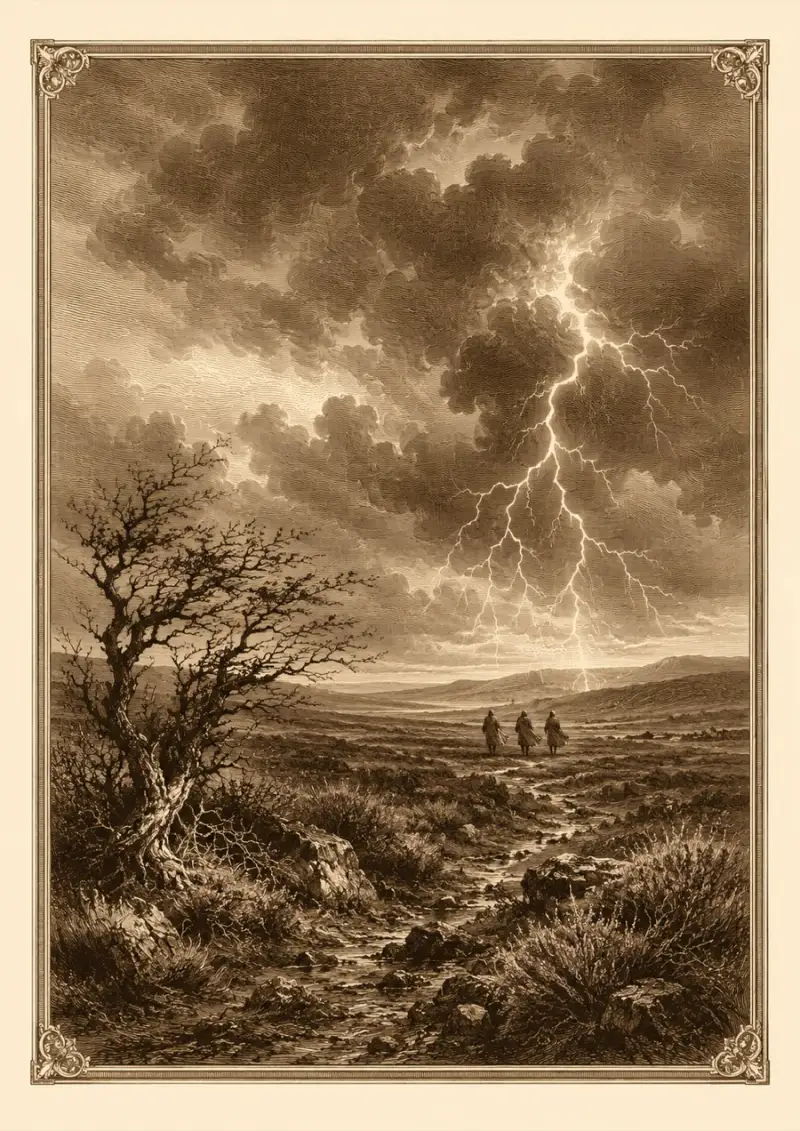
- Role
- Three supernatural figures, the Weird Sisters, whose prophecies tempt Macbeth
- First appear
- Act 1, Scene 1
- Last appear
- Act 4, Scene 1
- Key scenes
- 1.1, 1.3, 4.1; also 3.5, with Hecate
- Speak in
- Short rhymed lines, mostly of seven or eight syllables, often beginning on a stress
Macbeth: key quotes and analysis (PDF)
PDF, 11 pages, 813 KB. Free, no sign-up, made to be printed.
The ten core quotations for Macbeth, each with plain English, analysis and a fill-the-gap test. Or read the full study guide.
Who are the Witches?
The Witches are three supernatural figures who meet Macbeth on a heath, greet him as a future king, and later show him apparitions that seem to promise he cannot be defeated. The characters who meet them call them the Weird Sisters
, and the old sense of that adjective is to do with fate. They speak the play’s first words, appear in only a handful of scenes, and are not seen again after Act 4, Scene 1.
The central question is whether they cause the tragedy or only start it. The Witches have knowledge without control: they predict, tempt and mislead, but every killing in the play is chosen and carried out by a human being. They never mention murder, and they never lie. They tell a man who already wants the crown that he will have it, and leave him to decide how.
The Witches across the play
Act 1: the meeting
The first scene, in thunder and lightning, tells us only that they intend to meet Macbeth. In Scene 3 we see their ordinary business first, and it is petty: one has been Killing swine
, another plans to torment a sailor because his wife refused her chestnuts. Then they hail Macbeth as Glamis, Cawdor and king, give Banquo his riddles, and vanish when questioned, As breath into the wind
.
Acts 2 and 3: absent but working
They are offstage for the murders of Duncan and Banquo, which is the point: the crimes happen without them. Their words go on working in the minds of both men. In Act 3, Scene 5 their mistress Hecate scolds them for dealing with Macbeth without her and plans his ruin through false confidence. Most editors think this scene was added after Shakespeare wrote the play, probably by Thomas Middleton, whose play The Witch contains the two songs that Act 3, Scene 5 and Act 4, Scene 1 call for.
Act 4: the cauldron
The balance has changed. In Act 1 they sought Macbeth out, and now he comes looking for them and gives the orders: answer me
. They brew a charm from poisonous and mutilated things and call up three apparitions and a show of kings. Having shown him the one sight he dreaded, they dance and vanish for good.
Act 5: the words come true
The Witches do not return, but their prophecies run the last act. Macbeth repeats them like a charm against fear until Birnam Wood moves and Macduff explains his birth. Only then does he see how he has been handled, and call them juggling fiends
.
Reading the characters
They tempt and do not command
Look at what the Witches actually say in Act 1. They state three titles. There is no instruction, no method, no mention of Duncan. The thought of murder is Macbeth’s, and it comes so quickly that the prophecy seems to have found something already there: Banquo notices that he starts and seems to fear / Things that do sound so fair
. Shakespeare also sets limits on their power. The First Witch can send storms against the sailor, but she admits that his ship cannot be lost
. They can make a man suffer but cannot decide his end. See Macbeth quotes about fate for the wider argument.
Their weapon is equivocation
The Witches harm Macbeth with true statements. This is equivocation (misleading by words that are technically true), and it is built into how they talk. From the first scene they deal in paradox (a statement that seems to contradict itself): a battle lost and won
, a man Lesser than Macbeth and greater
. In Act 4 the method becomes a trap, in promises worded to be misheard. Hecate names the aim, since security
, meaning overconfidence, Is mortals’ chiefest enemy
. Macbeth supplies the false meaning himself.
Shakespeare refuses to define them
Nobody in the play can say what the Witches are. Banquo cannot tell whether they are alive, whether they are women, or whether they were there at all. They look not like th’ inhabitants o’ th’ Earth / And yet are on ’t
, and he wonders if he and Macbeth have eaten on the insane root
. Asked what they are doing, they answer A deed without a name
. This vagueness is deliberate. It lets them be at once real agents of evil, as a Jacobean audience would have assumed, and a mirror for Macbeth’s own mind. His first line, So foul and fair a day I have not seen
, echoes theirs before he has met them.
Key quotations
When the hurly-burly’s done,
Second Witch · Act 1, Scene 1 1.1.3-4
When the battle’s lost and won.
Plain English: When the uproar is over, when the battle has been both lost and won.
Context: The opening scene. The First Witch has asked when the three will meet again, and this is the answer.
Methods: The lines are short, rhymed and begin on a stress, a chanting rhythm that separates the Witches from every human speaker in the play. the hurly-burly’s done
reduces a war to a passing noise. lost and won
is the play’s first paradox. It is literally true, since every battle is lost by one side and won by the other: the contradiction is only in the hearing. Duncan echoes it innocently one scene later: What he hath lost, noble Macbeth hath won
.
In an essay: Use it to show that double meaning is established as the Witches’ language from their first exchange, and that it spreads to other speakers.
Though his bark cannot be lost,
First Witch · Act 1, Scene 3 1.3.25-26
Yet it shall be tempest-tossed.
Plain English: I cannot sink his ship, but I will make sure it is battered by storms.
Context: Waiting for Macbeth, the First Witch describes her revenge on a sailor whose wife insulted her. She will keep him from sleep and waste him away.
Methods: The couplet turns on Though
and Yet
, a concession followed by a threat, and the concession matters more. cannot
is a plain statement of limited power: she may torment but not destroy. The ship works as a small model of the main plot. Macbeth, too, will be tempest-tossed
, sleepless and worn down, but his wreck will be his own doing.
In an essay: The best single piece of evidence that the Witches do not control fate. Link the sailor’s sleeplessness to Macbeth’s: Sleep shall neither night nor day / Hang upon his penthouse lid
.
All hail, Macbeth, that shalt be king hereafter!
Third Witch · Act 1, Scene 3 1.3.53
Plain English: Greetings, Macbeth, who will be king in time to come.
Context: The third of three greetings. The first names what Macbeth is, Thane of Glamis, and the second what he is about to learn he has become, Thane of Cawdor.
Methods: The three hails rise in steps from present to future, so the last borrows credibility from the first two. The verb shalt
is a flat prediction with no condition attached, and hereafter
gives no date and no means. Everything that will fill that gap is Macbeth’s. The form is a greeting, not a command. Lady Macbeth later takes up the phrase, greeting him with the all-hail hereafter
, so the words pass into a human mouth.
In an essay: Quote it to show exactly how little the prophecy contains. Set it beside Macbeth’s own If chance will have me king, why, chance may crown me
.
By the pricking of my thumbs,
Second Witch · Act 4, Scene 1 4.1.44-45
Something wicked this way comes.
Plain English: The tingling in my thumbs tells me that something evil is approaching.
Context: The Witches have finished their charm at the cauldron. Macbeth is about to enter, uninvited, to demand answers.
Methods: The surprise is in who is speaking. A witch, the play’s image of evil, senses the approach of evil, and it is Macbeth. He is not named or called a man: he is Something
, a thing. The singsong couplet makes the judgement sound casual. Structurally the line measures his fall. In Act 1 the Witches waited for a hero returning from battle. Now they greet a murderer as one of their own kind.
In an essay: Use it to track Macbeth’s decline through the Witches’ eyes, and to argue that by Act 4 he has outdone them: their evil is spells and riddles, and his is killing.
Be bloody, bold, and resolute. Laugh to scorn
Second Apparition · Act 4, Scene 1 4.1.90-92
The power of man, for none of woman born
Shall harm Macbeth.
Plain English: Be violent, daring and determined. Mock the strength of men, because nobody born of a woman will hurt Macbeth.
Context: The Witches raise three apparitions, which they call their masters. This is the second, in the form of a bloody child.
Methods: This is equivocation at its clearest. none of woman born
sounds universal, and Macbeth hears it so, but it leaves out a man delivered by surgery, as Macduff was. The opening imperatives are the nearest the supernatural comes to giving advice, and what it advises is what he is already doing. The speaker is a child covered in blood, which can be read as an image of the birth the words conceal. Macbeth listens to the promise and ignores the picture.
In an essay: Use it to show how the later prophecies differ from the first. These are designed to produce false confidence, and they lead straight to the order to kill Macduff’s family.
And be these juggling fiends no more believed
Macbeth · Act 5, Scene 8 5.8.23-26
That palter with us in a double sense,
That keep the word of promise to our ear
And break it to our hope.
Plain English: Let nobody trust these cheating devils again, who trick us with double meanings and keep their promises in the letter while breaking them in what we hoped.
Context: Macduff has just revealed that he was Untimely ripped
from his mother’s womb. Macbeth’s last protection is gone.
Methods: juggling
and palter
both mean to deceive by trickery, and double sense
defines equivocation exactly. The antithesis (two opposed ideas set in balance) of ear
and hope
separates what was said from what was understood: the promise was kept as words and broken as meaning. It repeats what Banquo told him in Act 1. Notice what is missing: he blames the fiends for deceiving him and says nothing of the murders he chose.
In an essay: Use it as Macbeth’s final verdict on the Witches, and question it. He was deceived about his safety, never about right and wrong.
Relationships
Macbeth
They choose him, naming him in the first scene, and they seem to know him: an apparition speaks his fear before he can ask, and he admits that it has harped my fear aright
. He begins by commanding them to stay and ends by cursing all those that trust them
, a curse that falls on himself. See the analysis of Macbeth.
Banquo
Banquo receives a prophecy as tempting as Macbeth’s and treats its givers as instruments of darkness
. His response shows that the Witches can be heard and not obeyed. See the analysis of Banquo.
Lady Macbeth
She never meets them, yet she calls on spirits
in language like theirs and supplies the persuasion to murder that they leave out. See the analysis of Lady Macbeth.
How the characters have been read
For the first audiences the Witches were a real kind of danger. The study guide notes that King James had written a book on witchcraft and examined accused witches himself. On this reading they are servants of the devil. The text supports it: Banquo at once thinks of the devil
, and the cauldron scene is a catalogue of horrors.
A psychological reading treats them as the outward form of Macbeth’s desires. The evidence is how well their words fit what he already wants, and how much he must add to them before anyone dies. A third approach, common in feminist criticism, notes how much of the play’s threat is placed in female figures, bearded witches and a wife who asks to be unsexed, and asks whether the play shares that anxiety about women’s power or holds it up for inspection.
These readings need not exclude one another, and staging decides the emphasis. Witches played as grotesque hags make evil external and Macbeth more of a victim. Witches played as ordinary or even attractive figures make the temptation more plausible and the responsibility more plainly his.
Essay angles and a model paragraph
- The Witches are the occasion of the tragedy and not its cause: they provide a prediction, and Macbeth provides the crime.
- The Witches’ true power is over language, and the play shows their double speech spreading through Scotland.
- Shakespeare keeps the Witches undefined so that evil in the play can be both a real force and a human choice.
Question: How does Shakespeare present the power of the Witches?
Practice questions
- Read Act 1, Scene 3 from the Witches’ entrance to the arrival of Macbeth and Banquo. How does Shakespeare present the Witches in this passage?
- How does Shakespeare use the Witches to create a sense of evil in the play as a whole?
- “The Witches do not change Macbeth. They reveal him.” How far do you agree?
- Consider the view that the Witches matter less as characters than as a way of speaking that infects the whole play.
For more evidence, see Macbeth quotes about the supernatural, test yourself with the Macbeth questions and answers, and return to the study guide for context and critics.