
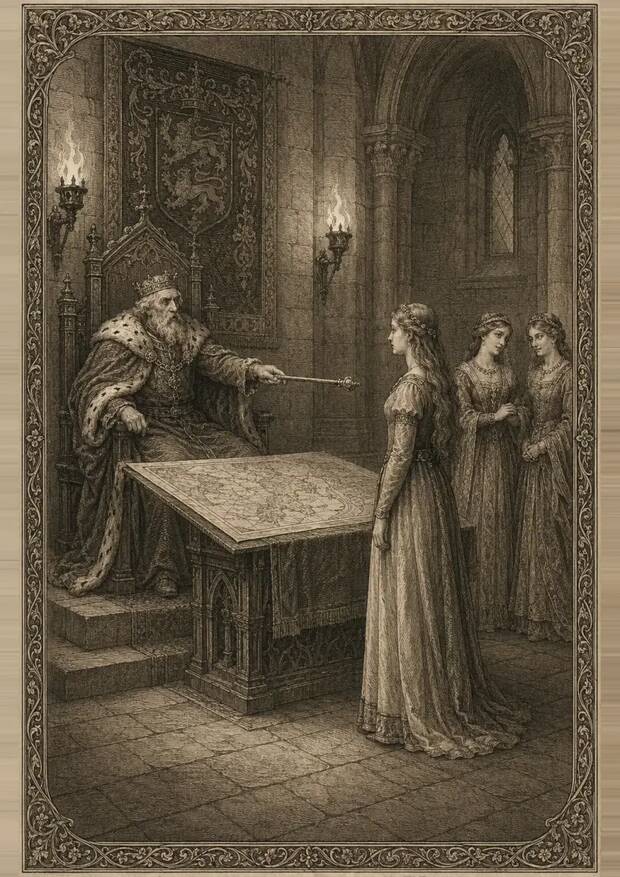
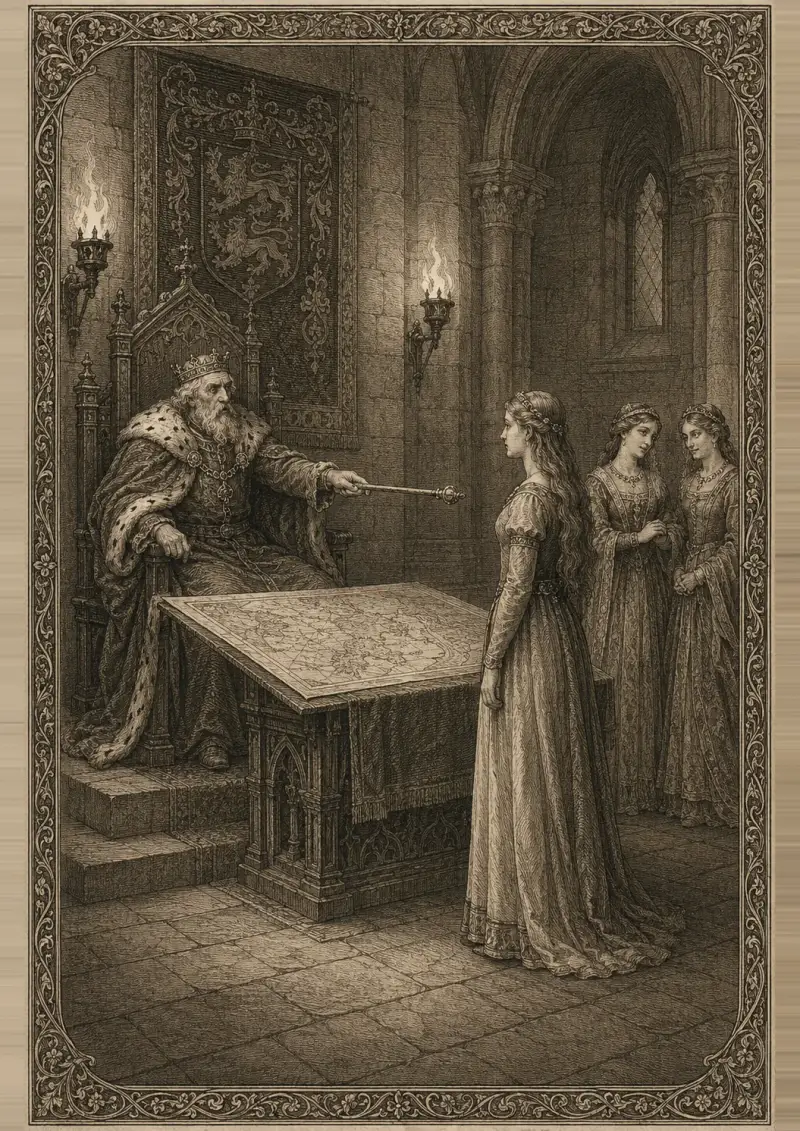
King Lear: study cards (PDF)
PDF, 15 pages, 1.0 MB. Free, no sign-up, made to be printed.
Also for King Lear: the study guide and the quotation sheet (PDF).
How to use the cards
Each card has one quotation from King Lear on the front. Say who speaks it, where it comes in the play, and what it means, then turn the card to check. Mark the ones you know and the deck will skip them next time on this device; keep turning the rest until they stick.
Every card comes from the study guide and the quotes-by-theme pages, so each one links back to the full analysis. On paper, print the PDF, cut along the dashed lines and fold each strip down the middle.
The cards
-
Card 1 of 50
Nothing will come of nothing. Speak again.
Who says it, when, and what does it mean?
Card 1 of 50
Lear · Act 1, Scene 1
You will get nothing if you say nothing. Try again.
-
Card 2 of 50
I love your Majesty
According to my bond, no more nor less.Who says it, when, and what does it mean?
Card 2 of 50
Cordelia · Act 1, Scene 1
I love you as a daughter should love her father, exactly that much.
-
Card 3 of 50
Only we shall retain
The name and all th’ addition to a king.
The sway, revenue, execution of the rest,
Beloved sons, be yoursWho says it, when, and what does it mean?
Card 3 of 50
Lear · Act 1, Scene 1
I will keep only the title of king and the honours that go with it. The rule, the income and the carrying out of everything else are yours, my sons-in-law.
In an essay: This is the play’s founding mistake about power. Use it to argue that the tragedy starts with a political error as well as a family one, and set it against Goneril’s
authorities / That he hath given away
.Quotes about power
-
Card 4 of 50
Think’st thou that duty shall have dread to speak
When power to flattery bows? To plainness honor’s bound
When majesty falls to folly.Who says it, when, and what does it mean?
Card 4 of 50
Kent · Act 1, Scene 1
Do you think loyalty will be afraid to speak when power gives in to flattery? Honour has to speak plainly when a king acts like a fool.
In an essay: Kent offers the play’s model of legitimate resistance: obedience to the office can mean defying the man. Link it to the servant who opposes Cornwall in Act 3, another subordinate who serves his master best by disobeying him.
Quotes about power
-
Card 5 of 50
Which of you shall we say doth love us most,
That we our largest bounty may extend
Where nature doth with merit challenge.Who says it, when, and what does it mean?
Card 5 of 50
Lear · Act 1, Scene 1
Which of you shall I say loves me most, so that I can give the biggest share to the one whose natural affection and deserving together earn it?
In an essay: Start here for any question on parents and children. The love test turns a family into a market, and Goneril and Regan go on following its logic.
Quotes about family
-
Card 6 of 50
Why have my sisters husbands if they say
They love you all? Haply, when I shall wed,
That lord whose hand must take my plight shall carry
Half my love with him, half my care and duty.Who says it, when, and what does it mean?
Card 6 of 50
Cordelia · Act 1, Scene 1
Why are my sisters married, if they say all their love is yours? Perhaps when I marry, my husband will take half my love, care and duty with him.
In an essay: A quotation that complicates the picture of Cordelia as simply the loving child. Use it to argue that she rejects the test in its own language, and that the scene is a clash between two people who are alike.
Quotes about family
-
Card 7 of 50
Thou, Nature, art my goddess. To thy law
My services are bound.Who says it, when, and what does it mean?
Card 7 of 50
Edmund · Act 1, Scene 2
Nature, you are the goddess I serve. I follow your law and no other.
-
Card 8 of 50
Legitimate Edgar, I must have your land.
Our father’s love is to the bastard Edmund
As to th’ legitimate.Who says it, when, and what does it mean?
Card 8 of 50
Edmund · Act 1, Scene 2
Edgar, my lawful brother, I must have your land. Our father loves his bastard Edmund as much as his legitimate son.
In an essay: Edmund is the subplot’s version of Goneril and Regan: a child who sees family as property. Note that Gloucester helped to make him, introducing him in the first scene with jokes about his conception.
Quotes about family
-
Card 9 of 50
Thou, Nature, art my goddess. To thy law
My services are bound. Wherefore should I
Stand in the plague of customWho says it, when, and what does it mean?
Card 9 of 50
Edmund · Act 1, Scene 2
Nature, you are my goddess, and yours is the law I serve. Why should I put up with the curse of mere custom?
In an essay: This is the challenge the rest of the play answers. In Shakespeare’s English an illegitimate child was a “natural” child, and Edmund turns the word into a philosophy. Set his goddess beside Lear’s in Act 1, Scene 4.
Quotes about nature
-
Card 10 of 50
This is the excellent foppery of the world, that when we are sick in fortune (often the surfeits of our own behavior) we make guilty of our disasters the sun, the moon, and stars
Who says it, when, and what does it mean?
Card 10 of 50
Edmund · Act 1, Scene 2
This is the world’s supreme foolishness: when things go badly for us, often through our own excesses, we blame the sun, moon and stars.
In an essay: The speech sounds modern and sensible, and the speaker is the villain. Use it to show that the play gives scepticism real force, then cite Kent’s opposite view in Act 4:
It is the stars, / The stars above us govern our conditions
. Shakespeare stages the debate without settling it.Quotes about nature
-
Card 11 of 50
Idle old man
That still would manage those authorities
That he hath given away.Who says it, when, and what does it mean?
Card 11 of 50
Goneril · Act 1, Scene 3
Foolish old man, who still wants to use the powers he has handed over.
In an essay: A quotation that complicates the obvious reading. Goneril is cruel, but on the facts she is right, and Lear’s own words in Act 1, Scene 1 prove it. Use it to argue that the daughters’ cruelty grows out of a position Lear handed them.
Quotes about power
-
Card 12 of 50
LEAR Who is it that can tell me who I am?
FOOL Lear’s shadow.Who says it, when, and what does it mean?
Card 12 of 50
Lear and the Fool · Act 1, Scene 4
Can anyone tell me who I am? Fool: You are only the shadow of Lear.
-
Card 13 of 50
Thou hadst little wit in thy bald crown when thou gav’st thy golden one away.
Who says it, when, and what does it mean?
Card 13 of 50
Fool · Act 1, Scene 4
There was not much sense in your bald head when you gave away your golden crown.
In an essay: Use the Fool to show that the play voices its political truth from the bottom of the hierarchy. He also tells Lear
thou mad’st thy / daughters thy mothers
: giving away power has reversed the family as well as the state.Quotes about power
-
Card 14 of 50
How sharper than a serpent’s tooth it is
To have a thankless child.Who says it, when, and what does it mean?
Card 14 of 50
Lear · Act 1, Scene 4
Having an ungrateful child hurts more than a snake’s bite.
In an essay: Often quoted as a simple truth about ungrateful children. Read in context it shows a father whose love turns to hatred the moment it is not repaid, as it did with Cordelia.
Quotes about family
-
Card 15 of 50
Hear, Nature, hear, dear goddess, hear!
Suspend thy purpose if thou didst intend
To make this creature fruitful.Who says it, when, and what does it mean?
Card 15 of 50
Lear · Act 1, Scene 4
Hear me, Nature, dear goddess. If you meant this creature to have children, change your plan.
In an essay: Use it to argue that Lear’s “nature” is really an extension of his own authority. He assumes the universe shares his sense of injury, an assumption the storm will destroy.
Quotes about nature
-
Card 16 of 50
O, let me not be mad, not mad, sweet heaven!
Keep me in temper. I would not be mad!Who says it, when, and what does it mean?
Card 16 of 50
Lear · Act 1, Scene 5
Heaven, do not let me go mad. Keep my mind steady. I do not want to be mad.
In an essay: Use it to show that Lear’s madness is prepared, not sudden, and that it begins at the moment guilt about Cordelia first surfaces.
Quotes about madness
-
Card 17 of 50
“Poor Turlygod! Poor Tom!”
That’s something yet. “Edgar” I nothing am.Who says it, when, and what does it mean?
Card 17 of 50
Edgar · Act 2, Scene 3
As “Poor Turlygod” or “Poor Tom” I am at least something. As Edgar, I am nothing.
In an essay: Edgar’s feigned madness is the control against which Lear’s real madness is measured.
Quotes about madness
-
Card 18 of 50
O, reason not the need! Our basest beggars
Are in the poorest thing superfluous.Who says it, when, and what does it mean?
Card 18 of 50
Lear · Act 2, Scene 4
Do not argue about what I need. Even the poorest beggar owns something more than bare necessity.
-
Card 19 of 50
GONERIL What need you five-and-twenty, ten, or five,
To follow in a house where twice so many
Have a command to tend you?
REGAN What need one?Who says it, when, and what does it mean?
Card 19 of 50
Goneril and Regan · Act 2, Scene 4
Why do you need twenty-five followers, or ten, or five, in a house where twice as many servants have orders to look after you? Regan: Why do you need even one?
In an essay: This is power taken by arithmetic, not violence. It mirrors the love test, where Lear measured love in land; now his daughters measure his worth in men. Moments later his threats collapse into
I will do such things
, a sentence he cannot finish because he has nothing to do them with.Quotes about power
-
Card 20 of 50
But yet thou art my flesh, my blood, my daughter,
Or, rather, a disease that’s in my flesh,
Which I must needs call mine.Who says it, when, and what does it mean?
Card 20 of 50
Lear · Act 2, Scene 4
And yet you are my flesh, my blood, my daughter. Or say instead a disease in my flesh, which I am forced to admit is my own.
In an essay: Use it to show that the play makes family a bond that cannot be dissolved by either side. Lear banished Cordelia in a sentence; here he finds that disowning a child is not possible.
Quotes about family
-
Card 21 of 50
I have full cause of weeping, but this heart
Shall break into a hundred thousand flaws
Or ere I’ll weep. O Fool, I shall go mad!Who says it, when, and what does it mean?
Card 21 of 50
Lear · Act 2, Scene 4
I have every reason to cry, but my heart will shatter into a hundred thousand pieces before I do. Fool, I am going mad.
In an essay: The play links madness to feeling that is held down. Compare Act 4, Scene 7, where Lear’s recovery is marked by tears: his own
scald
, and he notices Cordelia’s arewet
.Quotes about madness
-
Card 22 of 50
O sir, you are old.
Nature in you stands on the very verge
Of his confine.Who says it, when, and what does it mean?
Card 22 of 50
Regan · Act 2, Scene 4
Sir, you are old. Your life has reached the very edge of its allotted limit.
In an essay: A quotation that complicates the theme: the “unnatural” daughter argues from nature too, and from a fact nobody can deny. Lear’s bitter reply,
Age is unnecessary
, shows he has understood her.Quotes about nature
-
Card 23 of 50
I am a man
More sinned against than sinning.Who says it, when, and what does it mean?
Card 23 of 50
Lear · Act 3, Scene 2
Others have wronged me more than I have wronged anyone.
-
Card 24 of 50
My wits begin to turn.
Come on, my boy. How dost, my boy? Art cold?
I am cold myself.Who says it, when, and what does it mean?
Card 24 of 50
Lear · Act 3, Scene 2
My mind is starting to go. Come on, lad. How are you? Are you cold? I am cold too.
In an essay: A quotation that complicates the idea of madness as pure loss. Lear’s wits turn and his heart opens together, which leads to the prayer for
Poor naked wretches
in Act 3, Scene 4. See also our essay on “Blow winds, and crack your cheeks”.Quotes about madness
-
Card 25 of 50
Nor rain, wind, thunder, fire are my daughters.
I tax not you, you elements, with unkindness.
I never gave you kingdom, called you childrenWho says it, when, and what does it mean?
Card 25 of 50
Lear · Act 3, Scene 2
Rain, wind, thunder and lightning are not my daughters. I do not accuse you elements of unkindness. I never gave you a kingdom or called you my children.
In an essay: The storm is often described as pathetic fallacy (weather mirroring feeling). This passage shows Lear himself doubting that reading. The storm is not on his side or against him.
Quotes about nature
-
Card 26 of 50
O, I have ta’en
Too little care of this. Take physic, pomp.
Expose thyself to feel what wretches feelWho says it, when, and what does it mean?
Card 26 of 50
Lear · Act 3, Scene 4
I have neglected this. Let the powerful take their medicine and feel what the poor feel.
-
Card 27 of 50
O Regan, Goneril,
Your old kind father whose frank heart gave all!
O, that way madness lies. Let me shun that;
No more of that.Who says it, when, and what does it mean?
Card 27 of 50
Lear · Act 3, Scene 4
Regan, Goneril, your kind old father, whose generous heart gave you everything. No: thinking of that leads to madness. I must avoid it. No more.
In an essay: Use it to argue that Lear’s madness is an obsession with a single subject. The thought he shuns here returns within minutes, in the next quotation.
Quotes about madness
-
Card 28 of 50
Didst thou give all to thy daughters? And art thou come to this?
Who says it, when, and what does it mean?
Card 28 of 50
Lear · Act 3, Scene 4
Did you give everything to your daughters? Is that how you ended up like this?
In an essay: Real madness meets performed madness. Note the irony that Tom is in fact a child wronged by a father, so Lear’s mad guess is the reverse of the truth.
Quotes about madness
-
Card 29 of 50
Thou art the thing itself; unaccommodated man is no more but such a poor, bare, forked animal as thou art.
Who says it, when, and what does it mean?
Card 29 of 50
Lear · Act 3, Scene 4
You are the real thing. A human being without the extras is nothing more than a poor, naked, two-legged animal like you.
In an essay: The play’s bleakest definition of human nature, and a reversal of
reason not the need
in Act 2, where Lear insisted that people need more than animals do. Remember the irony: Tom’s nakedness is a disguise, sothe thing itself
is an act.Quotes about nature
-
Card 30 of 50
Then let them anatomize Regan; see what breeds about her heart. Is there any cause in nature that make these hard hearts?
Who says it, when, and what does it mean?
Card 30 of 50
Lear · Act 3, Scene 6
Then let them dissect Regan and see what is growing around her heart. Is there any natural cause that makes hearts so hard?
In an essay: Use it as the turning point in Lear’s thinking about nature. In Act 1 he was sure nature was on his side; here he suspects that cruelty may be as natural as love.
Quotes about nature
-
Card 31 of 50
Though well we may not pass upon his life
Without the form of justice, yet our power
Shall do a court’sy to our wrath, which men
May blame but not control.Who says it, when, and what does it mean?
Card 31 of 50
Cornwall · Act 3, Scene 7
We cannot properly sentence him to death without a formal trial, but our power will bow to our anger, and people may criticise that but cannot stop it.
In an essay: Use it as the play’s plainest statement of power without restraint, and then note that Cornwall is mistaken. A servant does try to control him, and gives him the wound he dies of. The play allows resistance, at a price.
Quotes about power
-
Card 32 of 50
As flies to wanton boys are we to th’ gods;
They kill us for their sport.Who says it, when, and what does it mean?
Card 32 of 50
Gloucester · Act 4, Scene 1
The gods treat us as careless boys treat flies. They kill us for fun.
-
Card 33 of 50
O dear son Edgar,
The food of thy abused father’s wrath,
Might I but live to see thee in my touch,
I’d say I had eyes again.Who says it, when, and what does it mean?
Card 33 of 50
Gloucester · Act 4, Scene 1
Dear Edgar, whom your deceived father’s anger fed on: if I could live to touch you, it would be like having my eyes back.
In an essay: The subplot’s parallel to Lear’s reunion with Cordelia. Both fathers recognise the wronged child only after losing everything.
Quotes about family
-
Card 34 of 50
Tigers, not daughters, what have you performed?
A father, and a gracious aged manWho says it, when, and what does it mean?
Card 34 of 50
Albany · Act 4, Scene 2
You are tigers, not daughters. What have you done? A father, and a kind old man...
In an essay: Albany voices the audience’s reaction, and as Goneril’s husband he shows the household dividing against itself. Set his
daughters
against Lear’spelican daughters
in Act 3: children imagined as feeding on the parent.Quotes about family
-
Card 35 of 50
It will come:
Humanity must perforce prey on itself,
Like monsters of the deep.Who says it, when, and what does it mean?
Card 35 of 50
Albany · Act 4, Scene 2
It will happen: human beings will be forced to feed on one another, like monsters of the sea.
In an essay: The prediction comes true inside the villains’ own party: Goneril poisons Regan over Edmund. Use it to show that the play lets Edmund’s view of nature run to its conclusion, which is self-destruction.
Quotes about nature
-
Card 36 of 50
LEAR Thou hast seen a farmer’s dog bark at a beggar?
GLOUCESTER Ay, sir.
LEAR And the creature run from the cur? There thou might’st behold the great image of authority: a dog’s obeyed in office.Who says it, when, and what does it mean?
Card 36 of 50
Lear and Gloucester · Act 4, Scene 6
You have seen a farm dog bark at a beggar, and the man run away from it? There is the true picture of authority: even a dog is obeyed when it holds a post.
In an essay: This is where the theme widens from one king to all government. Pair it with
Robes and furred gowns hide all
from the same speech, and with Edgar’s commentReason in madness
, to argue that the play gives its sharpest political analysis to a man with no power left to lose.Quotes about power
-
Card 37 of 50
O, matter and impertinency mixed,
Reason in madness!Who says it, when, and what does it mean?
Card 37 of 50
Edgar · Act 4, Scene 6
Sense and nonsense mixed together. There is reason in his madness.
In an essay: The key quotation for the theme’s central paradox. Support it with content from the speech itself, such as
Robes and furred gowns hide all
, to show what the mad Lear understands that the sane king did not.Quotes about madness
-
Card 38 of 50
The King is mad. How stiff is my vile sense
That I stand up and have ingenious feeling
Of my huge sorrows! Better I were distract.Who says it, when, and what does it mean?
Card 38 of 50
Gloucester · Act 4, Scene 6
The King is mad. How stubborn my wretched mind is, that I stay upright and fully conscious of my great sorrows. It would be better to be mad.
In an essay: A second complicating quotation, and a use of the subplot. Gloucester suffers in his body and stays sane; Lear suffers in his mind. Ask which the play presents as worse.
Quotes about madness
-
Card 39 of 50
Thou hast a daughter
Who redeems nature from the general curse
Which twain have brought her to.Who says it, when, and what does it mean?
Card 39 of 50
Gentleman · Act 4, Scene 6
You have one daughter who rescues nature from the universal curse that the other two have brought on it.
In an essay: The strongest counter-evidence to a wholly bleak reading. Then test it: the speaker is a minor character, and Cordelia’s death raises the question of what her redemption achieved.
Quotes about nature
-
Card 40 of 50
I am a very foolish fond old man,
Fourscore and upward, not an hour more nor lessWho says it, when, and what does it mean?
Card 40 of 50
Lear · Act 4, Scene 7
I am a silly, doting old man, eighty and more, not an hour more or less.
-
Card 41 of 50
LEAR I know you do not love me, for your sisters
Have, as I do remember, done me wrong.
You have some cause; they have not.
CORDELIA No cause, no cause.Who says it, when, and what does it mean?
Card 41 of 50
Lear and Cordelia · Act 4, Scene 7
I know you do not love me. Your sisters have wronged me, as I recall, and you have a reason to; they have none. Cordelia: No reason, none.
In an essay: The moral centre of the theme. Link it to
Nothing
in the first scene: Cordelia’s shortest speeches frame the relationship, and in both she refuses to make love a matter of calculation.Quotes about family
-
Card 42 of 50
Thou art a soul in bliss, but I am bound
Upon a wheel of fire, that mine own tears
Do scald like molten lead.Who says it, when, and what does it mean?
Card 42 of 50
Lear · Act 4, Scene 7
You are a soul in heaven, but I am tied to a wheel of fire, and my own tears burn me like melted lead.
In an essay: Use it to show madness passing into recognition. A few lines later he can say
I fear I am not in my perfect mind
, a sane sentence about being insane, and the plain style of his recovery begins.Quotes about madness
-
Card 43 of 50
Thou ’lt come no more,
Never, never, never, never, never.Who says it, when, and what does it mean?
Card 43 of 50
Lear · Act 5, Scene 3
You will never come back. Never.
-
Card 44 of 50
The weight of this sad time we must obey,
Speak what we feel, not what we ought to say.Who says it, when, and what does it mean?
Card 44 of 50
Edgar · Act 5, Scene 3
We must bear this grief and say what we truly feel, not what is expected.
-
Card 45 of 50
And we’ll wear out,
In a walled prison, packs and sects of great ones
That ebb and flow by th’ moon.Who says it, when, and what does it mean?
Card 45 of 50
Lear · Act 5, Scene 3
Shut in our prison, we will outlast whole gangs and factions of powerful people, who rise and fall like the tides.
In an essay: A second complicating quotation. Lear has found a freedom from power, but his indifference is a luxury he does not have: Edmund is standing beside him, and gives the order for their deaths within the scene. Renouncing power does not put anyone beyond its reach.
Quotes about power
-
Card 46 of 50
For us, we will resign,
During the life of this old Majesty,
To him our absolute powerWho says it, when, and what does it mean?
Card 46 of 50
Albany · Act 5, Scene 3
As for me, I will hand my absolute power back to the old King for as long as he lives.
In an essay: Use it for the ending of the theme. Power is restored to its rightful owner and makes no difference. The survivors are reluctant to rule: Kent declines, and Edgar speaks only of
The weight of this sad time
.Quotes about power
-
Card 47 of 50
We two alone will sing like birds i’ th’ cage.
When thou dost ask me blessing, I’ll kneel down
And ask of thee forgiveness.Who says it, when, and what does it mean?
Card 47 of 50
Lear · Act 5, Scene 3
The two of us will sing like caged birds. When you ask for my blessing, I will kneel and ask you to forgive me.
In an essay: A second complicating quotation. Use it as evidence of how far Lear has changed, then question it: his vision of family is beautiful, private and impossible, and Edmund ends it within a few lines.
Quotes about family
-
Card 48 of 50
Yet Edmund was beloved.
The one the other poisoned for my sake,
And after slew herself.Who says it, when, and what does it mean?
Card 48 of 50
Edmund · Act 5, Scene 3
Even so, Edmund was loved. One sister poisoned the other for my sake, and then killed herself.
In an essay: Use it to argue that even the play’s coldest calculator wanted to be loved, which sends us back to how Gloucester treated him. His next words are an attempt to save Cordelia, too late.
Quotes about family
-
Card 49 of 50
Do you see this? Look on her, look, her lips,
Look there, look there!Who says it, when, and what does it mean?
Card 49 of 50
Lear · Act 5, Scene 3
Do you see this? Look at her, look at her lips. Look there, look there.
In an essay: The play does not say whether Lear dies sane. Offer both readings: a last merciful delusion, or a final clear look at an unbearable fact.
Quotes about madness
-
Card 50 of 50
Why should a dog, a horse, a rat have life,
And thou no breath at all?Who says it, when, and what does it mean?
Card 50 of 50
Lear · Act 5, Scene 3
Why should a dog, a horse or a rat be alive, when you have no breath at all?
In an essay: The ending of the theme. Nature gives life without regard to worth, which answers Lear’s earlier belief that it rewards the deserving. Pair it with
cheap as beast’s
in Act 2.Quotes about nature
Next steps
When the deck is easy, write with it: take three cards and turn them into a paragraph with the essay planner, or test yourself on the quotation sheet and the questions and answers. For one passage a day without trying, Daily Bard puts a quotation and its plain-English reading on your phone each morning.
A page of Shakespeare, every day.
This resource comes from Daily Bard, an app for iPhone and iPad. Each morning it shows one engraved plate and one passage, exactly as Shakespeare wrote it, with a plain-English reading on the back of the leaf.
Free to download. The Full Edition is a one-time US$11.99: no subscription, no account, no ads, no tracking.
Get it on the App Store: apps.apple.com/app/id6792967225
More free study guides, lesson plans and close readings: dailybard.app