
King Lear: study questions and answers (PDF)
PDF, 16 pages, 916 KB. Free, no sign-up, made to be printed.
Use it with the King Lear study guide and the quotation sheet (PDF).
How to use these questions
Read or reread the act first, then cover the answers and try the questions from memory. The comprehension questions check that you know what happens and in what order, which matters in a play with two plots. The analysis questions ask how and why: each model answer makes a point, quotes briefly, names a method and explains its effect, and you can use that pattern in your own writing. The essay questions at the end come with outline answers, not full essays, so that you can practise building the argument yourself.
Keep the King Lear study guide open for context and themes, and use the King Lear quotation sheet to learn the short quotations these answers rely on.
Act 1
Comprehension
How does Lear plan to divide his kingdom, and what does he mean to keep for himself?
He will split Britain into three and give each daughter a share according to how well she declares her love, so that he can Unburdened crawl toward death
. He keeps the title of king and a hundred knights, and means to live with his daughters by monthly turns. He had hoped to spend his old age with Cordelia.
What do the three daughters say in the love test?
Goneril says she loves her father Dearer than eyesight, space, and liberty
. Regan says the same and adds that Goneril falls short. Cordelia answers Nothing, my lord
, then explains that she loves him According to my bond, no more nor less
, and that half her love will go to her husband when she marries.
What happens to Cordelia and to Kent as a result?
Lear disowns Cordelia and divides her third between Albany and Cornwall. Burgundy will not take her without a dowry; the King of France marries her for herself. Kent, who protests, is banished: he has five days to prepare, must leave on the sixth, and will be killed if he is found in the kingdom on the tenth.
How does Edmund begin his plot against Edgar in Act 1, Scene 2?
He makes a show of hiding a letter, which Gloucester demands to read. It is forged in Edgar’s name and suggests that the brothers should share their father’s income if he were dead. Edmund then pretends to defend Edgar while confirming Gloucester’s fears, and afterwards warns Edgar that their father is furious and that he should go armed.
Why do Lear and Goneril quarrel in Act 1, Scene 4, and how does the scene end?
Goneril complains that Lear’s knights are riotous and asks him A little to disquantity your train
. Lear, enraged, curses her with childlessness. He then finds she has already dismissed fifty of his followers, and leaves for Regan’s house. In the same scene the banished Kent, in disguise, enters Lear’s service, and the Fool first appears.
Analysis
How does Shakespeare present Lear in the opening scene?
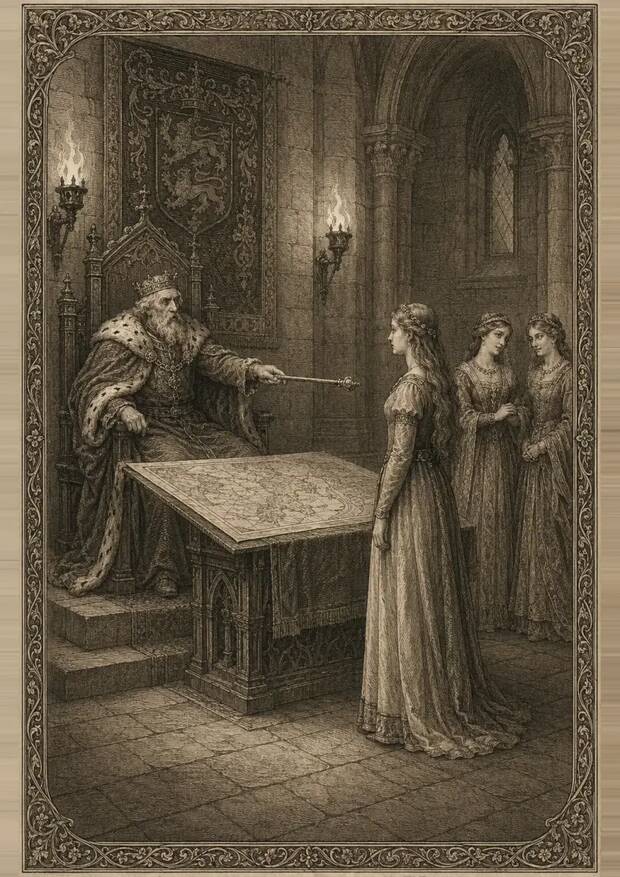
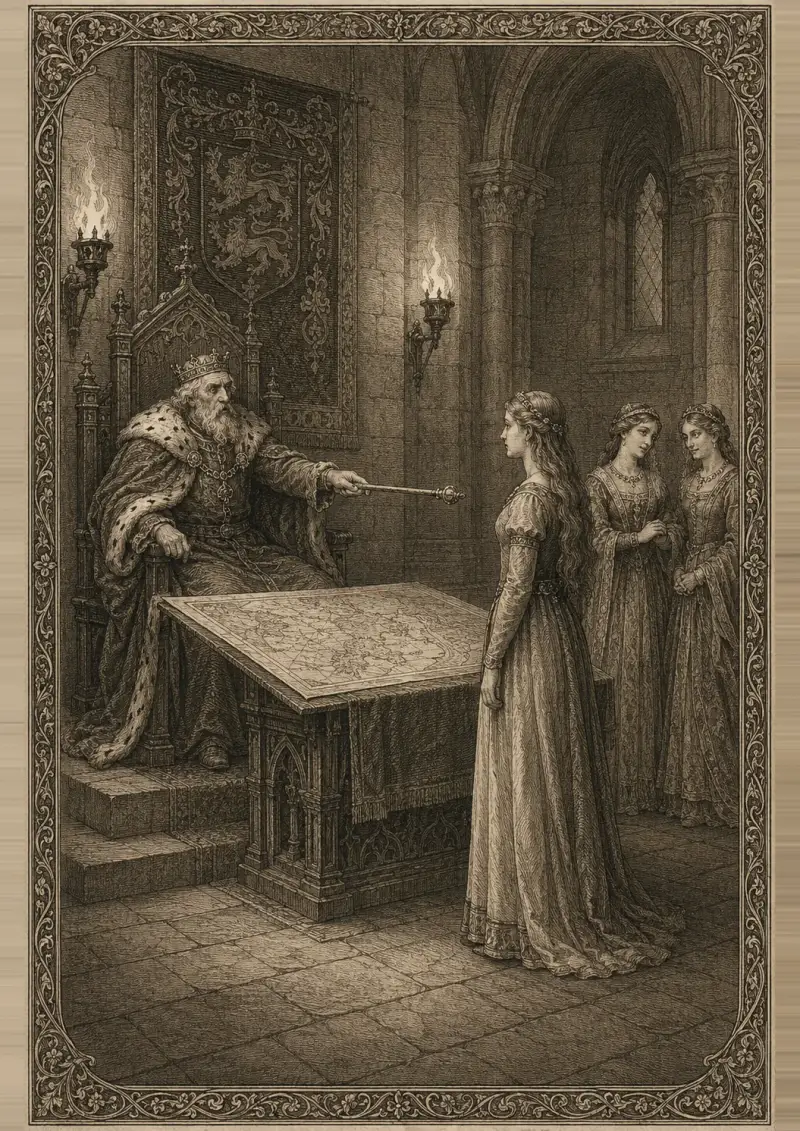
Lear is presented as a ruler whose authority has gone unquestioned for so long that he can no longer tell love from obedience. He speaks in commands and in the royal plural, and stages a private matter, his daughters’ affection, as a public ceremony with a map as its prop. When Cordelia refuses, his anger is instant and absolute: Come not between the dragon and his wrath
. The metaphor shows how he sees himself, as a creature of power, not a father. Kent’s imperative See better, Lear
introduces the play’s imagery of sight and names the fault. Regan’s later remark that he hath ever but slenderly known himself
confirms that this rashness is his character, not a sudden change.
Is Cordelia right to answer as she does?
The question is open, and the text supports two readings. On one, Cordelia shows integrity. Her sisters’ speeches are hyperbole (deliberate exaggeration), and her Nothing
refuses to treat love as a bid in an auction. France sees it so, calling her most rich being poor
. On the other, she is her father’s daughter: proud, exact and unwilling to bend in public. Her language of bond
and halves is cool at a moment that called for warmth, and a gentler answer might have saved them both. The strongest answers hold the two together. Cordelia is right about love and unwise about her father, and the play makes her honesty a cause of the disaster as well as its remedy.
How does Edmund’s first soliloquy shape the audience’s response to him?
The soliloquy (a speech of private thought, spoken alone on stage) wins the audience before Edmund has done any harm. He speaks directly and wittily, and his argument has force: why should he be called base
when his mind and body are as good as his brother’s? He rejects custom for Nature
, turning his illegitimacy into a creed, and the rhetorical questions invite agreement. The repetition of legitimate
mocks the word until it sounds empty. The closing cry, Now, gods, stand up for bastards
, is funny and defiant. Shakespeare makes the villain attractive so that the audience shares in his plot, and so that the play’s question about what is natural has a persuasive spokesman on the wrong side.
Act 2
Comprehension
How does Edmund complete his deception of Gloucester in Act 2, Scene 1?
He persuades Edgar to flee, stages a brief sword fight as their father approaches, and cuts his own arm. He tells Gloucester that Edgar tried to draw him into murdering him and attacked him when he refused. Gloucester orders Edgar hunted down and promises to make Edmund, his Loyal and natural boy
, able to inherit.
Why is Kent put in the stocks?
Arriving at Gloucester’s castle with Lear’s letters, the disguised Kent meets Goneril’s steward Oswald, abuses and beats him. Cornwall, offended by Kent’s blunt answers, orders him into the stocks until noon; Regan extends it: Till night, my lord, and all night, too
. Gloucester objects that the King will take the punishment of his messenger as an insult.
What disguise does Edgar choose in Act 2, Scene 3, and why?
Proclaimed an outlaw, with every port watched, Edgar decides to become Poor Tom, a Bedlam beggar: a wandering madman with a grimed face, knotted hair and only a blanket. It is the lowest shape he can think of and so the safest. He ends the soliloquy Edgar I nothing am
.
How do Regan and Cornwall receive Lear when he arrives?
They have left their own house to avoid receiving him and are staying with Gloucester. At first they decline to see him, saying they are sick and weary, which Lear calls Mere fetches
. When Regan does appear she defends Goneril, tells her father he is old and should be ruled by others, and urges him to return and apologise.
What happens to Lear’s hundred knights, and how does the act end?
Goneril has cut them to fifty. Regan will accept only twenty-five. Goneril asks why he needs twenty-five, or ten, or five, and Regan finishes: What need one?
Lear refuses their terms and goes out into the rising storm with the Fool. Regan and Cornwall tell Gloucester to shut his doors.
Analysis
How does Shakespeare present Goneril and Regan in Act 2, Scene 4?
They are presented as a single, reasonable-sounding force. Their cruelty is delivered in polite, practical language: Regan’s I pray you, father, being weak, seem so
is courteous in form and merciless in content. They share verse lines, one finishing the other’s sentence, which shows them acting as one mind, and the falling numbers, fifty, twenty-five, ten, five, one, turn Lear’s dignity into arithmetic. This mirrors the love test, where he measured love in land. Shakespeare gives them real arguments (a hundred armed men are hard to house), so the audience watches plausibility become persecution. The stage picture of Regan taking Goneril’s hand completes Lear’s isolation.
What is the importance of Lear’s speech beginning “O, reason not the need”?
It is the play’s first serious statement about what a human being is worth. Asked why he needs even one follower, Lear answers that need is the wrong measure: even beggars own something beyond bare necessity, and if people are allowed only what nature requires, Man’s life is cheap as beast’s
. He points to his daughter’s fine clothes, worn for show, not warmth. The argument breaks off before he can say what true need is, and the syntax collapses into threats he cannot finish and a struggle not to weep. The speech prepares the heath scenes, where Lear meets a man with nothing and has to test his own argument against the sight.
What does the Fool contribute to Acts 1 and 2?
The Fool tells Lear the truth in a form that cannot be punished. His riddles and rhymes all return to one subject, the folly of giving power away: Lear has made his daughters thy mothers
, and when Lear asks who he is, the Fool replies Lear’s shadow
. In Act 2 his song about fathers who wear rags
and fathers who bear bags
reduces the daughters’ love to self-interest. He speaks prose and song against the court’s verse, the voice of common sense. He is also loyal. He follows Lear into the storm, so that his bitter jokes are those of a servant who stays.
Act 3
Comprehension
What do we learn from Kent’s conversation with the Gentleman in Act 3, Scene 1?
Lear is out in the storm with only the Fool. Kent reveals that there is hidden division between Albany and Cornwall, and that a French force has secretly landed. He sends the Gentleman to Dover to report the King’s treatment, with a ring that will tell Cordelia who has sent him.
What does Gloucester confide to Edmund in Act 3, Scene 3, and what does Edmund do?
Gloucester says that Cornwall and Regan have forbidden him to help Lear, that he has a letter about the invasion locked in his closet, and that he means to relieve the King secretly. Edmund resolves at once to tell Cornwall, expecting his father’s lands as a reward: The younger rises when the old doth fall
.
Whom does Lear meet at the hovel, and how does he react?
Edgar, disguised as Poor Tom, comes out of the hovel, nearly naked and raving of the foul fiend. Lear assumes that only daughters could have brought a man so low. He calls Tom the thing itself
and tears at his own clothes, crying Off, off, you lendings
. Gloucester then arrives with a torch to lead them to shelter.
What happens in the farmhouse in Act 3, Scene 6?
The mad Lear holds an imaginary trial of Goneril and Regan, with Poor Tom, the Fool and Kent as judges. The Fool speaks his last line in the play, And I’ll go to bed at noon
. Gloucester returns with news of a plot against the King’s life, and Lear is carried on a litter towards Dover.
What is done to Gloucester in Act 3, Scene 7?
Cornwall and Regan have him bound to a chair and question him as a traitor. Cornwall puts out one eye. A servant draws his sword to stop him and wounds him; Regan stabs the servant from behind. Cornwall puts out the other eye, Regan reveals that Edmund betrayed him, and Gloucester is thrust out of doors.
Analysis
How does Shakespeare use the storm in Act 3, Scene 2?
The storm works on three levels at once. It is literal: an old man is outdoors on a night when, as the Fool says, there is no pity for wise men nor fools
. It reflects Lear’s mind, the tempest
he later says is in it, a use of weather often called pathetic fallacy. And it is an opponent he tries to command: Blow winds, and crack your cheeks
is a string of imperatives from a king with nothing left to order but the sky. The storm does not obey, and Lear half admits it when he says the elements owe him nothing. His claim to be More sinned against than sinning
shows that self-pity still outweighs self-knowledge. See the essay on “Blow winds, and crack your cheeks”.
How does Lear’s prayer in Act 3, Scene 4 mark a change in him?
For the first time Lear thinks about people he has never noticed. Before entering the hovel he sends the Fool in ahead of him, then addresses the Poor naked wretches
of his kingdom and asks how their houseless heads
survive such weather. The admission O, I have ta’en / Too little care of this
is the first time he blames himself for anything as a ruler. The imperatives that used to fall on others are now turned on his own class: Take physic, pomp
. He even proposes a remedy, that the rich should shake the superflux
to the poor. The insight comes at the edge of madness, and the entrance of Poor Tom straight afterwards tips him over.
Why does Shakespeare show the blinding of Gloucester on stage?
Shakespeare could have had the blinding reported, as Cornwall’s death is, so staging it is a choice. It makes the play’s central metaphor literal: Gloucester, who could not see which son was true, loses his eyes, and will say I stumbled when I saw
. It shows what power does when nothing checks it. Cornwall’s Out, vile jelly
reduces an eye to matter, and the casual cruelty of let him smell / His way to Dover
is Regan’s. Yet the scene also contains the play’s clearest act of goodness. A nameless servant, who says better service have I never done you
, gives his life to stop it. The audience is made to witness the worst and one refusal to accept it.
Act 4
Comprehension
How does Edgar come to be his father’s guide?
In Act 4, Scene 1 the blinded Gloucester is led on by an old tenant and meets Poor Tom. Not knowing him for his son, he sends the old man away and asks the beggar to lead him to the cliff at Dover, where he means to end his life. Edgar agrees and keeps his disguise.
What changes in Goneril’s household in Act 4, Scene 2?
Goneril gives Edmund a favour and a kiss and sends him back to Cornwall. Albany, changed by what he has learnt, denounces her and her sister as Tigers, not daughters
; she calls him a Milk-livered man
. A messenger brings news that Cornwall has died of the servant’s wound and that Gloucester is blinded. Albany vows to avenge Gloucester’s eyes.
What happens at “Dover cliff” in Act 4, Scene 6?
Edgar persuades his father that they stand at the cliff’s edge and describes the dizzying drop. Gloucester kneels, renounces the world, and falls forward on level ground. Edgar, changing his voice, pretends to be a passer-by at the foot who saw him fall, and tells him Thy life’s a miracle
. Gloucester resolves to bear his suffering.
What happens between Edgar and Oswald?
Regan has told Oswald that whoever kills Gloucester will be rewarded. Oswald finds the blind man and draws his sword. Edgar, speaking as a country peasant, fights and kills him. Dying, Oswald asks him to deliver his letters to Edmund. Edgar reads Goneril’s, which urges Edmund to murder Albany, and keeps it to show the Duke.
How are Lear and Cordelia reunited?
Cordelia’s soldiers find Lear, who has been wandering mad and crowned with weeds. In Act 4, Scene 7 he has slept, been dressed in fresh clothes and is woken with music. He takes Cordelia for a spirit, then slowly knows her and expects her hatred. She answers No cause, no cause
, and he asks her to forget, and forgive
.
Analysis
Why does Edgar let his father believe he has fallen from the cliff?
Edgar’s stated aim is to cure despair, and it works for a time: Gloucester says Henceforth I’ll bear / Affliction
. The method is theatre. On a bare stage Edgar’s speech builds a cliff out of words, shrinking fishermen to mice, so that the audience half believes in it too. The scene can be read two ways. It is a son’s loving trick, a staged miracle for a man who thinks the gods kill us for their sport
. It is also grotesque: a blind man falling flat on nothing, deceived again by a child. Critics who see the play as absurd rest much on this moment. Edgar’s long delay in revealing himself, which he later calls a fault
, keeps the doubt alive.
What does the mad Lear understand in Act 4, Scene 6 that he did not understand before?
He understands that he was flattered, that he is mortal, and that authority is a costume. His courtiers told me I was everything
, and the storm taught him otherwise. When Gloucester asks to kiss his hand he says it smells of mortality
. He claims to be every inch a king
and then takes kingship apart: a beggar runs from a farmer’s dog, and that is the great image of authority
. Justice depends on dress, since Robes and furred gowns hide all
. The speeches slide between verse and prose and are mixed with obsession and disgust, especially about women. Edgar’s aside, Reason in madness
, tells the audience how to listen.
How does Shakespeare make the reunion in Act 4, Scene 7 so moving?
Chiefly by simplicity. After the roaring of the heath, Lear speaks in short plain words: I am a very foolish fond old man
. The titles have gone and what is left is an exact, humble account of himself. He tries to kneel to his daughter, reversing the ceremony of the first scene, and she will not let him. His reasoning still expects punishment, since she has some cause
, and her reply cancels the debt in four monosyllables: No cause, no cause
. Shakespeare surrounds the moment with gentleness, sleep, music, fresh garments and a doctor’s care, so that the scene feels like a healing and an ending. That feeling is what makes Act 5 so hard to bear.
Act 5
Comprehension
What does Edgar give Albany before the battle?
Still disguised, Edgar hands Albany the letter taken from Oswald and asks him to read it before fighting. If Albany wins, he is to have a trumpet sounded, and a champion will appear to prove what the letter says. Edmund, alone, then admits he has sworn love to both sisters and intends no mercy for Lear and Cordelia.
What is the result of the battle, and what order does Edmund give?
Cordelia’s army is defeated offstage, and she and Lear are taken prisoner. Lear welcomes prison if they can be together. Edmund sends them off under guard and gives a captain a written order, promising him advancement. We learn later that it is for Cordelia to be hanged and her death made to look like suicide.
How is Edmund brought down?
Albany arrests him for treason and has the herald sound the trumpet for a challenger. At the third sound Edgar enters armed and unrecognised, accuses Edmund and wounds him mortally in single combat. Edgar then reveals who he is and reports that Gloucester has died, his heart failing between joy and grief when his son made himself known.
How do Goneril and Regan die?
Goneril poisons Regan, her rival for Edmund; Regan sickens on stage and is led away to die. When Albany produces the letter that proves her plot against him, Goneril leaves, and a gentleman enters with a bloody knife to report that she has stabbed herself. Their bodies are brought on stage.
How do Cordelia and Lear die, and who is left to rule?
Edmund, dying, tries to recall his order, but too late. Lear enters carrying Cordelia, hanged in the prison; he has killed the man who did it. He dies over her body, believing or hoping that her lips move. Albany asks Kent and Edgar to govern. Kent declines, expecting to die soon; Edgar speaks the closing lines in the Folger text.
Analysis
What does Lear’s “birds i’ th’ cage” speech show about how he has changed?
It shows a man who no longer wants what he gave everything to keep. Captured, Lear refuses to see his other daughters and imagines prison as happiness: he and Cordelia will sing like birds i’ th’ cage
, and he will kneel to ask her forgiveness. Court politics has shrunk to gossip about who’s in, who’s out
. The simile is tender and the rhythm is calm, a long sentence of small pleasures joined by “and”. Yet the speech is also blind. Lear speaks for Cordelia, who says almost nothing, and ignores the danger standing beside them. Shakespeare lets the audience share his peace for a moment so that Edmund’s whispered order, given as they leave, cuts across it.
How should we understand Edmund’s attempt to do good at the end?
Shakespeare leaves the motive open. After Edgar’s story Edmund says he is moved; seeing the sisters’ bodies he says Yet Edmund was beloved
; then, Some good I mean to do / Despite of mine own nature
. One reading is that the man who made nature his goddess finally acts against it, which suggests that character is not fixed. Another is that he is still performing, enjoying a last effect, and he delays fatally before speaking. Either way the attempt fails, and its failure is the point of the structure. The reprieve is sent, Albany prays The gods defend her
, and Lear at once enters with Cordelia dead. Repentance comes, and makes no difference.
Does the ending of King Lear offer any consolation?
This is the central debate about the play, and both sides have evidence. Against consolation: Cordelia dies after the battle is over and the villains are beaten, so her death serves no purpose. Lear’s Never, never, never, never, never
denies any reunion, and Kent can only ask Is this the promised end?
For consolation: evil destroys itself, Edgar and Albany survive, and Lear dies loved and looking at Cordelia, perhaps believing she lives: Look there, look there
. The final couplet asks the survivors to Speak what we feel, not what we ought to say
, which honours Cordelia’s honesty. A balanced answer notes that Shakespeare removed the happy ending of his sources, so whatever comfort remains is deliberately small.
Whole-text questions
How does Lear change in the course of the play?
He moves from command to humility, and from seeing others as extensions of himself to seeing them as people. In Act 1 he weighs love in land and banishes those who tell him the truth. Loss teaches him by stages: I did her wrong
in Act 1, sympathy for the Fool and for Poor naked wretches
in Act 3, contempt for empty authority in Act 4, and at last the plain self-description of the reunion. The limits of the change are worth stating. His anger and his habit of speaking for others survive, and his new knowledge saves nobody. Whether it justifies what he suffers is left for the audience to decide.
Why does Shakespeare give the play a second plot?
The story of Gloucester and his sons repeats the story of Lear and his daughters: a father believes the false child, rejects the true one, is cast out, and is cared for by the child he wronged. The repetition turns one family’s misfortune into something like a law of the play’s world. It also allows contrasts. Gloucester’s suffering is of the body, Lear’s of the mind; Gloucester’s fault began in lust, Lear’s in pride. The plots are joined by Edmund, who is loved by both of Lear’s elder daughters, and they meet in Act 4, Scene 6, when the mad king and the blind earl talk together. Edgar’s line He childed as I fathered
states the parallel outright.
What is the significance of the word “nothing”?
It begins as Cordelia’s answer in the love test and Lear’s reply, Nothing will come of nothing
, a proverb he means as a threat. The play proves him wrong, since everything comes of it. The word then spreads. Edmund hides the forged letter and calls it nothing; the Fool tells Lear he is now nothing himself; Edgar, taking his disguise, says Edgar I nothing am
. Each use strips something away, an inheritance, an identity, a name, and the play keeps asking what remains when a person has nothing. In the last scene the repeated negatives of Lear’s final speech, “no” and “never”, complete the pattern.
How does Shakespeare use clothing and nakedness?
Clothes in the play stand for everything a person is given by rank. Lear tells Regan that her fine dress is worn for show, not warmth. Kent and Edgar survive by changing their dress, and Edgar’s disguise is near nakedness. On the heath Lear looks at Poor Tom and finds the thing itself
, then tries to strip: Off, off, you lendings
. In his madness he sees that justice depends on dress, because Robes and furred gowns hide all
. The pattern reverses at the reunion, where he wakes in fresh garments, and returns in his last request, to have a button undone. Clothing lets the play ask whether dignity is real or merely worn.
What part do the gods play in King Lear?
The characters call on them constantly and never receive a reply. The setting is pre-Christian Britain, so they swear by Apollo, Jupiter and Nature. Lear expects the heavens to take his side. Gloucester, blinded, concludes that the gods kill us for their sport
; Edgar insists that The gods are just
; Albany sees divine judgement in Cornwall’s death. Events support none of them for long. The clearest test is in the final scene, where Albany’s prayer for Cordelia is followed at once by her body. Shakespeare shows people needing to believe in justice, and leaves the audience to judge whether anything but human action supplies it.
Why does the Fool disappear after Act 3?
The text gives no explanation, so this is a question of interpretation. His last words are And I’ll go to bed at noon
, and he is not seen again. One reading is dramatic: the Fool’s task is to tell Lear the truth, and once Lear is mad and speaking bitter truths himself, the role is complete. Another is thematic: the play is moving into a harsher world where jokes offer no protection. Lear’s late line that his poor fool is hanged
is usually taken to refer to Cordelia, “fool” being a term of affection, though it also recalls the Fool. A practical theory, that one actor played both parts, cannot be proved.
Essay questions with outline answers
“Goneril and Regan are monsters, with no redeeming qualities.” How far do you agree?
Thesis: The sisters end as monsters, but Shakespeare shows them becoming so by steps, from grievances that begin as reasonable.
- Point 1: Their first private conversation, at the end of Act 1, Scene 1, is clear-sighted, not wicked. They have watched their father banish his favourite, and judge that he
hath ever but slenderly known himself
. - Point 2: Their complaints have substance and their methods are cold. In Act 2, Scene 4 the bargaining ends in
What need one?
: cruelty in the form of good housekeeping. - Point 3: Power removes restraint. Regan helps to blind Gloucester and kills the servant; Goneril plots her husband’s death and poisons her sister. Albany’s
Tigers, not daughters
marks the point at which they leave the human family. - Counter-argument: The play gives them no soliloquy of doubt and no remorse, and the animal imagery invites us to see them as predators by nature. Feminist critics have replied that the play makes female power itself look monstrous.
Conclusion: They are shaped by a father who taught them that love is a transaction, and they are responsible for what they do with the lesson.
“The Fool is the wisest character in the play.” Discuss.
Thesis: The Fool sees Lear’s mistake more clearly than anyone, but his wisdom is limited to diagnosis; the play gives deeper understanding to those who suffer and act.
- Point 1: He understands power. From his first scene he tells Lear he was foolish to give away his crown and has made his
daughters thy mothers
. His answer to Lear’s question about identity,Lear’s shadow
, is the play’s political truth in two words. - Point 2: His wisdom is practical and unsentimental. In the storm he prefers a dry house and flattery to rain, and his line
This cold night will turn us all to fools and madmen
ties sanity to shelter. - Point 3: He is loyal against his own advice. He counsels self-interest and then follows the King onto the heath, which shows that his worldly wisdom is not the whole of him.
- Counter-argument: He can name the error but cannot mend it, and he vanishes in Act 3. Cordelia’s forgiveness, Edgar’s endurance and the mad Lear’s insight into justice reach further than his riddles.
Conclusion: The Fool is the play’s sharpest observer, and Shakespeare removes him when observation is no longer enough.
How far is Cordelia responsible for the tragedy that follows the first scene?
Thesis: Cordelia’s refusal is the occasion of the tragedy, not its cause; the cause is a test that should never have been set, though her manner makes the breach worse.
- Point 1: The fault lies in the question. Lear asks for love to be performed in public for a reward. Any truthful answer must disappoint him, and Kent, the scene’s honest witness, defends her at once.
- Point 2: Her answer is exact to the point of harshness.
According to my bond, no more nor less
and her talk of giving half her love to a husband meet her father’s arithmetic with her own, before the court and two suitors. - Point 3: Her later conduct answers the charge. She returns for
love, dear love, and our aged father’s right
, and tells him she hasNo cause
for resentment. The woman who would not say she loved him proves it. - Counter-argument: She knows her sisters and her father, and warns the sisters as she leaves. A few softer words might have kept Lear out of their hands. Her silence can be read as pride.
Conclusion: Cordelia is the least to blame of anyone in the first scene, but Shakespeare makes her recognisably Lear’s child, which keeps the tragedy inside the family.
How does Shakespeare present loyalty and service in King Lear?
Thesis: The play separates true service, which may mean disobeying, from mere obedience, and shows that loyalty is practised mostly by the powerless.
- Point 1: Kent defines loyal service as honesty. He contradicts the King,
See better, Lear
, is banished for it, and returns in disguise to serve him as a common man to the end. - Point 2: Oswald is the contrast: a servant who obeys perfectly. He insults Lear on Goneril’s instruction, carries her letters and tries to kill Gloucester for reward. Obedience without judgement is shown as a vice.
- Point 3: The servant in Act 3, Scene 7 gives the theme its sharpest form. He tells Cornwall
better service have I never done you
than to stop him, and dies for it. Loyalty to a master’s good outranks loyalty to his orders. - Counter-argument: Loyalty achieves little. Kent cannot save Lear, the servant cannot save Gloucester’s second eye, and Cordelia’s faithfulness ends in her death. The play honours service without promising that it works.
Conclusion: In a world where the high-born betray, Shakespeare places fidelity in servants, an exile and a fool, and values it for itself.
“Edgar, not Lear, is the character who truly learns from suffering.” How far do you agree?
Thesis: Edgar’s learning is more complete and more useful than Lear’s, since he survives to act on it, but it is also less profound, and the play questions his confident morals.
- Point 1: Edgar begins as a credulous heir, easily deceived by Edmund, and is reduced to the lowest condition:
Edgar I nothing am
. As Poor Tom he learns what the powerless endure. - Point 2: He turns suffering into care for others. He guides his father, stages the “miracle” at Dover and teaches endurance:
Men must endure / Their going hence even as their coming hither
. He ends as the armed champion who defeats Edmund. - Point 3: Lear’s learning is deeper but comes too late to use. His recognition of the poor, of false authority and of his own folly is the heart of the play, and he dies before it can change anything.
- Counter-argument: Edgar’s lessons can sound too neat.
The gods are just
is a hard thing to say of his father’s blinding, he admits his delay in revealing himself was a fault, and events keep outrunning his maxims.
Conclusion: Edgar learns how to go on living and Lear learns what he has been, and the final lines suggest the young cannot fully share what the old have seen: The oldest hath borne most
.
For quotations organised by theme, see the pages on power, family, madness and nature. The essay planner gives a one-page structure for turning any of these outlines into a timed essay.

A page of Shakespeare, every day.
This resource comes from Daily Bard, an app for iPhone and iPad. Each morning it shows one engraved plate and one passage, exactly as Shakespeare wrote it, with a plain-English reading on the back of the leaf.
Free to download. The Full Edition is a one-time US$11.99: no subscription, no account, no ads, no tracking.
Get it on the App Store: apps.apple.com/app/id6792967225
More free study guides, lesson plans and close readings: dailybard.app