
King Lear: key quotes and analysis (PDF)
PDF, 11 pages, 835 KB. Free, no sign-up, made to be printed.
The ten core quotations for King Lear, each with plain English, analysis and a fill-the-gap test. Or read the full study guide.
Family in King Lear
King Lear argues that family love cannot be measured, bought or commanded, and that fathers who treat it as a debt teach their children to keep accounts. The play opens with one father asking his daughters to bid for land with declarations of love, and another joking about his illegitimate son in the son’s presence. Goneril and Regan treat Lear exactly as he treated love, as a matter of quantity: when he protests I gave you all
, Regan answers And in good time you gave it
. Edmund turns Gloucester’s careless favour into a plan: I must have your land
.
Against this the play sets a different idea of the family bond, one that owes nothing to reward. Cordelia loses her inheritance and comes back with an army for love, dear love, and our aged father’s right
. Edgar, hunted by his father’s order, leads him by the hand. Neither asks for an apology. Shakespeare tells the story twice so that a parent’s blindness looks like a general law, not one household’s misfortune.
The play does not reward the loyal children. Family love is the highest value in King Lear, and it protects no one: Gloucester’s heart breaks when he learns who his guide was, and Cordelia is hanged.
Key quotations about family
The quotations run in play order and are drawn from both plots, so that you can set Lear’s family beside Gloucester’s; learn the short phrases picked out in the analysis.
Which of you shall we say doth love us most,
Lear · Act 1, Scene 1 1.1.56-58
That we our largest bounty may extend
Where nature doth with merit challenge.
Plain English: Which of you shall I say loves me most, so that I can give the biggest share to the one whose natural affection and deserving together earn it?
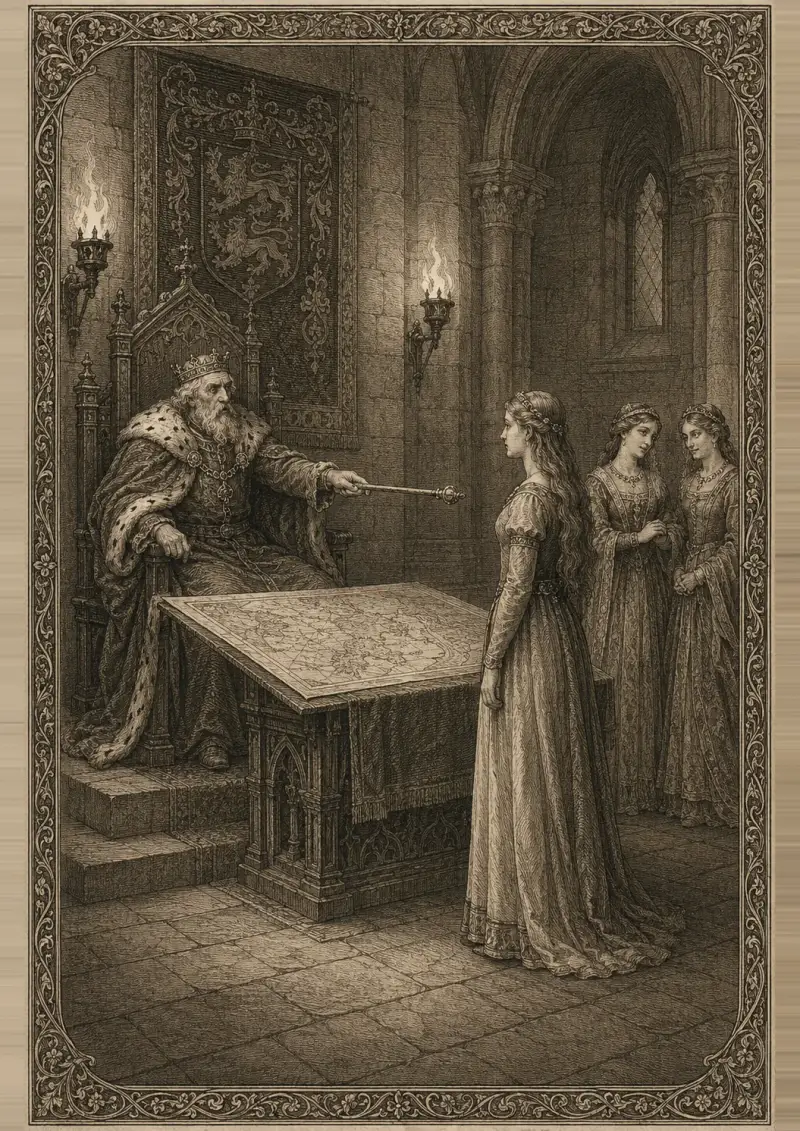
Context: Before the whole court, with a map in front of him, Lear announces the division of the kingdom and asks each daughter to speak in turn.
Methods: The superlatives most
and largest
are paired, so that love and land rise together like a price and a purchase. Lear does not ask who loves him most but who shall we say
does: the test is about public statement from its first words. In nature doth with merit challenge
he asks for two incompatible things, the love that is simply given by birth and the love that has to be earned in competition.
In an essay: Start here for any question on parents and children. The love test turns a family into a market, and Goneril and Regan go on following its logic.
Why have my sisters husbands if they say
Cordelia · Act 1, Scene 1 1.1.109-113
They love you all? Haply, when I shall wed,
That lord whose hand must take my plight shall carry
Half my love with him, half my care and duty.
Plain English: Why are my sisters married, if they say all their love is yours? Perhaps when I marry, my husband will take half my love, care and duty with him.
Context: Cordelia has answered Nothing
and been told to try again. She explains herself: she will Obey you, love you, and most honor you
, as a daughter should, and no further.
Methods: A rhetorical question (one asked to make a point, not to get an answer) exposes her sisters’ speeches as logically impossible. Then Cordelia does something uncomfortable: she answers Lear’s arithmetic with arithmetic. The repeated Half
divides love into portions, just as he has divided the map. Her vocabulary is contractual, plight
(a pledge), care and duty
. She is right, and she sounds like her father’s daughter.
In an essay: A quotation that complicates the picture of Cordelia as simply the loving child. Use it to argue that she rejects the test in its own language, and that the scene is a clash between two people who are alike.
Legitimate Edgar, I must have your land.
Edmund · Act 1, Scene 2 1.2.17-19
Our father’s love is to the bastard Edmund
As to th’ legitimate.
Plain English: Edgar, my lawful brother, I must have your land. Our father loves his bastard Edmund as much as his legitimate son.
Context: Edmund is alone with the forged letter that will turn Gloucester against Edgar. This is the close of his first soliloquy (a speech of private thought, spoken alone on stage).
Methods: Edmund addresses his absent brother by a legal category, Legitimate Edgar
, and speaks of himself in the third person as the bastard Edmund
, trying the labels on with contempt. The blunt modal verb in I must have your land
turns a brother into an obstacle. The most revealing line is the middle one: he knows he is loved equally. Love is not what he lacks; land is, and he treats his father’s affection as an advantage to be used.
In an essay: Edmund is the subplot’s version of Goneril and Regan: a child who sees family as property. Note that Gloucester helped to make him, introducing him in the first scene with jokes about his conception.
How sharper than a serpent’s tooth it is
Lear · Act 1, Scene 4 1.4.302-303
To have a thankless child.
Plain English: Having an ungrateful child hurts more than a snake’s bite.
Context: Goneril has told Lear to reduce his train of knights. He calls on Nature to make her barren, or to give her a child who will torment her.
Methods: The comparative sharper
and the image of the serpent’s tooth
make ingratitude a physical wound, and sibilance (repeated s sounds) lets the actor hiss the line. The word that matters is thankless
. Lear’s idea of a child is still someone who owes thanks, which is the thinking of the love test. The line also ends a curse on his own daughter’s womb: he answers a failure of family feeling by wishing her family out of existence.
In an essay: Often quoted as a simple truth about ungrateful children. Read in context it shows a father whose love turns to hatred the moment it is not repaid, as it did with Cordelia.
But yet thou art my flesh, my blood, my daughter,
Lear · Act 2, Scene 4 2.4.254-256
Or, rather, a disease that’s in my flesh,
Which I must needs call mine.
Plain English: And yet you are my flesh, my blood, my daughter. Or say instead a disease in my flesh, which I am forced to admit is my own.
Context: Goneril has arrived at Gloucester’s castle and Regan has taken her by the hand. Lear tells Goneril they will never meet again, then cannot leave it there.
Methods: The triplet my flesh, my blood, my daughter
climbs from body to relationship, each my
insisting on the tie he has just tried to cut. Then Or, rather
corrects it mid-thought, and the daughter becomes a disease
. The metaphor is more honest than Lear intends. A disease in one’s own flesh is no outside enemy: Which I must needs call mine
admits that Goneril’s cruelty comes from him.
In an essay: Use it to show that the play makes family a bond that cannot be dissolved by either side. Lear banished Cordelia in a sentence; here he finds that disowning a child is not possible.
O dear son Edgar,
Gloucester · Act 4, Scene 1 4.1.22-25
The food of thy abused father’s wrath,
Might I but live to see thee in my touch,
I’d say I had eyes again.
Plain English: Dear Edgar, whom your deceived father’s anger fed on: if I could live to touch you, it would be like having my eyes back.
Context: Gloucester, newly blinded, is being led by an old tenant. He learnt as he was blinded that Edmund betrayed him and Edgar was innocent. Edgar, disguised as Poor Tom, is standing within earshot.
Methods: Dramatic irony (the audience knows what a character does not) shapes the whole speech: the son he longs to touch is a few steps away. The metaphor The food of thy abused father’s wrath
makes anger an appetite that consumed a child, and abused
(deceived) accepts that he was tricked without excusing himself. see thee in my touch
swaps one sense for another. Sight is what failed him as a father; touch is all he has left, and it is enough.
In an essay: The subplot’s parallel to Lear’s reunion with Cordelia. Both fathers recognise the wronged child only after losing everything.
Tigers, not daughters, what have you performed?
Albany · Act 4, Scene 2 4.2.49-50
A father, and a gracious aged man
Plain English: You are tigers, not daughters. What have you done? A father, and a kind old man...
Context: Goneril returns home to find her husband changed. Albany has heard how Lear was driven out into the storm, and for the first time he condemns her.
Methods: The opening antithesis (two opposed ideas set in balance) Tigers, not daughters
removes Goneril and Regan from the human family altogether. Albany then builds his charge in order of importance: A father
comes first, before gracious
or aged
, because the kinship is the heart of the crime. He goes on to call them Most barbarous, most degenerate
, and degenerate
carries its root sense of falling away from one’s kind.
In an essay: Albany voices the audience’s reaction, and as Goneril’s husband he shows the household dividing against itself. Set his daughters
against Lear’s pelican daughters
in Act 3: children imagined as feeding on the parent.
LEAR I know you do not love me, for your sisters
Lear and Cordelia · Act 4, Scene 7 4.7.83-87
Have, as I do remember, done me wrong.
You have some cause; they have not.
CORDELIA No cause, no cause.
Plain English: I know you do not love me. Your sisters have wronged me, as I recall, and you have a reason to; they have none. Cordelia: No reason, none.
Context: Lear wakes in Cordelia’s camp after a long sleep, in fresh clothes, with music playing. He recognises her slowly and expects punishment: If you have poison for me, I will drink it
.
Methods: Lear is still reasoning by the logic of deserving: wrong is repaid with wrong, so Cordelia, who has cause
, cannot love him. Her reply cancels the logic instead of arguing with it. The repetition No cause, no cause
is four monosyllables, the plainest speech in the play, and it is generous to the point of being untrue, since she had every cause. Where the love test demanded a measured quantity, she offers love with no account kept.
In an essay: The moral centre of the theme. Link it to Nothing
in the first scene: Cordelia’s shortest speeches frame the relationship, and in both she refuses to make love a matter of calculation.
We two alone will sing like birds i’ th’ cage.
Lear · Act 5, Scene 3 5.3.10-12
When thou dost ask me blessing, I’ll kneel down
And ask of thee forgiveness.
Plain English: The two of us will sing like caged birds. When you ask for my blessing, I will kneel and ask you to forgive me.
Context: The battle is lost and father and daughter are prisoners. Cordelia asks if they will see her sisters; Lear answers No, no, no, no
and imagines their life in prison.
Methods: The picture of mutual kneeling rewrites the proper ceremony between child and parent. A daughter kneels for blessing
; this father will kneel in return for forgiveness
. The simile like birds i’ th’ cage
is tender, but it is still a cage. We two alone
shuts out the world, including the husband Cordelia spoke of in Act 1. Lear has learnt humility; whether he has stopped wanting all of her love is less certain.
In an essay: A second complicating quotation. Use it as evidence of how far Lear has changed, then question it: his vision of family is beautiful, private and impossible, and Edmund ends it within a few lines.
Yet Edmund was beloved.
Edmund · Act 5, Scene 3 5.3.287-289
The one the other poisoned for my sake,
And after slew herself.
Plain English: Even so, Edmund was loved. One sister poisoned the other for my sake, and then killed herself.
Context: Edmund is dying of the wound Edgar gave him. The bodies of Goneril and Regan have just been carried on stage.
Methods: Edmund again speaks of himself in the third person, as he did in Act 1, but the tone has changed from mockery to wonder. Yet
sets the claim against a whole life as the son who was joked about and kept abroad. The passive was beloved
states the one thing he seems to have wanted. His proof is horrible: a poisoning and a suicide, sister destroying sister. The only love this family’s schemers can show is competitive and lethal.
In an essay: Use it to argue that even the play’s coldest calculator wanted to be loved, which sends us back to how Gloucester treated him. His next words are an attempt to save Cordelia, too late.
How the theme develops
| Where | What happens to the theme | Quotation to know |
|---|---|---|
| Act 1 | Two fathers misjudge their children. Lear sells land for declarations of love and disowns Cordelia; Gloucester believes a forged letter. Lear curses Goneril. | Which of you shall we say doth love us most |
| Act 2 | Gloucester disinherits Edgar and names Edmund his heir. Goneril and Regan combine and bargain away Lear’s knights. Family becomes a contest over what is owed. | I gave you all |
| Act 3 | Lear, shut out, sees every wrong as the work of daughters. Edmund betrays his father for the earldom, and Gloucester learns the truth as he is blinded. | He childed as I fathered |
| Act 4 | The wronged children care for the fathers who wronged them. Edgar guides Gloucester; Cordelia forgives Lear. The sisters become rivals for Edmund. | No cause, no cause |
| Act 5 | Both reunions end in death. Gloucester’s heart gives way when Edgar reveals himself; Goneril poisons Regan and kills herself; Cordelia is hanged and Lear dies over her body. | Burst smilingly |
The theme turns in Act 4. For three acts family ties are instruments: of bargaining, of inheritance, of revenge. Then the children who were cast out return and ask for nothing, and the play shows what the bond is when no account is kept. It ends by taking that away. Edgar reports that his father’s heart, caught ’Twixt two extremes of passion, joy and grief
, could not survive the reunion, and Lear’s last speech is addressed to a daughter who cannot answer.
Model paragraph
Question: How does Shakespeare present relationships between parents and children in King Lear?
Why it works: It argues one idea (love treated as debt) and tests it at three points in the play. Each quotation is short and embedded, and the analysis says what small features do: a pair of superlatives, a shared verse line, four monosyllables. The last sentence uses a fact about how the play was constructed to widen the point.
Practice questions
- Read Act 4, Scene 7 from Lear’s waking to the end of the scene. How does Shakespeare present the relationship between Lear and Cordelia in this extract?
- How does Shakespeare use the Gloucester family to develop the play’s ideas about fathers and children?
- “Lear and Gloucester are the authors of their children’s cruelty.” How far do you agree?
- “King Lear has no mothers, and the absence is the point.” Consider how the play’s all-paternal families shape its treatment of love, authority and inheritance.
Test your knowledge of both plots with the King Lear questions and answers, and see the character notes in the study guide. The family quarrel is also a political one, traced in the quotes about power, and both fathers call their children’s behaviour unnatural, an idea examined in the quotes about nature.