
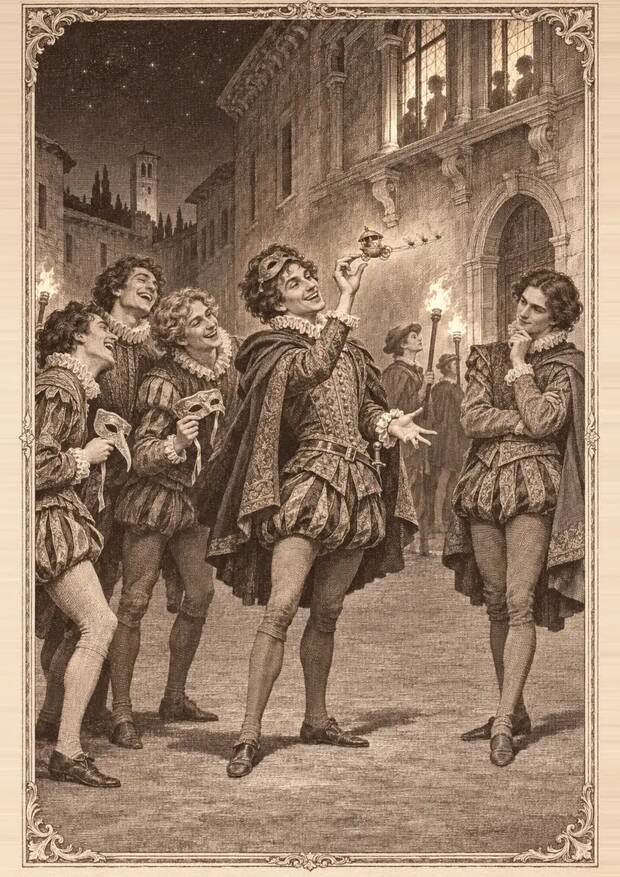
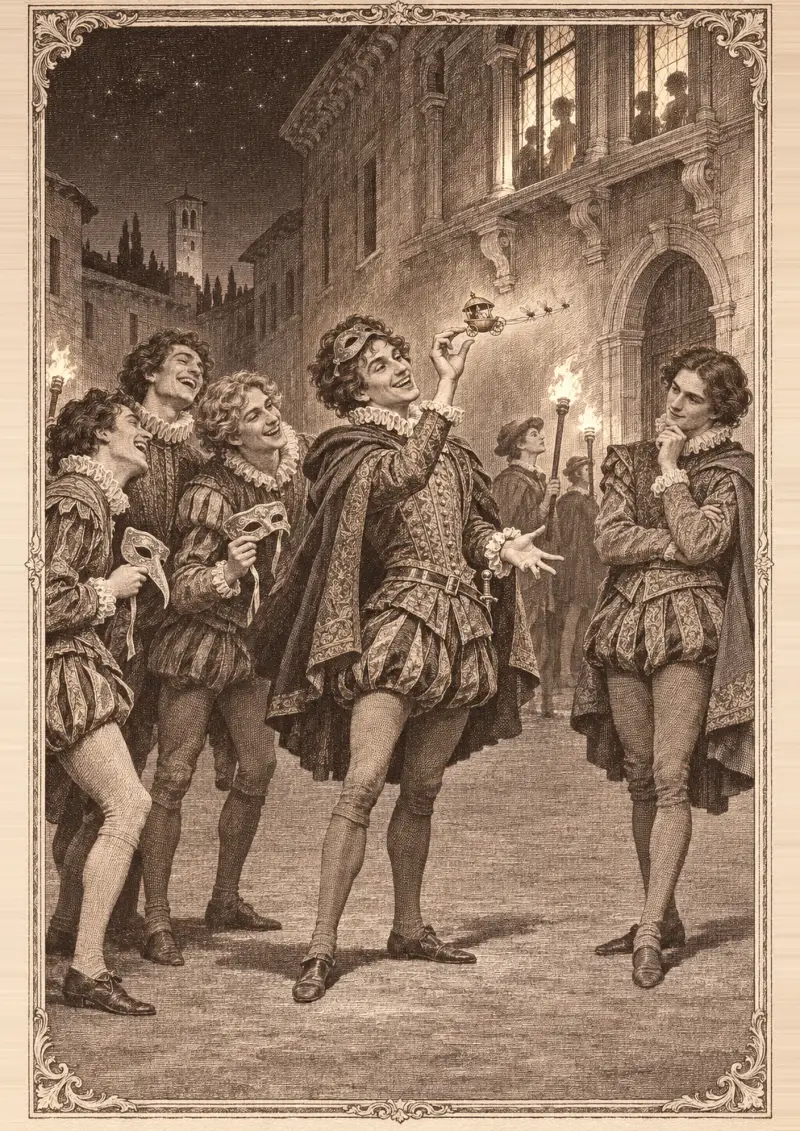
Romeo and Juliet: study cards (PDF)
PDF, 14 pages, 1.0 MB. Free, no sign-up, made to be printed.
Also for Romeo and Juliet: the study guide and the quotation sheet (PDF).
How to use the cards
Each card has one quotation from Romeo and Juliet on the front. Say who speaks it, where it comes in the play, and what it means, then turn the card to check. Mark the ones you know and the deck will skip them next time on this device; keep turning the rest until they stick.
Every card comes from the study guide and the quotes-by-theme pages, so each one links back to the full analysis. On paper, print the PDF, cut along the dashed lines and fold each strip down the middle.
The cards
-
Card 1 of 49
Why then, O brawling love, O loving hate,
O anything of nothing first create!Who says it, when, and what does it mean?
Card 1 of 49
Romeo · Act 1, Scene 1
Love is a fight and hatred is a passion; everything is made out of nothing.
-
Card 2 of 49
Love is a smoke made with the fume of sighs;
Being purged, a fire sparkling in lovers’ eyes;
Being vexed, a sea nourished with loving tears.Who says it, when, and what does it mean?
Card 2 of 49
Romeo · Act 1, Scene 1
Love is a smoke made of sighs; when it clears it is a fire in the eyes, and when it is troubled it is a sea of tears.
In an essay: Use this as the baseline: love before Juliet is fluent, rhymed, and about Romeo. Measure every later quotation against it.
Quotes about love
-
Card 3 of 49
What, drawn and talk of peace? I hate the word
As I hate hell, all Montagues, and thee.Who says it, when, and what does it mean?
Card 3 of 49
Tybalt · Act 1, Scene 1
You have your sword out and you talk about peace? I hate that word as I hate hell, every Montague, and you.
In an essay: Tybalt is the feud in a single body. Quote this to show hatred as a settled identity, then contrast Benvolio’s
I do but keep the peace
to show that the young men are not all alike.Quotes about conflict
-
Card 4 of 49
Three civil brawls bred of an airy word
By thee, old Capulet, and Montague,
Have thrice disturbed the quiet of our streetsWho says it, when, and what does it mean?
Card 4 of 49
Prince · Act 1, Scene 1
Three public riots, born from a casual remark by you, old Capulet, and you, Montague, have three times broken the peace of our streets.
In an essay: Use it to argue that responsibility lies with the older generation, and that authority in Verona can punish conflict but cannot cure it.
Quotes about conflict
-
Card 5 of 49
Ay me, sad hours seem long.
Was that my father that went hence so fast?Who says it, when, and what does it mean?
Card 5 of 49
Romeo · Act 1, Scene 1
Oh, hours pass slowly when you are sad. Was that my father who left so quickly?
In an essay: Use it to show that time is tied to emotion from Romeo’s first lines. The lover who finds the hours long with Rosaline will find every hour too short with Juliet.
Quotes about time
-
Card 6 of 49
My child is yet a stranger in the world.
She hath not seen the change of fourteen years.
Let two more summers wither in their pride
Ere we may think her ripe to be a bride.Who says it, when, and what does it mean?
Card 6 of 49
Capulet · Act 1, Scene 2
My daughter is still new to the world. She is not yet fourteen. Let two more summers pass before we think her ready to marry.
In an essay: The before picture. Quote
two more summers
beside his laterO’ Thursday let it be
to show that haste in this play is not only a fault of the young.Quotes about time
-
Card 7 of 49
If love be rough with you, be rough with love.
Prick love for pricking, and you beat love down.Who says it, when, and what does it mean?
Card 7 of 49
Mercutio · Act 1, Scene 4
If love treats you badly, treat it badly back. Satisfy your desire and you will be rid of it.
In an essay: This complicates any claim that the play simply celebrates romance. Shakespeare gives the anti-romantic view to the wittiest speaker on stage, Mercutio, so the lovers’ idealism has to prove itself against a clever sceptic.
Quotes about love
-
Card 8 of 49
I fear too early, for my mind misgives
Some consequence yet hanging in the stars
Shall bitterly begin his fearful date
With this night’s revelsWho says it, when, and what does it mean?
Card 8 of 49
Romeo · Act 1, Scene 4
I fear we will arrive too early. I have a foreboding that some event, still waiting in the stars, will begin its terrible course at tonight’s party.
In an essay: Use it to show that belief in fate works as a way of not deciding. Romeo senses danger, gives the responsibility to someone else, and goes in anyway.
Quotes about fate
-
Card 9 of 49
My only love sprung from my only hate!
Too early seen unknown, and known too late!Who says it, when, and what does it mean?
Card 9 of 49
Juliet · Act 1, Scene 5
The one man I love is the son of the one family I hate; I saw him before I knew who he was.
-
Card 10 of 49
Did my heart love till now? Forswear it, sight,
For I ne’er saw true beauty till this night.Who says it, when, and what does it mean?
Card 10 of 49
Romeo · Act 1, Scene 5
Have I ever loved before? My eyes, swear that I have not, because I never saw real beauty until tonight.
In an essay: Use it to show that the play is honest about its hero. His love for Juliet starts as his love for Rosaline did, through the eyes. The difference comes afterwards, when she speaks.
Quotes about love
-
Card 11 of 49
Good pilgrim, you do wrong your hand too much,
Which mannerly devotion shows in this;
For saints have hands that pilgrims’ hands do touch,
And palm to palm is holy palmers’ kiss.Who says it, when, and what does it mean?
Card 11 of 49
Juliet · Act 1, Scene 5
Pilgrim, you are too hard on your hand, which is only showing proper devotion. Pilgrims touch the hands of saints’ statues, and pressing palm to palm is how pilgrims kiss.
In an essay: This is the strongest evidence that love in the play is mutual: two voices complete one poem. Contrast it with Romeo’s solo performance in Act 1, Scene 1.
Quotes about love
-
Card 12 of 49
If he be married,
My grave is like to be my wedding bed.Who says it, when, and what does it mean?
Card 12 of 49
Juliet · Act 1, Scene 5
If he is already married, I am likely to die unmarried.
In an essay: A good example of how fate in this play is partly an effect of structure. The sense of doom is created by what the audience already knows, not by anything supernatural on stage.
Quotes about fate
-
Card 13 of 49
He shall be endured.
What, goodman boy? I say he shall. Go to.
Am I the master here or you? Go to.Who says it, when, and what does it mean?
Card 13 of 49
Capulet · Act 1, Scene 5
He will be put up with. What, my fine boy? I say he will. Enough. Am I master in this house, or are you?
In an essay: A quotation that complicates the picture: the head of a feuding house restrains the feud, and a new conflict opens between old and young. Compare his tone here with his rage at Juliet in Act 3, Scene 5.
Quotes about conflict
-
Card 14 of 49
But soft, what light through yonder window breaks?
It is the East, and Juliet is the sun.Who says it, when, and what does it mean?
Card 14 of 49
Romeo · Act 2, Scene 2
Quiet: what is that light at the window? It is the dawn, and Juliet is the sun.
-
Card 15 of 49
What’s in a name? That which we call a rose
By any other word would smell as sweet.Who says it, when, and what does it mean?
Card 15 of 49
Juliet · Act 2, Scene 2
A name is only a label; a rose would smell the same whatever we called it.
-
Card 16 of 49
My bounty is as boundless as the sea,
My love as deep. The more I give to thee,
The more I have, for both are infinite.Who says it, when, and what does it mean?
Card 16 of 49
Juliet · Act 2, Scene 2
My generosity and my love are as limitless as the sea; giving them only increases them.
In an essay: This is the play’s definition of mutual love. Contrast it with the Petrarchan model, in which the lady withholds, and note that Shakespeare gives the definition to the woman.
Quotes about love
-
Card 17 of 49
O, swear not by the moon, th’ inconstant moon,
That monthly changes in her circled orb,
Lest that thy love prove likewise variable.Who says it, when, and what does it mean?
Card 17 of 49
Juliet · Act 2, Scene 2
Do not swear by the moon, which changes shape every month, in case your love turns out to be just as changeable.
In an essay: Use it to argue that Juliet is the play’s critic of love poetry. Pair it with
Love is a smoke
to show Romeo’s style being corrected.Quotes about love
-
Card 18 of 49
’Tis but thy name that is my enemy.
Thou art thyself, though not a Montague.Who says it, when, and what does it mean?
Card 18 of 49
Juliet · Act 2, Scene 2
Only your name is my enemy. You would still be yourself if you were not a Montague.
In an essay: Use it to show Juliet’s intelligence and the limits of reason against an inherited quarrel. Our essay on “What’s in a name?” follows the argument through the speech.
Quotes about conflict
-
Card 19 of 49
It is too rash, too unadvised, too sudden,
Too like the lightning, which doth cease to be
Ere one can say “It lightens.”Who says it, when, and what does it mean?
Card 19 of 49
Juliet · Act 2, Scene 2
This is too reckless, too thoughtless, too sudden. It is too like lightning, which is gone before you can say “There is lightning”.
In an essay: A quotation that complicates the idea of thoughtless young lovers. Juliet sees the danger with complete clarity and goes ahead, so the tragedy lies in knowing and still not waiting.
Quotes about time
-
Card 20 of 49
Is Rosaline, that thou didst love so dear,
So soon forsaken? Young men’s love then lies
Not truly in their hearts, but in their eyes.Who says it, when, and what does it mean?
Card 20 of 49
Friar Lawrence · Act 2, Scene 3
Have you dropped Rosaline so quickly, after loving her so much? Then young men love with their eyes, not their hearts.
In an essay: A second complication. The play voices the obvious objection to love at first sight and does not fully answer it. The lovers’ constancy until death is their only reply.
Quotes about love
-
Card 21 of 49
Two such opposed kings encamp them still
In man as well as herbs - grace and rude will;
And where the worser is predominant,
Full soon the canker death eats up that plant.Who says it, when, and what does it mean?
Card 21 of 49
Friar Lawrence · Act 2, Scene 3
Two opposed kings are always camped in people as well as in plants: goodness and crude desire. Where the worse one wins, death soon eats that plant like a grub.
In an essay: This is the essential counter-quotation. Set it against
star-crossed
to show that the play contains a moral explanation of the tragedy as well as an astrological one. The page on Friar Lawrence asks whether he lives by it.Quotes about fate
-
Card 22 of 49
Wisely and slow. They stumble that run fast.
Who says it, when, and what does it mean?
Card 22 of 49
Friar Lawrence · Act 2, Scene 3
Go wisely and slowly. People who run fast trip over.
In an essay: Use it to show the gap between what the Friar says about time and what he does. Our page on Friar Lawrence treats him as a test of whether good intentions excuse bad judgement.
Quotes about time
-
Card 23 of 49
The clock struck nine when I did send the Nurse.
In half an hour she promised to return.
Perchance she cannot meet him. That’s not so.Who says it, when, and what does it mean?
Card 23 of 49
Juliet · Act 2, Scene 5
It was nine o’clock when I sent the Nurse. She promised to be back in half an hour. Perhaps she cannot find him. No, that cannot be it.
In an essay: Use it for youth against age. The young experience waiting as torment, and the play’s plot depends on messages that are carried too slowly.
Quotes about time
-
Card 24 of 49
These violent delights have violent ends
And in their triumph die, like fire and powder,
Which, as they kiss, consume.Who says it, when, and what does it mean?
Card 24 of 49
Friar Lawrence · Act 2, Scene 6
Intense pleasures end as intensely as they begin, like fire meeting gunpowder.
-
Card 25 of 49
They are but beggars that can count their worth,
But my true love is grown to such excess
I cannot sum up sum of half my wealth.Who says it, when, and what does it mean?
Card 25 of 49
Juliet · Act 2, Scene 6
Only the poor can count what they own. My love has grown so great that I cannot add up even half of it.
In an essay: Use it to show that love resists language: at the moment of greatest feeling Juliet says that words are not enough. It also links love to the haste explored on our quotes about time page.
Quotes about love
-
Card 26 of 49
A plague o’ both your houses!
Who says it, when, and what does it mean?
Card 26 of 49
Mercutio · Act 3, Scene 1
A curse on both your families.
-
Card 27 of 49
This day’s black fate on more days doth depend.
This but begins the woe others must end.Who says it, when, and what does it mean?
Card 27 of 49
Romeo · Act 3, Scene 1
The dark fate of today hangs over days to come. This is only the start of a sorrow that later days must finish.
In an essay: The best single moment for arguing that Romeo uses fate to disown his decisions. Quote the couplet, the choice and the cry in sequence. Our Romeo page develops the point.
Quotes about fate
-
Card 28 of 49
O calm, dishonorable, vile submission!
Alla stoccato carries it away.Who says it, when, and what does it mean?
Card 28 of 49
Mercutio · Act 3, Scene 1
What a calm, dishonourable, disgusting surrender. The fencer’s thrust wins the day.
In an essay: Essential for arguing that masculine honour, not family hatred alone, causes the deaths. See the page on Mercutio for his part in the turn to tragedy.
Quotes about conflict
-
Card 29 of 49
Help me into some house, Benvolio,
Or I shall faint. A plague o’ both your houses!
They have made worms’ meat of me.Who says it, when, and what does it mean?
Card 29 of 49
Mercutio · Act 3, Scene 1
Help me indoors, Benvolio, or I will faint. A curse on both your families. They have turned me into food for worms.
In an essay: This is the hinge of the play, where comedy ends. Use it to show the feud killing an outsider, and note that the plague of the curse becomes literal when quarantine stops the Friar’s letter.
Quotes about conflict
-
Card 30 of 49
O sweet Juliet,
Thy beauty hath made me effeminate
And in my temper softened valor’s steel.Who says it, when, and what does it mean?
Card 30 of 49
Romeo · Act 3, Scene 1
Sweet Juliet, your beauty has made me womanish and softened the steel of courage in my character.
In an essay: The key quotation for conflict within a character. Love and honour pull Romeo in opposite directions, and honour wins. It supports a reading of the feud as a test of manhood, a view associated with feminist criticism of the play.
Quotes about conflict
-
Card 31 of 49
Give me my Romeo, and when I shall die,
Take him and cut him out in little stars,
And he will make the face of heaven so fine
That all the world will be in love with nightWho says it, when, and what does it mean?
Card 31 of 49
Juliet · Act 3, Scene 2
Give me my Romeo, and when I die, take him and cut him into little stars. He will make the sky so beautiful that the whole world will fall in love with night.
In an essay: The clearest example of love and death imagined as one thing. Compare the light imagery with Romeo’s in Act 2, Scene 2, discussed in our essay on “But soft, what light”.
Quotes about love
-
Card 32 of 49
Gallop apace, you fiery-footed steeds,
Towards Phoebus’ lodging. Such a wagoner
As Phaeton would whip you to the west
And bring in cloudy night immediately.Who says it, when, and what does it mean?
Card 32 of 49
Juliet · Act 3, Scene 2
Gallop fast, horses of the sun, to where the sun god sleeps. A driver like Phaeton would whip you into the west and bring on night at once.
In an essay: The best quotation for impatience as both glorious and fatal. Compare
immediately
with the Friar’sWisely and slow
.Quotes about time
-
Card 33 of 49
Monday, ha ha! Well, Wednesday is too soon.
O’ Thursday let it be. O’ Thursday, tell her,
She shall be married to this noble earl.Who says it, when, and what does it mean?
Card 33 of 49
Capulet · Act 3, Scene 4
Monday, is it? Well, Wednesday is too soon. Let it be Thursday. Tell her that on Thursday she will be married to this noble count.
In an essay: Set this against Act 1, Scene 2 to argue that the old drive the timetable of the tragedy. Capulet’s hurry is what forces the potion plan and then cuts a day from it.
Quotes about time
-
Card 34 of 49
Hang thee, young baggage, disobedient wretch!
I tell thee what: get thee to church o’ Thursday,
Or never after look me in the face.Who says it, when, and what does it mean?
Card 34 of 49
Capulet · Act 3, Scene 5
Marry Paris on Thursday, you worthless girl, or I disown you.
-
Card 35 of 49
O God, I have an ill-divining soul!
Methinks I see thee, now thou art so low,
As one dead in the bottom of a tomb.Who says it, when, and what does it mean?
Card 35 of 49
Juliet · Act 3, Scene 5
My soul foresees evil. Now that you are down there, you look to me like a dead man at the bottom of a tomb.
In an essay: Use it to show that the lovers feel fated, and that the play lets a premonition be both true and explicable. It also pairs neatly with Romeo’s foreboding before the feast.
Quotes about fate
-
Card 36 of 49
An you be mine, I’ll give you to my friend.
An you be not, hang, beg, starve, die in the streets,
For, by my soul, I’ll ne’er acknowledge theeWho says it, when, and what does it mean?
Card 36 of 49
Capulet · Act 3, Scene 5
If you are my daughter, I will give you to my friend. If you are not, you can hang, beg, starve and die in the street, because I swear I will never own you as mine.
In an essay: Use it to show that conflict in the play is domestic as well as public, and that both kinds grow from a father’s authority. Pair it with the gentle Capulet of Act 1, Scene 2 for a strong contrast.
Quotes about conflict
-
Card 37 of 49
Wilt thou be gone? It is not yet near day.
It was the nightingale, and not the lark,
That pierced the fearful hollow of thine ear.Who says it, when, and what does it mean?
Card 37 of 49
Juliet · Act 3, Scene 5
Must you go? It is nowhere near morning. It was the nightingale, not the lark, whose song startled you.
In an essay: Use it to show the lovers resisting time and failing. They can agree to call the lark a nightingale, but they cannot make the sun obey, and the parting ends with Juliet’s vision of Romeo in a tomb, discussed under quotes about fate.
Quotes about time
-
Card 38 of 49
Death lies on her like an untimely frost
Upon the sweetest flower of all the field.Who says it, when, and what does it mean?
Card 38 of 49
Capulet · Act 4, Scene 5
Death lies on her like a frost out of season on the loveliest flower in the field.
In an essay: Use
untimely
as the one-word summary of the theme. It also shows Shakespeare keeping sympathy for Capulet in the moment his haste rebounds on him.Quotes about time
-
Card 39 of 49
Then I deny you, stars!
Who says it, when, and what does it mean?
Card 39 of 49
Romeo · Act 5, Scene 1
Then I reject you, fate.
-
Card 40 of 49
Is it e’en so? Then I deny you, stars!
Thou knowest my lodging. Get me ink and paper,
And hire post-horses. I will hence tonight.Who says it, when, and what does it mean?
Card 40 of 49
Romeo · Act 5, Scene 1
Is that how it is? Then I reject you, stars. You know where I am staying. Fetch ink and paper and hire fast horses. I leave tonight.
In an essay: The central irony of the theme. Romeo believes he is rebelling against destiny, and his rush to the tomb is exactly what brings the Prologue’s ending about.
Quotes about fate
-
Card 41 of 49
Unhappy fortune! By my brotherhood,
The letter was not nice but full of charge,
Of dear import, and the neglecting it
May do much danger.Who says it, when, and what does it mean?
Card 41 of 49
Friar Lawrence · Act 5, Scene 2
What bad luck. I swear the letter was not trivial but full of weighty and important matter, and the failure to deliver it may cause great harm.
In an essay: Use it for the strongest case that fate rules the play, then turn it. The quarantine is bad luck, but a plan with one letter and no second messenger is a decision.
Quotes about fate
-
Card 42 of 49
Death, that hath sucked the honey of thy breath,
Hath had no power yet upon thy beauty.
Thou art not conquered.Who says it, when, and what does it mean?
Card 42 of 49
Romeo · Act 5, Scene 3
Death has taken the sweetness of your breath, but it has had no power over your beauty yet. You are not defeated.
In an essay: Use it for the ending of the theme: love outlasts death in Romeo’s mind and is destroyed by his haste in fact. Juliet’s echo when she wakes,
Thy lips are warm
, shows how narrow the margin was.Quotes about love
-
Card 43 of 49
O, here
Will I set up my everlasting rest
And shake the yoke of inauspicious stars
From this world-wearied flesh!Who says it, when, and what does it mean?
Card 43 of 49
Romeo · Act 5, Scene 3
Here I will stay for ever, and shake off the burden of unlucky stars from this body that is tired of the world.
In an essay: Use it to show Romeo’s belief in fate hardening into the cause of his death. Link
yoke
back tohanging in the stars
to show how carefully the idea is tracked across the play.Quotes about fate
-
Card 44 of 49
A greater power than we can contradict
Hath thwarted our intents. Come, come away.Who says it, when, and what does it mean?
Card 44 of 49
Friar Lawrence · Act 5, Scene 3
A power too great for us to oppose has wrecked our plans. Come away, quickly.
In an essay: A quotation that complicates the fate reading from the inside. The claim that heaven did it is put in the mouth of a character whose own choices we have watched fail.
Quotes about fate
-
Card 45 of 49
See what a scourge is laid upon your hate,
That heaven finds means to kill your joys with love,
And I, for winking at your discords too,
Have lost a brace of kinsmen. All are punished.Who says it, when, and what does it mean?
Card 45 of 49
Prince · Act 5, Scene 3
See what a punishment has fallen on your hatred: heaven has used love to kill your children. And I, for turning a blind eye to your quarrels, have lost two kinsmen. Everyone is punished.
In an essay: Use it for the ending, and question it. The fathers take hands, yet their promises of gold statues can sound like one more competition, and Capulet’s last phrase calls the children
Poor sacrifices of our enmity
. Peace arrives, at a price that makes it hard to call a victory.Quotes about conflict
-
Card 46 of 49
O thou untaught! What manners is in this,
To press before thy father to a grave?Who says it, when, and what does it mean?
Card 46 of 49
Montague · Act 5, Scene 3
You ill-taught boy. What kind of manners is this, to push in front of your father on the way to the grave?
In an essay: A less familiar quotation that works well in a conclusion. The young have run so fast that they have overtaken the old, and the generation that set the pace is left to bury them.
Quotes about time
-
Card 47 of 49
From forth the fatal loins of these two foes
A pair of star-crossed lovers take their life;Who says it, when, and what does it mean?
Card 47 of 49
Chorus · Prologue
From these two enemy families come two lovers whom the stars oppose.
-
Card 48 of 49
The fearful passage of their death-marked love
And the continuance of their parents’ rage,
Which, but their children’s end, naught could removeWho says it, when, and what does it mean?
Card 48 of 49
Chorus · Prologue
The frightening course of their doomed love, and their parents’ continuing anger, which nothing except their children’s deaths could end.
In an essay: Quote this to show that even the Prologue does not blame the stars alone. Fate and the feud are bound together from the first speech.
Quotes about fate
-
Card 49 of 49
Two households, both alike in dignity
(In fair Verona, where we lay our scene),
From ancient grudge break to new mutiny,
Where civil blood makes civil hands unclean.Who says it, when, and what does it mean?
Card 49 of 49
Chorus · Prologue
In Verona, two families of equal rank turn an old grudge into fresh violence, and citizens stain their hands with each other’s blood.
In an essay: Use
alike
andancient grudge
to establish that the feud is causeless and symmetrical. This is the foundation for any argument that the play blames a society.Quotes about conflict
Next steps
When the deck is easy, write with it: take three cards and turn them into a paragraph with the essay planner, or test yourself on the quotation sheet and the questions and answers. For one passage a day without trying, Daily Bard puts a quotation and its plain-English reading on your phone each morning.
A page of Shakespeare, every day.
This resource comes from Daily Bard, an app for iPhone and iPad. Each morning it shows one engraved plate and one passage, exactly as Shakespeare wrote it, with a plain-English reading on the back of the leaf.
Free to download. The Full Edition is a one-time US$11.99: no subscription, no account, no ads, no tracking.
Get it on the App Store: apps.apple.com/app/id6792967225
More free study guides, lesson plans and close readings: dailybard.app