
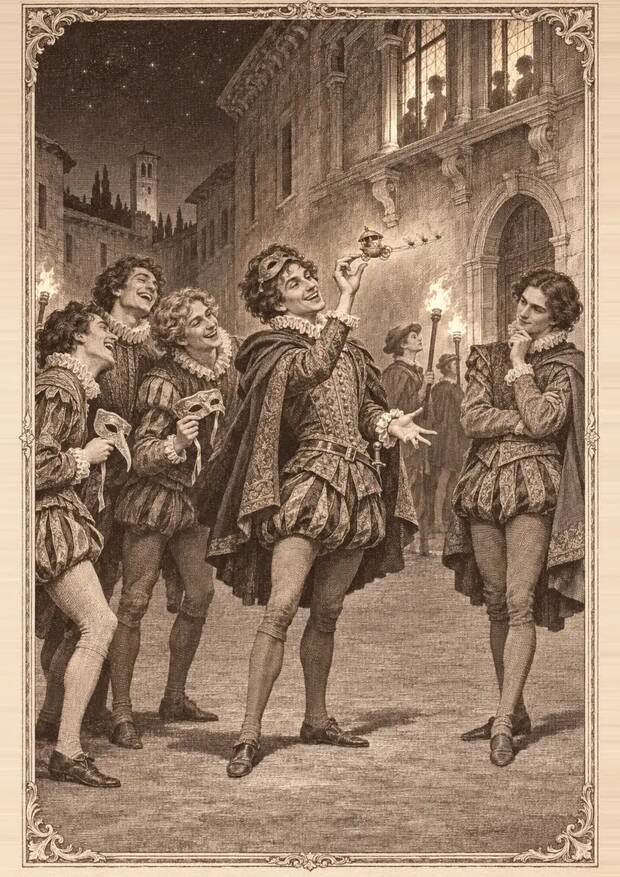
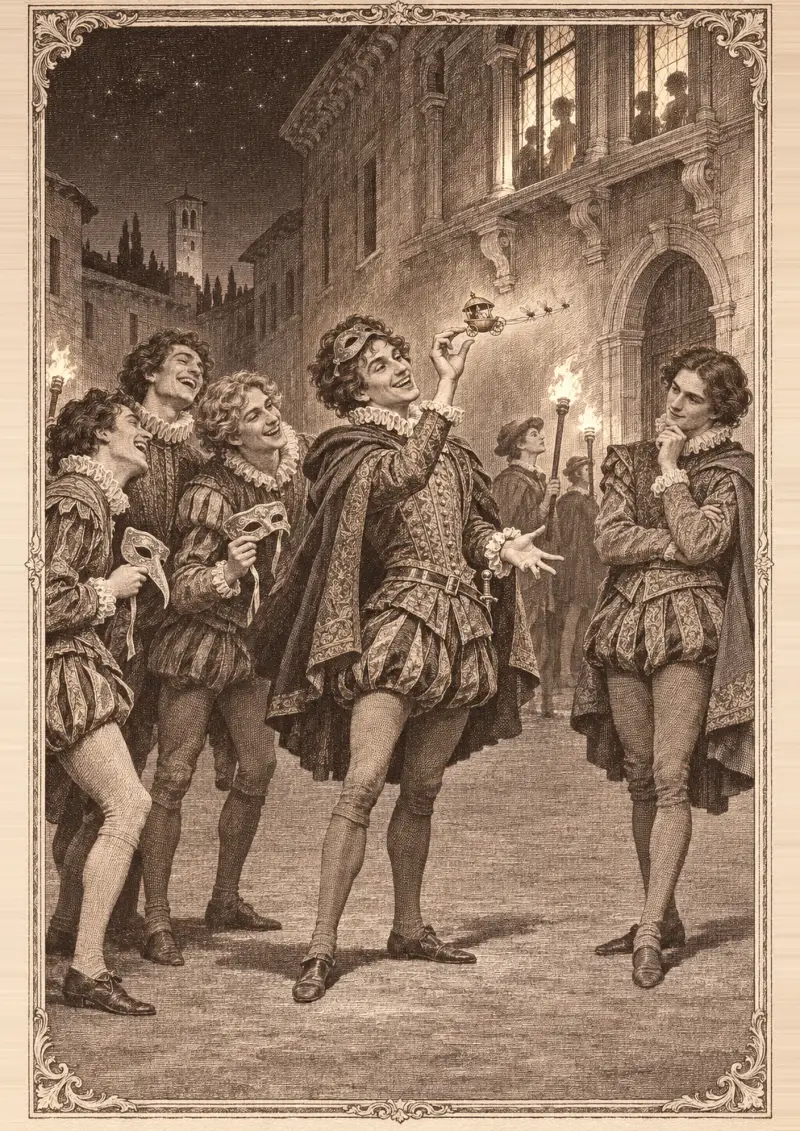
Romeo and Juliet: study questions and answers (PDF)
PDF, 17 pages, 957 KB. Free, no sign-up, made to be printed.
Use it with the Romeo and Juliet study guide and the quotation sheet (PDF).
How to use these questions
Read the act first, then cover the answers and try the questions from memory. The comprehension questions check that you know what happens, in what order and to whom. The analysis questions ask how and why Shakespeare does it, and their answers are short models of the kind of paragraph an essay needs: a point, a quotation, a method and its effect. The essay questions at the end come with outline answers that you can expand into full essays.
Where a question has more than one defensible answer, the answer says so. For background on context, themes and form, use the Romeo and Juliet study guide. To learn the quotations used here, print the quotation sheet.
Act 1
Comprehension
What does the Prologue tell the audience before the story begins?
That two Verona families of equal rank are locked in an ancient grudge
, that A pair of star-crossed lovers
will be born to them and die, and that only those deaths will bury their parents’ strife
. The Chorus gives away the ending in the form of a sonnet, so the audience watches to find out how and why, not what.
How does the street fight in Act 1, Scene 1 begin, and how does the Prince end it?
The Capulet servants Sampson and Gregory pick a quarrel with two Montague servants; Sampson bites his thumb at them. Benvolio tries to part them, Tybalt attacks Benvolio, and citizens and both old fathers join in. Prince Escalus stops it. This is the third such brawl, so he tells Capulet and Montague that next time Your lives shall pay the forfeit of the peace
.
Why is Romeo unhappy when we first meet him?
He loves Rosaline, who does not love him back and has vowed to stay chaste: She hath forsworn to love
. He has been walking alone before dawn and shutting himself in his room by day. Benvolio advises him to Examine other beauties
. Romeo replies that this would only remind him how beautiful Rosaline is.
What does Capulet say to Paris about marrying Juliet, and how does Romeo come to be at the Capulet feast?
In Scene 2 Capulet says that Juliet is not yet fourteen. He asks Paris to wait two more summers and to win her heart first: My will to her consent is but a part
. The servant sent out with the guest list for that night’s feast cannot read and asks Romeo for help. Rosaline’s name is on the list, so Benvolio persuades Romeo to go.
What happens when Romeo and Juliet meet in Act 1, Scene 5?
Romeo sees Juliet across the room and forgets Rosaline: Did my heart love till now?
Tybalt recognises his voice and sends for his rapier, but Capulet forbids a fight in his house. Romeo takes Juliet’s hand, they talk, and they kiss twice. Only afterwards does each learn from the Nurse who the other is.
Analysis
How does Shakespeare present the feud in the opening scene?
As a habit that nobody can explain. It starts among servants, in prose, with puns that join fighting to sex: Sampson boasts that he will thrust his maids to the wall
. Violence and male swagger are linked from the first minute. The fight then climbs the social ladder, from servants to Tybalt to the two old men. Capulet calls for his long sword
and his wife tells him he needs A crutch
. The joke has a point: the feud is kept alive by men too old to fight it. The Prince’s phrase bred of an airy word
confirms that the cause is nothing at all. Shakespeare shows a whole city infected before he shows a single lover. See quotes about conflict.
How does Shakespeare present Romeo’s love for Rosaline?
As a performance of love learned from poetry. Romeo speaks in oxymorons (contradictory terms yoked together): Feather of lead, bright smoke, cold fire, sick health
. The list is clever and empty. Any lover in any sonnet of the period could have said it, and Rosaline herself never speaks in the play. His love is also solitary: he shuts out the daylight to make what his father calls an artificial night
. Shakespeare builds this pose so that the audience can measure the change when Romeo meets Juliet, whose first act is to answer him. The Friar later delivers the verdict on the Rosaline phase: his love did read by rote
, reciting what it could not yet understand.
Why does Shakespeare write the lovers’ first conversation as a sonnet?
The fourteen lines that begin If I profane with my unworthiest hand
rhyme as a sonnet, the standard form of Elizabethan love poetry, but here the form is shared. Romeo speaks the first quatrain (a four-line unit), Juliet the second, and they divide the rest, each giving one line of the final couplet. In the poetry Romeo has been imitating, the lady is silent. Juliet answers, matches his rhymes and steers his conceit (an extended comparison) of pilgrim and saint: palm to palm is holy palmers’ kiss
. The religious imagery makes desire sound like devotion, and the shared form shows two minds meeting as equals. Her dry comment You kiss by th’ book
adds teasing: she can see the convention he is using.
Act 2
Comprehension
What does Romeo overhear from the orchard in Act 2, Scene 2?
Juliet, at her window and believing herself alone, says that only Romeo’s name is her enemy. She wishes he would Deny thy father and refuse thy name
, and says that if he will swear his love she will stop being a Capulet. Romeo steps forward and answers her. She has therefore confessed her love before any courtship has taken place.
Who first raises marriage, and what do the lovers arrange?
Juliet does. She tells Romeo that if his bent of love be honorable
and his purpose marriage
, he should send her word the next day of where and when the ceremony will be. She will send a messenger to him, and they fix the time: nine o’clock. If he does not mean marriage, she asks him to leave her alone.
Why does Friar Lawrence agree to marry them?
Not because he trusts Romeo’s feelings. He is shocked at how fast Rosaline has been dropped: Young men’s love then lies / Not truly in their hearts, but in their eyes
. He agrees In one respect
only: he hopes the marriage will turn your households’ rancor to pure love
. His motive is to end the feud.
What do we learn about Tybalt in Act 2, Scene 4, and what message does Romeo give the Nurse?
Tybalt has sent a letter to Montague’s house, which Mercutio takes to be a challenge to Romeo. Romeo then tells the Nurse that Juliet must find a reason to come to Friar Lawrence’s cell that afternoon, where she will be shrived and married
. His servant will bring a rope ladder so that he can reach her room that night.
What happens in Act 2, Scene 6?
Romeo waits at the cell with the Friar, who warns him to love moderately
. Juliet arrives, the lovers greet each other, and the Friar hurries them away to be married. The ceremony itself is not shown on stage. It takes place on the afternoon after the night they met.
Analysis
How does Shakespeare present Juliet in the orchard scene?
As the more practical and the more honest of the two. Romeo reaches for hyperbole (deliberate exaggeration); Juliet asks questions about how he got in and who might see him. She stops his vow by th’ inconstant moon
, a poor witness to constancy, and she gives up the expected game of pretending reluctance: farewell compliment
. She is also the one who names the risk. Their contract is too rash, too unadvised, too sudden
, Too like the lightning
, a brightness gone before it can be named. Yet she proposes marriage a few lines later. Shakespeare gives her the clearest sight of the danger and the will to act anyway, so her love reads as a choice. Our essay on “What’s in a name?” follows her reasoning closely.
How does Friar Lawrence’s first speech prepare the audience for the tragedy?
He enters gathering herbs and reasoning, in rhyming couplets, that every natural thing holds opposite powers. In one small flower Poison hath residence and medicine power
. He then applies the idea to people, in whom grace and rude will
camp like rival kings. The speech states the play’s governing principle: good things, wrongly used, destroy. Virtue itself turns vice, being misapplied
describes in advance what will happen to love, to the Friar’s own good intentions and to his potion. The speech also establishes his skill with drugs, so the sleeping draught of Act 4 does not arrive from nowhere. Romeo walks on just before the Friar holds up the poisonous flower, a quiet piece of foreshadowing (a hint of what is to come).
How does Shakespeare create a sense of haste in Act 2?
Through clocks, messengers and impatient verse. The whole act covers less than a day, from the orchard at night to a wedding the next afternoon. Romeo tells the Friar I stand on sudden haste
. Juliet, waiting three hours for the Nurse, complains that Love’s heralds should be thoughts
and that old people are Unwieldy, slow, heavy, and pale as lead
. The adjectives drag, as the Nurse does. Against this the Friar sets a proverb, Wisely and slow. They stumble that run fast
, and then abandons it, promising in Scene 6 that we will make short work
. The young measure time in minutes; the old advise delay and then give way. See quotes about time.
Act 3
Comprehension
Why does Romeo refuse to fight Tybalt, and what happens as a result?
Romeo has just married Juliet, so Tybalt is now his kinsman. He says he values the name Capulet As dearly as mine own
, but cannot explain why. Mercutio, disgusted by this vile submission
, fights Tybalt himself. Romeo steps between them and Tybalt stabs Mercutio under Romeo’s arm. Mercutio is helped away and dies offstage. When Tybalt returns, Romeo kills him and runs.
What sentence does the Prince pass on Romeo?
Banishment, not death. Benvolio reports that Tybalt killed Mercutio first, and Montague argues that Romeo only did what the law would have done. The Prince, whose own kinsman Mercutio is dead, exiles Romeo immediately, promises both families a heavy fine, and warns that if Romeo is found in Verona that hour is his last
.
How does Juliet hear the news, and how does she react?
From the Nurse, whose wailing of he’s dead
first makes Juliet think that Romeo has been killed. When she learns that Romeo has killed Tybalt she turns on him for a moment: O serpent heart hid with a flow’ring face
. Then she rebukes herself and takes her husband’s side. The word that destroys her is banished
. The Nurse goes to find Romeo, taking Juliet’s ring.
What happens in Friar Lawrence’s cell in Act 3, Scene 3?
Romeo, in hiding, says that exile is worse than death and throws himself to the ground. When the Nurse describes Juliet’s grief he draws his dagger to kill himself. The Friar stops him and gives him a plan: spend the night with Juliet, leave for Mantua before daybreak, and wait there until the marriage can be made public and the Prince asked for a pardon.
What does Capulet arrange in Scene 4, and who is still on Juliet’s side at the end of Scene 5?
Capulet promises Juliet to Paris and sets the wedding for Thursday without consulting her. When she refuses, he threatens to disown her. Her mother says I have done with thee
. The Nurse advises her to marry Paris, since Romeo cannot come back. Juliet decides never to confide in the Nurse again. Only the Friar is left, and beyond him one last resource: myself have power to die
.
Analysis
Why is Act 3, Scene 1 the turning point of the play?
Because it turns a private love story into a public disaster, and comedy into tragedy. Until now the play has had the ingredients of comedy: masks, a feast, a secret wedding. Then its wittiest character dies in the middle of a joke, in prose: Ask for me tomorrow, and you shall find me a grave man
. The pun is funny and literally true. Romeo’s reaction shows the code of honour reclaiming him. He blames Juliet’s beauty for making him effeminate
and calls on fire-eyed fury
. The man who answered Tybalt with love now speaks Tybalt’s language. His cry O, I am Fortune’s fool
blames chance, but the audience has just watched him choose. Every later scene deals with the consequences. See our analysis of Mercutio.
How does Shakespeare present Capulet in Act 3, Scene 5?
As a father whose affection depends on obedience. He enters comparing his weeping daughter, tenderly, to a ship in a storm. Her refusal turns him at once to abuse: green-sickness carrion
, baggage
, tallow face
. The insults reduce her to a sick body and to goods. His verse breaks into commands, Speak not; reply not; do not answer me
, and the threat is spelled out in monosyllables that land like blows: hang, beg, starve, die in the streets
. In Act 1, Scene 2 he said that his will was but a part
of her consent. He is no simple monster. He protests that his constant care hath been / To have her matched
, and he means it, which is what disturbs: he believes he is being kind.
How does Shakespeare use the dawn in Act 3, Scene 5?
The lovers’ only night together ends in an argument about a bird. Juliet insists it was the nightingale, and not the lark
. When Romeo agrees to stay and be caught, Come death and welcome. Juliet wills it so
, she is the one who faces facts: It is, it is. Hie hence, begone, away
. The scene is an aubade (a dawn song of parting lovers), and it reverses the usual values of light and dark. Day, normally safety, now means separation. Romeo’s line More light and light, more dark and dark our woes
holds the paradox in one balanced sentence. Shakespeare adds foreshadowing: looking down, Juliet sees Romeo As one dead in the bottom of a tomb
. It is the last time they speak to each other.
Act 4
Comprehension
What happens when Juliet meets Paris at Friar Lawrence’s cell, and what does she threaten once he has gone?
Paris greets her as his wife. Juliet answers politely in one-line replies that commit her to nothing: What must be shall be
. As soon as he leaves she drops the pretence, shows the Friar a knife and says she will kill herself unless he can find a way to prevent the wedding.
What is Friar Lawrence’s plan?
Juliet is to go home and agree to marry Paris. On the night before the wedding she must sleep alone and drink the liquid in the vial he gives her. It will make her seem dead for two and forty hours
, and her family will lay her in the Capulet vault. The Friar will write to Romeo, who will be there when she wakes and take her to Mantua.
What does Capulet do when Juliet pretends to give in?
He is so pleased that he moves the wedding forward a day, from Thursday to Wednesday: I’ll have this knot knit up tomorrow morning
. Juliet must therefore take the potion that same night, a day earlier than the Friar intended. Capulet stays up all night supervising the preparations himself.
What does Juliet fear before she drinks the potion?
In Scene 3 she fears, in turn, that the potion will not work (she lays a knife beside her in case); that the Friar has given her real poison to hide his part in her marriage; that she will wake before Romeo comes and suffocate in the vault; and that she will go mad among the bones and Tybalt’s corpse. She imagines Tybalt’s ghost hunting Romeo, and drinks.
Who finds Juliet, and how does the Friar respond to the family’s grief?
The Nurse finds her on the wedding morning, and the parents and Paris lament over her. The Friar, who knows she is alive, tells them to stop: she is in heaven and better off. He directs them to carry her to the church for burial. The wedding preparations become a funeral: Our wedding cheer to a sad burial feast
.
Analysis
How does Shakespeare present Juliet’s state of mind in the potion soliloquy?
As fear mastered by will. Having sent away her mother and the Nurse, she feels a faint cold fear
and calls the Nurse back, then stops herself: My dismal scene I needs must act alone
. The theatrical metaphor is exact: a part to play and no fellow actors. The soliloquy (a speech of private thought, spoken alone) is built from questions beginning “What if”, each more vivid than the last. The syntax follows her panic: one sentence about the vault piles clause on clause, breaks off and has to start again twice. Yet she also reasons. She tests her suspicion of the Friar and rejects it, because he hath still been tried a holy man
. Courage here is not the absence of fear. It is the toast that ends the speech: I drink to thee
.
How does Shakespeare present Friar Lawrence in Act 4?
As resourceful and compromised. Faced with Juliet’s knife he improvises a kind of hope
, and admits it needs as desperate an execution
as the crisis itself. The plan avoids the one honest course, which is to tell the Capulets that Juliet is already married. It protects her from a bigamous wedding, and it also protects him. Juliet notices this herself when she wonders whether the vial is poison. In Scene 5 he comforts the family with a sermon built on what he knows to be a lie, telling them she’s best married that dies married young
. This can be read as pastoral care or as manipulation, and the text supports both. Our analysis of Friar Lawrence weighs the two readings.
How does Shakespeare join marriage and death in Act 4, Scene 5?
Capulet personifies Death (gives it human form) as the bridegroom who reached Juliet first: Death is my son-in-law; Death is my heir
. The pun in Flower as she was, deflowered by him
makes the wedding night and the death one event. This completes a pattern that began when Juliet first saw Romeo and said My grave is like to be my wedding bed
, and which her own mother continued in anger: I would the fool were married to her grave
. The dramatic irony (the audience knowing more than the characters) is sharp. Juliet is alive, so the grief is real and mistaken at once. In Act 5 the image becomes fact.
Act 5
Comprehension
What news does Balthasar bring to Mantua, and what does Romeo do?
Balthasar saw Juliet laid in the Capulet vault and rode straight to tell Romeo that she is dead. He brings no letter from the Friar. Romeo answers Then I deny you, stars
, orders horses for that night and decides to die beside her. He buys poison for forty ducats from a starving apothecary, although selling it carries the death penalty in Mantua.
Why does Friar Lawrence’s letter never reach Romeo?
Friar John, who was to carry it, went to find another friar to travel with him. That friar was visiting the sick, and the town’s health officers, suspecting plague in the house, sealed both men inside. John could neither deliver the letter nor find anyone willing to take it. Friar Lawrence sends for a crowbar and goes to the vault alone, intending to hide Juliet in his cell.
What happens between Romeo and Paris at the tomb?
Paris has come at night to lay flowers at Juliet’s tomb. He sees Romeo breaking it open, assumes he means to dishonour the bodies and tries to arrest him. Romeo begs him to leave: tempt not a desp’rate man
. Paris refuses, they fight, and Paris is killed. He asks to be laid beside Juliet, and Romeo, recognising him, does so.
How do Romeo and Juliet die?
Romeo looks at Juliet, remarks that she still seems alive, kisses her and drinks the poison. The Friar arrives just too late. Juliet wakes and asks for her husband. The Friar tells her that Romeo is dead, urges her to come away to a convent, and runs when he hears the watch. Juliet kisses Romeo’s lips in the hope of poison, then stabs herself with his dagger.
How does the play end?
The watch summons the Prince and both families. Montague reports that his wife has died of grief at Romeo’s exile. The Friar tells the whole story, and Balthasar, Paris’s page and Romeo’s letter confirm it. The Prince declares All are punished
. Capulet and Montague take hands, and each promises a gold statue of the other’s child.
Analysis
How does Shakespeare use dramatic irony in Romeo’s last speech?
Romeo describes exactly what the audience knows and draws the wrong conclusion. He sees that Beauty’s ensign yet / Is crimson in thy lips and in thy cheeks
. The military metaphor of an ensign (a flag) says that death has not captured her, and it is literally true: the potion is wearing off. He asks Why art thou yet so fair?
and answers with a fantasy that Death is amorous
and keeps her as a lover. The legal image of A dateless bargain to engrossing death
, a contract with no end date, shows how final his choice is. Shakespeare times it to the minute: the Friar enters as Romeo falls. The irony makes this death feel avoidable, and so harder to bear.
How does Shakespeare present Juliet’s death, and how does it differ from Romeo’s?
Romeo dies after a long, composed speech. Juliet has a handful of lines and no time. She refuses the Friar’s offer of a convent in plain words, for I will not away
, and is then alone for the last time. Her discovery Thy lips are warm
carries the cruelty of the timing in four monosyllables: he has only just died. Hearing the watch, she says Then I’ll be brief
and addresses the weapon: O, happy dagger, / This is thy sheath
. The word happy
means fortunate, and the metaphor makes her own body the place where the feud’s weapon finally comes to rest. His death is planned and paid for; hers is improvised with what lies to hand, the last act of a character who has had to act alone since Act 3.
Is the ending a true reconciliation?
It is open to two readings. In the hopeful one, the Prologue’s promise is kept: the deaths bury their parents’ strife
, the fathers take hands, and Capulet admits that the children were Poor sacrifices of our enmity
. In the sceptical one, the old habits survive in the language. Capulet calls the handshake my daughter’s jointure
, a marriage settlement, and Montague answers But I can give thee more
, so even grief becomes a contest in gold. The Prince’s phrase A glooming peace
will not decide between them: there is peace, and no light. What is certain is the cost. Five young people and Lady Montague are dead, and the Prince includes himself among the guilty for winking at your discords
.
Whole-text questions
Who or what is responsible for the deaths of Romeo and Juliet?
The play offers three answers and makes them work together. The first is fate: the Prologue calls the lovers star-crossed
, and chance blocks the letter. The second is the feud, which makes the marriage secret and turns a street quarrel into two killings. Mercutio’s dying curse, A plague o’ both your houses
, names it as the cause. The third is haste. Romeo kills Tybalt in fury, Capulet brings the wedding forward, the Friar gambles on a potion, and Romeo buys poison within minutes of the news. The strongest answer is that Shakespeare builds a world in which accidents are fatal because people act so fast. The undelivered letter kills only because Romeo does not wait a day. See quotes about fate.
How does Juliet change in the course of the play?
She moves from obedience to independence in about four days. In Act 1 she tells her mother I’ll look to like, if looking liking move
, promising to go no further than her parents allow. By Act 2 she is questioning what a name is and proposing marriage. Act 3 strips away her supports one at a time: Romeo is banished, her father threatens her, her mother refuses to listen and the Nurse advises bigamy. Her response is to become a careful actor, deceiving Paris and her father with words that are true in a sense they cannot hear. Alone with the potion, she says My dismal scene I needs must act alone
. Her last act is a decision taken with nobody to advise her. See our analysis of Juliet.
How does the structure of the play move from comedy to tragedy?
The first two acts follow the pattern of comedy: young lovers, parents in the way, joking friends and servants, a go-between and a wedding. The Prologue has warned us, but the mood on stage is festive. Act 3, Scene 1 breaks the pattern near the centre of the play, with the death of Mercutio, the chief source of laughter. After it the comic machinery keeps running and produces horror. A second wedding is arranged, the trick of a false death is tried, and a message goes astray. In a comedy each would end in laughter and reunion. Here the same devices kill. Shakespeare makes the audience feel how near the story was to a happy ending, which is why the last scene feels like waste and not like justice.
How does Shakespeare use light and dark imagery across the play?
The lovers see each other as light in darkness. To Romeo, Juliet doth teach the torches to burn bright
and is the sun
. To Juliet, Romeo is day in night
, and she imagines him cut out in little stars
. Because their love is secret, night protects them and daylight is the enemy. Juliet begs Come, civil night
, and at dawn Romeo says More light and light, more dark and dark our woes
. Brightness in the play is also brief, like the lightning Juliet fears or the gunpowder in the Friar’s warning. In the tomb the image returns for the last time. Juliet’s beauty makes the vault a feasting presence full of light
, and the Prince closes on a morning when the sun will not show his head
.
How does the play present the relationship between the young and the old?
As a failure of protection. Every adult who should guide the lovers lets them down. Capulet begins by respecting Juliet’s choice and ends by ordering her to church o’ Thursday
or into the street. Lady Capulet withdraws: I have done with thee
. The Nurse, for all her warmth, cannot see why a living husband in exile matters more than a rich one at hand. The Friar means well and keeps choosing secrecy over truth. Romeo’s parents never exchange a word with him on stage. The young, left without guidance they can trust, confide in no one and act at speed. In its context, a society where a father arranged his daughter’s marriage, the play does not attack parental authority outright. It shows what that authority costs when it stops listening.
What part does the code of male honour play in the tragedy?
It is the engine of the feud. From the first scene, being a man in Verona means refusing an insult: the servants fight over a bitten thumb. Tybalt lives by this code, swearing by the stock and honor of my kin
that to kill Romeo for coming to the feast would be no sin. Mercutio belongs to neither house and still cannot bear Romeo’s calm, dishonorable, vile submission
. Romeo tries to step outside the code and is pulled back in by shame, calling himself effeminate
. Love is treated as a threat to manhood, and the Friar uses the same idea when he calls Romeo’s tears womanish
. Critics who read the play in terms of gender argue that the feud is how Verona’s men prove themselves, and that the lovers die of it.
Essay questions with outline answers
“Friar Lawrence is more to blame than anyone else for the deaths of Romeo and Juliet.” How far do you agree?
Thesis: The Friar is the adult most directly involved in the catastrophe, but his errors are errors of judgement made inside a situation that the feud and the lovers’ haste created.
- Point 1: He marries them against his own advice. In Act 2, Scene 3 he calls Romeo a
young waverer
and warnsThey stumble that run fast
, yet performs the wedding that afternoon. His motive is the feud, not the couple. - Point 2: His plans depend on secrecy and luck. In Act 4, Scene 1 he chooses a potion over telling the truth, and the scheme rests on one letter. He admits it is
desperate
. - Point 3: He fails at the tomb. In Act 5, Scene 3 he leaves Juliet beside Romeo’s body with the words
I dare no longer stay
. - Counter-argument: He did not make the feud, kill Tybalt, force a second marriage or buy the poison. He alone confesses, offering his
old life
to the law, and the Prince repliesWe still have known thee for a holy man
.
Conclusion: He is guilty of bad judgement and a failure of nerve, but the play spreads the blame across a whole city: All are punished
.
“Romeo and Juliet’s love is infatuation, not true love.” How far do you agree?
Thesis: Shakespeare raises the suspicion of infatuation on purpose, then answers it by making this love different in kind from Romeo’s feelings for Rosaline: it is mutual, it changes how he speaks, and it is tested.
- Point 1: The case for infatuation is strong and the play states it. Romeo forgets Rosaline in a moment, and the Friar concludes that young men’s love lies
Not truly in their hearts, but in their eyes
. The lovers know each other for days. - Point 2: The love is mutual and spoken in a shared form. Their first exchange in Act 1, Scene 5 is a sonnet divided between them. Juliet’s
The more I give to thee, / The more I have
defines love as exchange, where Rosaline only refused. - Point 3: It survives a real test. In Act 3, Scene 2 Juliet learns that Romeo has killed her cousin and still asks
Shall I speak ill of him that is my husband?
- Counter-argument: We never see the love face ordinary time. The Friar’s
violent delights
speech suggests such intensity cannot last, and the play ends before it has to.
Conclusion: The love is real and very young at once; the tragedy is that it is never given the time that would prove which word fits better.
How important is Mercutio to the play as a whole?
Thesis: Mercutio is essential in two ways: alive, he supplies the mocking view of love that the lovers must be measured against; dead, he turns the play into a tragedy.
- Point 1: He is a foil (a contrasting character) to Romeo. In Act 1, Scene 4 he answers Romeo’s sighs with
If love be rough with you, be rough with love
, treating love as appetite. Romeo’s reply in Act 2, Scene 2,He jests at scars that never felt a wound
, marks the limit of that view. - Point 2: He shows that the code of honour reaches beyond the two families. He is the Prince’s kinsman, yet in Act 3, Scene 1 it is he who draws on Tybalt.
- Point 3: His death is the structural hinge. The jokes stop with
a grave man
, and his curse,A plague o’ both your houses
, judges the feud from outside it. - Counter-argument: He affects the plot only once, and he dies knowing nothing of Juliet. The love story could be told without him, as a much thinner play.
Conclusion: Mercutio is the play’s voice of laughter, and Shakespeare measures the tragedy by silencing it.
To what extent does the ending of Romeo and Juliet offer the audience consolation?
Thesis: The ending delivers the peace the Prologue promised and makes it feel too small for its price.
- Point 1: There is a real reconciliation. Capulet says
O brother Montague, give me thy hand
, and the feud that opened the play is over. The Prologue’s claim that the deathsbury their parents’ strife
is kept. - Point 2: The lovers are honoured. Montague promises that no figure will be valued like
true and faithful Juliet
, and the final couplet gives her name before his. - Point 3: The tone resists comfort. The Prince speaks of
A glooming peace
, the sunwill not show his head
, and his last couplet rhymeswoe
withRomeo
. - Counter-argument: The fathers still think in gold and settlements:
This is my daughter’s jointure
. The statues can be read as love finally recognised or as the old rivalry in a new form.
Conclusion: The consolation is public and civic, the loss is private and complete, and Shakespeare leaves the audience holding both.
How does Shakespeare use images of light and darkness to present the love of Romeo and Juliet?
Thesis: Light imagery presents the love as radiant and brief, and Shakespeare reverses the usual meanings of day and night to show a love that can exist only in secret.
- Point 1: Each lover is light to the other. In Act 1, Scene 5 Juliet
doth teach the torches to burn bright
, and in the orchardJuliet is the sun
. The images lift her above theenvious moon
associated with chaste Rosaline. - Point 2: Night becomes the lovers’ ally. In Act 3, Scene 2 Juliet calls on
love-performing night
and dismissesthe garish sun
. In Act 3, Scene 5 daylight means exile. - Point 3: Brightness is short-lived. Juliet compares their vow to
the lightning
, and the Friar compares passion tofire and powder
. The imagery predicts the speed of the ending. - Counter-argument: The pattern is not only ominous. In the tomb Romeo sees
a feasting presence full of light
: even there, love changes how the dark looks.
Conclusion: The imagery makes one argument throughout: this love is the brightest thing in Verona, and it burns out for that reason.
To turn any of these outlines into a full answer, use the one-page essay planner. For close work on the main characters, see our pages on Romeo and Juliet, and for quotations grouped by theme start with quotes about love.

A page of Shakespeare, every day.
This resource comes from Daily Bard, an app for iPhone and iPad. Each morning it shows one engraved plate and one passage, exactly as Shakespeare wrote it, with a plain-English reading on the back of the leaf.
Free to download. The Full Edition is a one-time US$11.99: no subscription, no account, no ads, no tracking.
Get it on the App Store: apps.apple.com/app/id6792967225
More free study guides, lesson plans and close readings: dailybard.app