
Romeo and Juliet: key quotes and analysis (PDF)
PDF, 11 pages, 842 KB. Free, no sign-up, made to be printed.
The ten core quotations for Romeo and Juliet, each with plain English, analysis and a fill-the-gap test. Or read the full study guide.
Fate in Romeo and Juliet
Romeo and Juliet argues that fate is real as a pattern but works through human haste: the stars are what the characters name at the moment they choose. The Prologue calls the lovers star-crossed
before we meet them, so the ending is never in doubt. What the play leaves open is the cause. Its characters answer with the vocabulary of destiny. Romeo fears something hanging in the stars
, calls himself Fortune’s fool
and finally defies the heavens. The Friar blames Unhappy fortune
and then a greater power
.
Shakespeare gives them some reason. Chance is busy in Verona: a servant who cannot read asks Romeo to read him the guest list, and an outbreak of plague stops a letter. Yet each accident becomes fatal only because someone is moving too fast to absorb it. Romeo kills Tybalt within minutes of Mercutio’s death. He buys poison within minutes of hearing that Juliet is dead, and never waits for the Friar’s letter. The Friar stakes two lives on one messenger.
So the useful question is not “fate or free will?” but “who talks about fate, and when?” The answer is consistent. Fate is invoked just before a rash act, as permission, or just after one, as an excuse. The one long speech about what governs human life, the Friar’s in Act 2, does not mention the stars at all.
Key quotations about fate
The ten quotations are in play order. For each, ask the same two questions: who is speaking of fate, and what are they about to do or have they just done?
The fearful passage of their death-marked love
Chorus · Prologue lines 9-11
And the continuance of their parents’ rage,
Which, but their children’s end, naught could remove
Plain English: The frightening course of their doomed love, and their parents’ continuing anger, which nothing except their children’s deaths could end.
Context: The Chorus speaks a sonnet before the action starts and gives away the whole plot, deaths included.
Methods: The compound adjective death-marked
has two senses: the love is marked out for death, and death is the mark, or target, it travels towards. Passage
makes that love a voyage, the first of the play’s images of steering and shipwreck. Then the syntax adds a second subject with a plain And
: the parents’ rage
. In the same sentence that seems to announce destiny, the Chorus names a human cause. The result is dramatic irony (the audience knowing more than the characters) for the next five acts.
In an essay: Quote this to show that even the Prologue does not blame the stars alone. Fate and the feud are bound together from the first speech.
I fear too early, for my mind misgives
Romeo · Act 1, Scene 4 1.4.113-116
Some consequence yet hanging in the stars
Shall bitterly begin his fearful date
With this night’s revels
Plain English: I fear we will arrive too early. I have a foreboding that some event, still waiting in the stars, will begin its terrible course at tonight’s party.
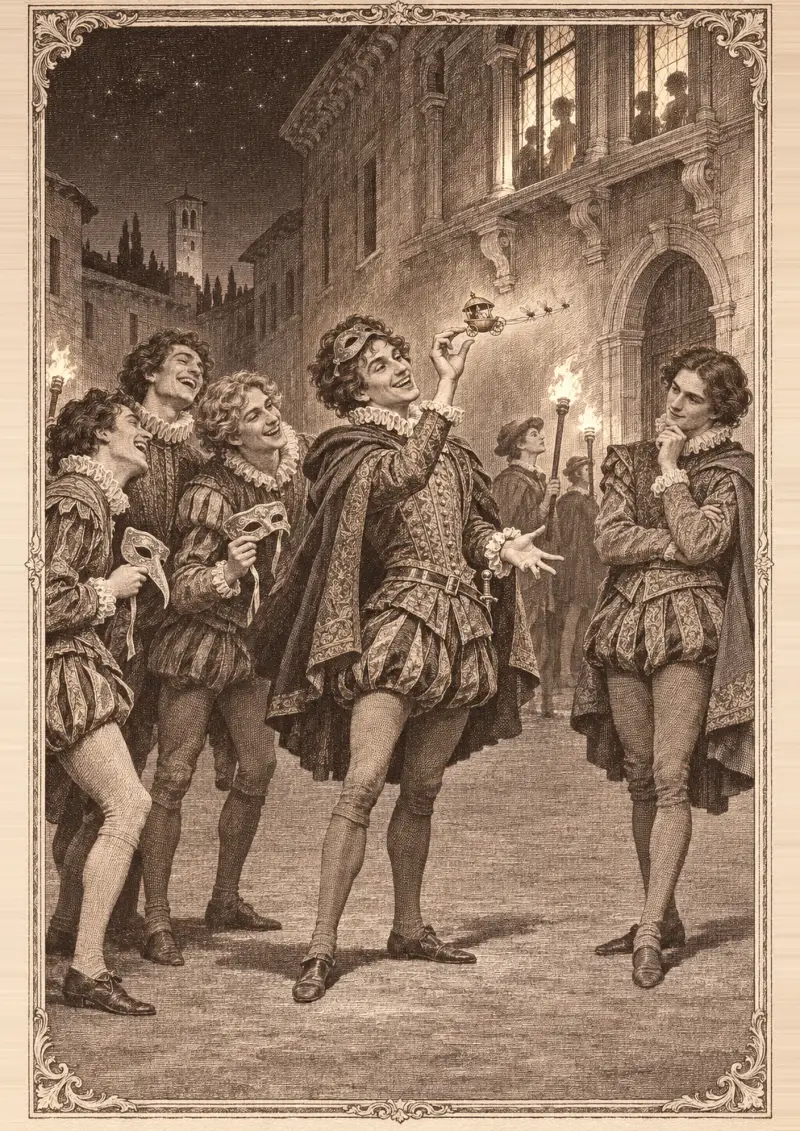
Context: Romeo and his friends are outside the Capulet house, about to go in masked. Benvolio has just said they will be late.
Methods: The participle hanging
pictures the future as something suspended overhead and ready to drop. Romeo then borrows the language of loans: date
, expire the term
, forfeit
. His life becomes a debt that will fall due. What follows matters most. He hands over the helm in a sailing metaphor, he that hath the steerage of my course / Direct my sail
, and walks in: On, lusty gentlemen
. The premonition changes nothing about what he does.
In an essay: Use it to show that belief in fate works as a way of not deciding. Romeo senses danger, gives the responsibility to someone else, and goes in anyway.
If he be married,
Juliet · Act 1, Scene 5 1.5.148-149
My grave is like to be my wedding bed.
Plain English: If he is already married, I am likely to die unmarried.
Context: The feast is ending. Juliet sends the Nurse to find out who the young man is, and says this while she waits for the answer.
Methods: Juliet means it as hyperbole (deliberate exaggeration): she would sooner die than marry anyone else. The audience, armed by the Prologue, hears a literal forecast, because her grave will be the place where she lies beside her husband. The line sets grave
against wedding bed
within ten syllables, the first of many times the play joins the two. Notice the conditional If
. She is not prophesying. Shakespeare is arranging her words so that we feel a design she cannot see.
In an essay: A good example of how fate in this play is partly an effect of structure. The sense of doom is created by what the audience already knows, not by anything supernatural on stage.
Two such opposed kings encamp them still
Friar Lawrence · Act 2, Scene 3 2.3.28-31
In man as well as herbs - grace and rude will;
And where the worser is predominant,
Full soon the canker death eats up that plant.
Plain English: Two opposed kings are always camped in people as well as in plants: goodness and crude desire. Where the worse one wins, death soon eats that plant like a grub.
Context: The Friar is alone at dawn, gathering herbs and reflecting that the same flower holds both poison and medicine. Romeo enters while he is speaking.
Methods: This is the play’s fullest statement about what rules human lives, and there are no stars in it. The Friar’s metaphor is a civil war inside each person, with grace
and rude will
as rival kings
. Destruction follows when the worse side wins, so death is a consequence of character. The rhyming couplets (pairs of rhymed lines) give the idea the ring of settled doctrine. Shakespeare times Romeo’s entrance to fall in the middle of the speech, so the lesson about rude will
acquires its example.
In an essay: This is the essential counter-quotation. Set it against star-crossed
to show that the play contains a moral explanation of the tragedy as well as an astrological one. The page on Friar Lawrence asks whether he lives by it.
This day’s black fate on more days doth depend.
Romeo · Act 3, Scene 1 3.1.124-125
This but begins the woe others must end.
Plain English: The dark fate of today hangs over days to come. This is only the start of a sorrow that later days must finish.
Context: Benvolio has just brought word that Mercutio is dead. Tybalt is about to come back on stage.
Methods: The verb depend
keeps its older sense of hanging, so the line repeats the image of Act 1: something suspended over the future. The couplet is impersonal. The woe
will be ended by others
, meaning other days, as if nobody were responsible. Then Tybalt enters and Romeo makes a choice in so many words, fire-eyed fury be my conduct now
, appointing rage as his guide. Seconds after the killing he cries O, I am Fortune’s fool!
. Fate is named before the act and after it. In between, he chooses.
In an essay: The best single moment for arguing that Romeo uses fate to disown his decisions. Quote the couplet, the choice and the cry in sequence. Our Romeo page develops the point.
O God, I have an ill-divining soul!
Juliet · Act 3, Scene 5 3.5.54-56
Methinks I see thee, now thou art so low,
As one dead in the bottom of a tomb.
Plain English: My soul foresees evil. Now that you are down there, you look to me like a dead man at the bottom of a tomb.
Context: Dawn after the wedding night. Romeo has climbed down from Juliet’s window on his way to exile, and she looks at him from above. They will not see each other alive again.
Methods: The simile grows out of the staging. Romeo is literally so low
, below her window, and Juliet turns the stage picture into an omen that the final scene will make real. Ill-divining
claims a prophetic gift, and the dramatic irony confirms it. Yet Shakespeare also supplies a natural explanation. Both are pale with grief, as Romeo says: Dry sorrow drinks our blood
. Juliet then appeals to another power, begging Fortune to Be fickle
and send him back.
In an essay: Use it to show that the lovers feel fated, and that the play lets a premonition be both true and explicable. It also pairs neatly with Romeo’s foreboding before the feast.
Is it e’en so? Then I deny you, stars!
Romeo · Act 5, Scene 1 5.1.25-27
Thou knowest my lodging. Get me ink and paper,
And hire post-horses. I will hence tonight.
Plain English: Is that how it is? Then I reject you, stars. You know where I am staying. Fetch ink and paper and hire fast horses. I leave tonight.
Context: In Mantua, Balthasar tells Romeo that Juliet lies in the Capulet vault. Romeo had woken that morning from a happy dream.
Methods: The defiance is an apostrophe (an address to something that cannot answer), and it lasts five monosyllables. The Folger text reads deny
where many editions print “defy”. What follows is a list of errands. The drop from the cosmos to ink and paper
and post-horses
shows what defying fate amounts to in practice: speed. The time word tonight
is the fatal one. Balthasar begs him to have patience
, and Romeo asks about letters from the Friar but does not wait for one.
In an essay: The central irony of the theme. Romeo believes he is rebelling against destiny, and his rush to the tomb is exactly what brings the Prologue’s ending about.
Unhappy fortune! By my brotherhood,
Friar Lawrence · Act 5, Scene 2 5.2.17-20
The letter was not nice but full of charge,
Of dear import, and the neglecting it
May do much danger.
Plain English: What bad luck. I swear the letter was not trivial but full of weighty and important matter, and the failure to deliver it may cause great harm.
Context: Friar John returns with the letter undelivered. He was shut in a house suspected of plague and could not get to Mantua or find a messenger.
Methods: This is chance at its purest, and the Friar’s first words call it fortune
, where Unhappy
means unlucky. Within three lines the vocabulary shifts to responsibility: neglecting
is a human failing. Shakespeare keeps the scene short and plain, with no imagery to soften it, so the audience sees how thin the plan was. An accident did stop the letter. A judgement left everything hanging on it.
In an essay: Use it for the strongest case that fate rules the play, then turn it. The quarantine is bad luck, but a plan with one letter and no second messenger is a decision.
O, here
Romeo · Act 5, Scene 3 5.3.109-112
Will I set up my everlasting rest
And shake the yoke of inauspicious stars
From this world-wearied flesh!
Plain English: Here I will stay for ever, and shake off the burden of unlucky stars from this body that is tired of the world.
Context: Romeo is in the tomb beside Juliet, holding the poison. She will wake shortly after he drinks it.
Methods: A yoke
is the wooden frame that harnesses an ox, so Romeo pictures the stars as a weight he has pulled all his life and suicide as slipping free. The adjective inauspicious
answers the Prologue’s star-crossed
, and the irony is complete: the act of escape is the fated end. He then finishes the sailing metaphor from Act 1. There he asked another to direct his sail. Now he orders a desperate pilot
to run his seasick weary bark
on the rocks.
In an essay: Use it to show Romeo’s belief in fate hardening into the cause of his death. Link yoke
back to hanging in the stars
to show how carefully the idea is tracked across the play.
A greater power than we can contradict
Friar Lawrence · Act 5, Scene 3 5.3.158-159
Hath thwarted our intents. Come, come away.
Plain English: A power too great for us to oppose has wrecked our plans. Come away, quickly.
Context: Juliet wakes in the tomb and asks for her husband. The Friar, who has arrived too late, hears the watch approaching.
Methods: The phrase greater power
is carefully vague. It could mean God, fortune or the stars, and the Friar does not say. What the vagueness achieves is to move the blame upwards, away from our intents
. The half-line that follows is a hurried imperative, and within a few lines he admits I dare no longer stay
and leaves her alone with the body. A moment earlier he had called the time itself guilty
. Talk of higher powers comes from the man with most to answer for, as he runs.
In an essay: A quotation that complicates the fate reading from the inside. The claim that heaven did it is put in the mouth of a character whose own choices we have watched fail.
How the theme develops
| Where | What happens to the theme | Quotation to know |
|---|---|---|
| Prologue and Act 1 | The ending is announced, and the characters’ forebodings echo it. Chance brings Romeo to the feast. | hanging in the stars |
| Act 2 | Fate goes quiet while the lovers make their own vows. The Friar offers a rival account in which will, not the stars, destroys people. | grace and rude will |
| Act 3 | Fate returns the instant blood is shed. Romeo blames Fortune for a killing he chose, and Juliet foresees a tomb. | O, I am Fortune’s fool! |
| Act 4 | Human planning tries to outwit events. Everything is made to depend on a potion and a letter. | Shall Romeo by my letters know our drift |
| Act 5 | Chance stops the letter, haste does the rest, and the survivors credit heaven. | Then I deny you, stars! |
The shape is a circle that the characters cannot see. The Prologue states the end, and each attempt to resist it, from the secret marriage to the potion to Romeo’s defiance, becomes a step towards it. The turn is Act 3, Scene 1, where Romeo first names fate aloud and then acts. The theme ends with the Prince’s verdict that heaven finds means to kill your joys with love
, which keeps both explanations alive: heaven did it, and it did it as a punishment for the families’ hate.
Model paragraph
Question: How far does Shakespeare present Romeo as a victim of fate?
Why it works: It answers “how far” with a clear position instead of sitting on the fence. It zooms in on single words (fool
, conduct
), links Act 3 to Act 5 to prove a pattern, and uses one sentence of context to sharpen the argument.
Practice questions
- Read Romeo’s speech in Act 1, Scene 4 beginning
I fear too early
. How does Shakespeare create a sense of foreboding here, and how does it shape the scenes that follow? - How does Shakespeare present the role of chance and accident in Romeo and Juliet?
- “The lovers are destroyed by their own haste, not by the stars.” How far do you agree?
- The Prologue tells the audience how the play ends. Discuss how this foreknowledge changes the nature of the tragedy, and whether a tragedy of fate can still hold its characters responsible.
The questions and answers page checks the plot details this argument relies on, and the study guide places fate beside the other themes. Haste is treated in full under quotes about time. For another play in which a prophecy and a choice are hard to separate, compare fate in Macbeth.