
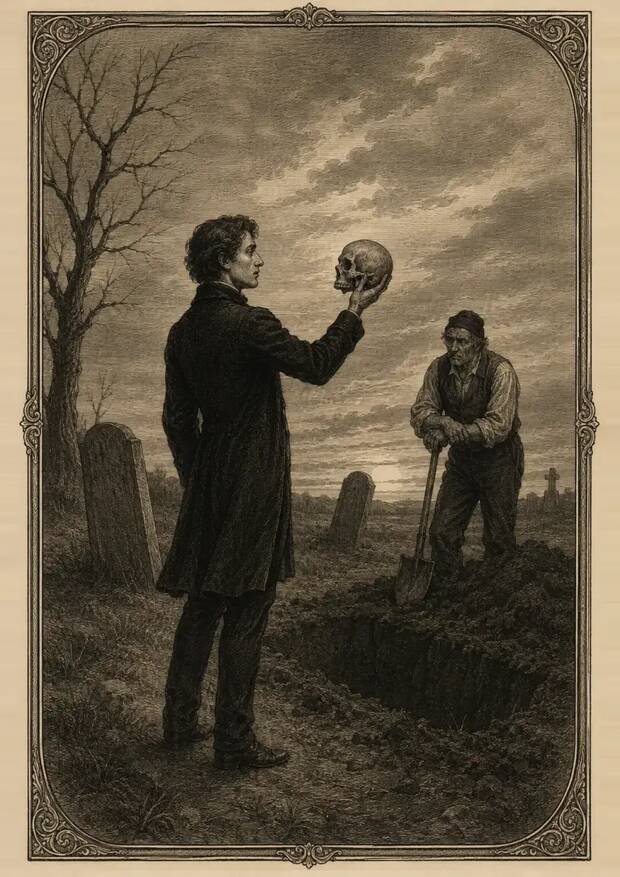
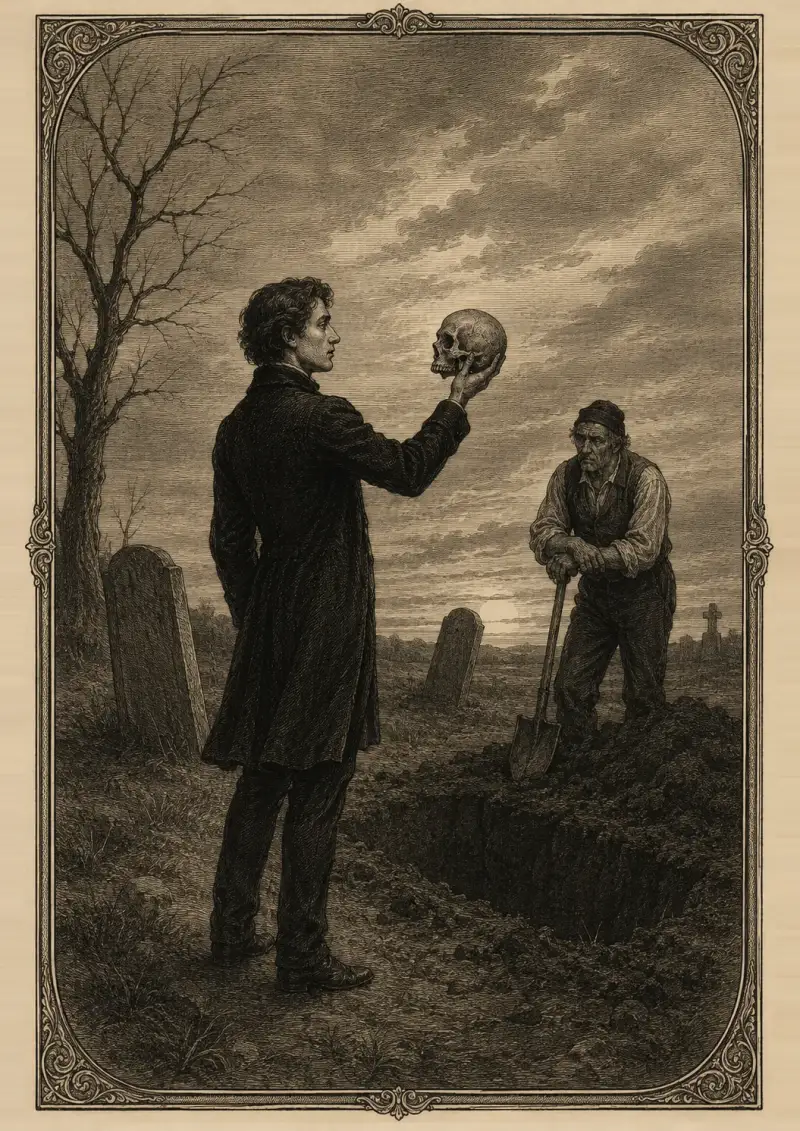
Hamlet: study cards (PDF)
PDF, 16 pages, 1.0 MB. Free, no sign-up, made to be printed.
Also for Hamlet: the study guide and the quotation sheet (PDF).
How to use the cards
Each card has one quotation from Hamlet on the front. Say who speaks it, where it comes in the play, and what it means, then turn the card to check. Mark the ones you know and the deck will skip them next time on this device; keep turning the rest until they stick.
Every card comes from the study guide and the quotes-by-theme pages, so each one links back to the full analysis. On paper, print the PDF, cut along the dashed lines and fold each strip down the middle.
The cards
-
Card 1 of 50
But I have that within which passes show,
These but the trappings and the suits of woe.Who says it, when, and what does it mean?
Card 1 of 50
Hamlet · Act 1, Scene 2
What I feel inside is beyond any outward display; black clothes are only the costume of grief.
-
Card 2 of 50
O, that this too, too sullied flesh would melt,
Thaw, and resolve itself into a dew,Who says it, when, and what does it mean?
Card 2 of 50
Hamlet · Act 1, Scene 2
I wish my stained body would simply dissolve into water and vanish.
-
Card 3 of 50
Thou know’st ’tis common; all that lives must die,
Passing through nature to eternity.Who says it, when, and what does it mean?
Card 3 of 50
Gertrude · Act 1, Scene 2
You know it is the ordinary way of things: everything that lives must die, passing through this natural life into eternity.
In an essay: This is the court’s official view: death is natural, general, and soon got over. Hamlet reaches something close to it in Act 5, but he has to earn what his mother says easily.
Quotes about death
-
Card 4 of 50
Or that the Everlasting had not fixed
His canon ’gainst self-slaughter! O God, God,
How weary, stale, flat, and unprofitable
Seem to me all the uses of this world!Who says it, when, and what does it mean?
Card 4 of 50
Hamlet · Act 1, Scene 2
Or I wish God had not set his law against suicide. O God, how tired, stale, flat and pointless all the business of this world seems to me.
In an essay: The wish to die comes before the Ghost, so it cannot be blamed on the burden of revenge. What holds him back here is a commandment; by Act 3 the barrier will have changed.
Quotes about death
-
Card 5 of 50
“Seems,” madam? Nay, it is. I know not “seems.” ...
These indeed “seem,”
For they are actions that a man might play;Who says it, when, and what does it mean?
Card 5 of 50
Hamlet · Act 1, Scene 2
“Seems”, mother? No, it is. I do not know what “seems” means. ... These outward signs really do “seem”, because they are actions that a man could act.
In an essay: This is Hamlet’s starting position: a simple moral opposition between sincerity and show. Begin here, then show how the play complicates it. The barb is aimed at the King and Queen, whose mourning was the brief performance.
Quotes about appearance and reality
-
Card 6 of 50
This above all: to thine own self be true,
And it must follow, as the night the day,
Thou canst not then be false to any man.Who says it, when, and what does it mean?
Card 6 of 50
Polonius · Act 1, Scene 3
Above all, be true to yourself, and it follows, as surely as night follows day, that you cannot then be false to anyone else.
In an essay: Students often quote this as Shakespeare’s wisdom. It is better read as a test of whether we judge words by their sound or by their speaker. In Elsinore the finest sentiments come from the least honest mouths.
Quotes about appearance and reality
-
Card 7 of 50
Something is rotten in the state of Denmark.
Who says it, when, and what does it mean?
Card 7 of 50
Marcellus · Act 1, Scene 4
There is a deep corruption in this country.
-
Card 8 of 50
And there assume some other horrible form
Which might deprive your sovereignty of reason
And draw you into madness? Think of it.Who says it, when, and what does it mean?
Card 8 of 50
Horatio · Act 1, Scene 4
What if the Ghost then takes some other terrible shape, one that could overthrow the rule of your reason and pull you into madness? Think about it.
In an essay: Real madness is established as a danger before feigned madness is ever proposed. Every later claim that Hamlet is “only acting” must be weighed against this warning from the play’s steadiest witness.
Quotes about madness
-
Card 9 of 50
The time is out of joint. O cursed spite
That ever I was born to set it right!Who says it, when, and what does it mean?
Card 9 of 50
Hamlet · Act 1, Scene 5
The age is dislocated like a bone, and it is my bad luck to be the one who has to reset it.
-
Card 10 of 50
How strange or odd some’er I bear myself
(As I perchance hereafter shall think meet
To put an antic disposition on)Who says it, when, and what does it mean?
Card 10 of 50
Hamlet · Act 1, Scene 5
However strangely or oddly I behave (since I may decide later that it suits me to put on a wild, clownish manner)
In an essay: This is the evidence that the madness begins as a choice. Qualify it at once: the idea comes to a man whose friend already finds his speech wild.
Quotes about madness
-
Card 11 of 50
Cut off, even in the blossoms of my sin,
Unhouseled, disappointed, unaneled,
No reck’ning made, but sent to my account
With all my imperfections on my head.Who says it, when, and what does it mean?
Card 11 of 50
Ghost · Act 1, Scene 5
Cut down in the full flower of my sins, without communion, unprepared, without the last anointing; no settling of accounts, but sent to judgement with all my faults upon me.
In an essay: This sets the rule for the first half of the play: how and when a person dies decides the fate of the soul. It explains the prayer scene, where Hamlet spares Claudius because he wants him killed with
no relish of salvation
in him. See revenge in Hamlet.Quotes about death
-
Card 12 of 50
If thou didst ever thy dear father love - ...
Revenge his foul and most unnatural murder.Who says it, when, and what does it mean?
Card 12 of 50
Ghost · Act 1, Scene 5
If you ever loved your dear father, avenge his foul and most unnatural murder.
In an essay: The command carries its own contradiction. Add the conditions that follow,
Taint not thy mind
andLeave her to heaven
, and you can argue that Hamlet’s delay is built into the task and is not a flaw in the man.Quotes about revenge
-
Card 13 of 50
Haste me to know ’t, that I, with wings as swift
As meditation or the thoughts of love,
May sweep to my revenge.Who says it, when, and what does it mean?
Card 13 of 50
Hamlet · Act 1, Scene 5
Tell me quickly, so that I, on wings as fast as thought or as a lover’s thoughts, can swoop to my revenge.
In an essay: The vow is sincere, and everything afterwards is measured against it. Use the imagery to show that Shakespeare has already told us what kind of avenger this will be.
Quotes about revenge
-
Card 14 of 50
O villain, villain, smiling, damned villain!
My tables - meet it is I set it down
That one may smile and smile and be a villain.Who says it, when, and what does it mean?
Card 14 of 50
Hamlet · Act 1, Scene 5
O villain, smiling, damned villain. My notebook: it is right that I write down that a person can smile and smile and still be a villain.
In an essay: From this point a face is no evidence. That creates the play’s problem of knowledge: if looks prove nothing, how can guilt be known? The answer will be the play within the play. See Claudius for the smooth public manner that Hamlet means.
Quotes about appearance and reality
-
Card 15 of 50
Your bait of falsehood take this carp of truth;
And thus do we of wisdom and of reach,
With windlasses and with assays of bias,
By indirections find directions out.Who says it, when, and what does it mean?
Card 15 of 50
Polonius · Act 2, Scene 1
Your bait of lies catches this fish of truth. That is how we men of wisdom and foresight, by roundabout approaches and curving attempts, find out the straight way by going indirectly.
In an essay: This quotation complicates the theme. The court and Hamlet use the same indirect means, so the difference between them has to lie in their ends. It is strong evidence for a question about whether Hamlet is corrupted by the world he opposes.
Quotes about appearance and reality
-
Card 16 of 50
The play’s the thing
Wherein I’ll catch the conscience of the King.Who says it, when, and what does it mean?
Card 16 of 50
Hamlet · Act 2, Scene 2
I will use the performance as a trap to expose the King’s guilt.
-
Card 17 of 50
Though this be madness, yet there is method in ’t.
Who says it, when, and what does it mean?
Card 17 of 50
Polonius · Act 2, Scene 2
This may be madness, but there is a system in it.
In an essay: Usually quoted to prove that Hamlet is sane, the line also shows how diagnosis works at court. The watcher hears sense, files it under madness and stops listening. Pair it with Laertes’s phrase for Ophelia in Act 4,
A document in madness
.Quotes about madness
-
Card 18 of 50
I am but mad north-north-west. When the wind is southerly, I know a hawk from a handsaw.
Who says it, when, and what does it mean?
Card 18 of 50
Hamlet · Act 2, Scene 2
I am only mad when the wind blows from one particular quarter. When it turns, I can tell one thing from another perfectly well.
In an essay: This is the strongest evidence for a controlled performance. Notice the risk, though: he is hinting at the truth to the King’s agents, which is either confidence or recklessness.
Quotes about madness
-
Card 19 of 50
So as a painted tyrant Pyrrhus stood
And, like a neutral to his will and matter,
Did nothing.Who says it, when, and what does it mean?
Card 19 of 50
First Player · Act 2, Scene 2
So Pyrrhus stood like a tyrant in a painting and, as if indifferent to both his purpose and his task, did nothing.
In an essay: This complicates any reading in which Hamlet simply ought to act. The decisive avenger he asks to hear about is a butcher. Shakespeare shows the pause and then the horror, and lets us ask which is worse.
Quotes about revenge
-
Card 20 of 50
That I, the son of a dear father murdered,
Prompted to my revenge by heaven and hell,
Must, like a whore, unpack my heart with wordsWho says it, when, and what does it mean?
Card 20 of 50
Hamlet · Act 2, Scene 2
That I, the son of a beloved father who was murdered, urged to my revenge by heaven and hell, must unload my heart in words like a prostitute.
In an essay: Hamlet knows what a revenge hero is supposed to sound like and cannot be one sincerely. His solution is to turn revenge into theatre: the play that will
catch the conscience of the King
. Link to appearance and reality.Quotes about revenge
-
Card 21 of 50
Is it not monstrous that this player here,
But in a fiction, in a dream of passion,
Could force his soul so to his own conceitWho says it, when, and what does it mean?
Card 21 of 50
Hamlet · Act 2, Scene 2
Is it not monstrous that this actor here, in a mere fiction, in a dream of feeling, could bend his soul so completely to his own imagination
In an essay: This is the turning point of the theme. Hamlet finds that performance has power over the real, and before the soliloquy ends he has made it a weapon, remembering that
guilty creatures sitting at a play
have been moved to confess.Quotes about appearance and reality
-
Card 22 of 50
The spirit that I have seen
May be a devil, and the devil hath power
T’ assume a pleasing shapeWho says it, when, and what does it mean?
Card 22 of 50
Hamlet · Act 2, Scene 2
The ghost I have seen may be a devil, and the devil has the power to take on an attractive form.
In an essay: Use this against the view that the delay is only an excuse. In a world where every appearance may lie, testing is the rational course. The context section of the guide explains why a Protestant prince had reason to doubt a ghost.
Quotes about appearance and reality
-
Card 23 of 50
To be or not to be - that is the question:
Whether ’tis nobler in the mind to suffer
The slings and arrows of outrageous fortune,Who says it, when, and what does it mean?
Card 23 of 50
Hamlet · Act 3, Scene 1
To live or not to live: is it nobler to endure what fortune throws at us?
-
Card 24 of 50
Now see that noble and most sovereign reason,
Like sweet bells jangled, out of time and harshWho says it, when, and what does it mean?
Card 24 of 50
Ophelia · Act 3, Scene 1
Now I see that noble, kingly mind like sweet bells rung out of tune and out of time.
In an essay: This complicates “feigned” madness: the act convinces the person who knows him best, and his cruelty to her is hard to explain as tactics. The page on Ophelia shows how this speech prepares her own breakdown.
Quotes about madness
-
Card 25 of 50
Love? His affections do not that way tend;
Nor what he spake, though it lacked form a little,
Was not like madness. There’s something in his soul
O’er which his melancholy sits on broodWho says it, when, and what does it mean?
Card 25 of 50
Claudius · Act 3, Scene 1
Love? His feelings do not lean that way. And what he said, though a little disordered, did not sound like madness. There is something in his soul that his melancholy is sitting on like a bird on its eggs.
In an essay: This is the politics of madness: the King does not believe in it, but the label licenses spying and exile. Link it to Claudius as a ruler who governs by observation.
Quotes about madness
-
Card 26 of 50
But that the dread of something after death,
The undiscovered country from whose bourn
No traveler returns, puzzles the will
And makes us rather bear those ills we have
Than fly to others that we know not of?Who says it, when, and what does it mean?
Card 26 of 50
Hamlet · Act 3, Scene 1
...if it were not that the fear of something after death, that unexplored land from whose border no traveller comes back, baffles the will and makes us put up with the troubles we have sooner than fly to others we know nothing about?
In an essay: Set this against the first soliloquy. There a law stopped him; here ignorance does. The full passage is read closely in the essay on “To be, or not to be”.
Quotes about death
-
Card 27 of 50
The harlot’s cheek beautied with plast’ring art
Is not more ugly to the thing that helps it
Than is my deed to my most painted word.Who says it, when, and what does it mean?
Card 27 of 50
Claudius · Act 3, Scene 1
A prostitute’s cheek, made beautiful with thick cosmetics, is no uglier beside the paint that covers it than my deed is beside my heavily painted words.
In an essay: The gap between seeming and being is a burden to the man who maintains it. Shakespeare refuses to make the villain a simple mask, and he lets us see behind it before Hamlet can.
Quotes about appearance and reality
-
Card 28 of 50
You would play upon me, you would seem to know my stops, you would pluck out the heart of my mystery
Who says it, when, and what does it mean?
Card 28 of 50
Hamlet · Act 3, Scene 2
You want to play on me like an instrument; you want to look as if you know which holes to cover; you want to pull out the heart of my secret.
In an essay: Hamlet claims to be unreadable while reading everyone else. That is useful for arguing that the play protects a core of reality in its hero which it never fully shows. The page on madness follows the same question.
Quotes about appearance and reality
-
Card 29 of 50
My words fly up, my thoughts remain below;
Words without thoughts never to heaven go.Who says it, when, and what does it mean?
Card 29 of 50
Claudius · Act 3, Scene 3
I said the prayer but did not mean it, and empty words do not reach heaven.
-
Card 30 of 50
Now might I do it pat, now he is a-praying,
And now I’ll do ’t. And so he goes to heaven,
And so am I revenged. That would be scanned:Who says it, when, and what does it mean?
Card 30 of 50
Hamlet · Act 3, Scene 3
I could do it neatly now, while he is praying. And now I will do it. And so he goes to heaven, and so I am revenged. That needs examining.
In an essay: Give both readings. This is the excuse of a man who cannot kill in cold blood, or it is revenge followed so far that it claims God’s right to judge a soul and becomes worse than the murder. Either way, all eight of the play’s deaths come after this chance is let go.
Quotes about revenge
-
Card 31 of 50
But ’tis not so above:
There is no shuffling; there the action lies
In his true nature, and we ourselves compelled,
Even to the teeth and forehead of our faults,
To give in evidence.Who says it, when, and what does it mean?
Card 31 of 50
Claudius · Act 3, Scene 3
But it is not like that in heaven. There no trickery works; there the case appears as it truly is, and we are forced, face to face with our own sins, to give evidence against ourselves.
In an essay: The play does have a standard of absolute truth, divine judgement, but nobody on earth has access to it. Even Hamlet, the expert in false shows, is beaten by one here. It is the best single example of appearance defeating him.
Quotes about appearance and reality
-
Card 32 of 50
It is not madness
That I have uttered. Bring me to the test,
And I the matter will reword, which madness
Would gambol from.Who says it, when, and what does it mean?
Card 32 of 50
Hamlet · Act 3, Scene 4
What I have said is not madness. Test me: I will repeat it all exactly, which a madman’s mind would skip away from.
In an essay: His firmest claim to sanity comes at his least controlled moment. Later in the scene he says he is
not in madness, / But mad in craft
. Use the pair to argue that madness is something listeners reach for when they do not want to hear an accusation.Quotes about madness
-
Card 33 of 50
Mad as the sea and wind when both contend
Which is the mightier.Who says it, when, and what does it mean?
Card 33 of 50
Gertrude · Act 4, Scene 1
As mad as the sea and the wind when they fight over which is stronger.
In an essay: Madness here is a shield. The word that Claudius uses to justify watching Hamlet, his mother uses to excuse him. State the ambiguity openly; see Gertrude for both readings.
Quotes about madness
-
Card 34 of 50
Your worm is your only emperor for diet. We fat all creatures else to fat us, and we fat ourselves for maggots. Your fat king and your lean beggar is but variable service - two dishes but to one table. That’s the end.
Who says it, when, and what does it mean?
Card 34 of 50
Hamlet · Act 4, Scene 3
The worm is the supreme emperor of eating. We fatten every other creature to fatten ourselves, and we fatten ourselves for maggots. A fat king and a thin beggar are only different courses served at the same table. That is how it ends.
In an essay: This is the turning point of the theme: for the first time death has no soul in it and no dread, only matter. Notice the coldness too. He is joking about a man he has just killed.
Quotes about death
-
Card 35 of 50
The imminent death of twenty thousand men
That for a fantasy and trick of fame
Go to their graves like bedsWho says it, when, and what does it mean?
Card 35 of 50
Hamlet · Act 4, Scene 4
The approaching death of twenty thousand men who, for an illusion and a trifle of reputation, go to their graves as calmly as to their beds.
In an essay: This complicates the idea that Hamlet grows steadily wiser about death. Here he envies men who die for nothing because they do not reflect, and Shakespeare lets us see the waste that his argument skates over.
Quotes about death
-
Card 36 of 50
Rightly to be great
Is not to stir without great argument,
But greatly to find quarrel in a straw
When honor’s at the stake.Who says it, when, and what does it mean?
Card 36 of 50
Hamlet · Act 4, Scene 4
True greatness is not a matter of waiting for a great cause before you act. It is to find a great cause for a fight even in a straw, when honour is at stake.
In an essay: Do not take this as Shakespeare’s verdict. Hamlet is arguing himself into admiring a war for nothing, and the language exposes the waste. Use it to show that revenge requires him to silence the judgement that makes him worth watching.
Quotes about revenge
-
Card 37 of 50
There’s rosemary, that’s for remembrance. Pray you, love, remember. And there is pansies, that’s for thoughts.
Who says it, when, and what does it mean?
Card 37 of 50
Ophelia · Act 4, Scene 5
Here is rosemary, which stands for remembering. Please, love, remember. And here are pansies, which stand for thoughts.
In an essay: Ophelia is Hamlet’s foil (a character whose likeness to another highlights a difference): the real madness falls on the person with the least power, and her songs say what obedience silenced. For another play in which madness speaks truth, compare madness in King Lear.
Quotes about madness
-
Card 38 of 50
To hell, allegiance! Vows, to the blackest devil!
Conscience and grace, to the profoundest pit!
I dare damnation.Who says it, when, and what does it mean?
Card 38 of 50
Laertes · Act 4, Scene 5
Loyalty can go to hell, and sworn oaths to the blackest devil. Conscience and God’s grace can go to the deepest pit. I am willing to be damned.
In an essay: Laertes is Hamlet’s foil (a character whose likeness to another highlights a difference). He shows revenge without thought, and it makes him a poisoner. Use him to argue that the play does not treat Hamlet’s hesitation as simple weakness.
Quotes about revenge
-
Card 39 of 50
Till that her garments, heavy with their drink,
Pulled the poor wretch from her melodious lay
To muddy death.Who says it, when, and what does it mean?
Card 39 of 50
Gertrude · Act 4, Scene 7
...until her clothes, heavy with the water they had drunk, dragged the poor girl down from her sweet song to a muddy death.
In an essay: Ophelia’s death is reported, not shown, and reported as a picture. The play then questions the picture: at the graveside the priest says
Her death was doubtful
. Even a death is open to interpretation. See Ophelia.Quotes about death
-
Card 40 of 50
No place indeed should murder sanctuarize;
Revenge should have no bounds.Who says it, when, and what does it mean?
Card 40 of 50
Claudius · Act 4, Scene 7
No place, indeed, should give a murderer sanctuary. Revenge should have no limits.
In an essay: Revenge can be steered. An avenger’s passion is a tool for anyone cool enough to use it, as Claudius does here. The doctrine of “no bounds” is spoken by the man it will kill, with poison
tempered by himself
.Quotes about revenge
-
Card 41 of 50
Alas, poor Yorick! I knew him, Horatio - a fellow of infinite jest,
Who says it, when, and what does it mean?
Card 41 of 50
Hamlet · Act 5, Scene 1
Poor Yorick. I knew him, Horatio: a man of endless humour.
-
Card 42 of 50
Alas, poor Yorick! I knew him, Horatio - a fellow of infinite jest, of most excellent fancy. He hath bore me on his back a thousand times, and now how abhorred in my imagination it is! My gorge rises at it.
Who says it, when, and what does it mean?
Card 42 of 50
Hamlet · Act 5, Scene 1
Poor Yorick. I knew him, Horatio: a man of endless jokes and wonderful imagination. He carried me on his back a thousand times, and now the thought of it revolts me. It turns my stomach.
In an essay: Compare Act 3. The
undiscovered country
has become an object he can hold, and dread has given way to disgust and then to dry humour. Nothing here tells him about the soul; what changes is that he can look.Quotes about death
-
Card 43 of 50
Now get you to my lady’s chamber, and tell her, let her paint an inch thick, to this favor she must come. Make her laugh at that.
Who says it, when, and what does it mean?
Card 43 of 50
Hamlet · Act 5, Scene 1
Now go to my lady’s room and tell her that even if she paints her face an inch thick, she must come to look like this in the end. Make her laugh at that.
In an essay: The argument about seeming is not won by sincerity. It is ended by mortality, the one reality no surface survives. After this scene Hamlet drops his antic manner. For the wider change, see death in Hamlet.
Quotes about appearance and reality
-
Card 44 of 50
There is a special providence in the fall of a sparrow. ... The readiness is all.
Who says it, when, and what does it mean?
Card 44 of 50
Hamlet · Act 5, Scene 2
Even a sparrow’s death is part of God’s design. What matters is to be ready.
-
Card 45 of 50
Now cracks a noble heart. Good night, sweet prince,
And flights of angels sing thee to thy rest.Who says it, when, and what does it mean?
Card 45 of 50
Horatio · Act 5, Scene 2
A noble heart breaks. Good night, dear prince; may angels sing you to your rest.
-
Card 46 of 50
Was ’t Hamlet wronged Laertes? Never Hamlet.
If Hamlet from himself be ta’en away,
And when he’s not himself does wrong Laertes,
Then Hamlet does it not; Hamlet denies it.
Who does it, then? His madness.Who says it, when, and what does it mean?
Card 46 of 50
Hamlet · Act 5, Scene 2
Was it Hamlet who wronged Laertes? Never. If Hamlet is taken out of himself, and wrongs Laertes when he is not himself, then Hamlet is not the one who does it. Hamlet denies it. Who does it, then? His madness.
In an essay: Either Hamlet lies in public, or he admits that the craft was never wholly craft. Either way, the label others fixed on him has become one he uses for himself, and madness ends as a question of who is responsible.
Quotes about madness
-
Card 47 of 50
If it be now, ’tis not to come; if it be not to come, it will be now; if it be not now, yet it will come. The readiness is all.
Who says it, when, and what does it mean?
Card 47 of 50
Hamlet · Act 5, Scene 2
If death comes now, it is not still to come; if it is not still to come, it will be now; if it is not now, it will come all the same. Being ready is everything.
In an essay: This can be read as Christian trust or as tired fatalism, and the short flat sentences support both. Either way, he has given up arranging the hour of a death, which is what he tried to do to Claudius in the prayer scene.
Quotes about death
-
Card 48 of 50
Had I but time (as this fell sergeant, Death,
Is strict in his arrest), O, I could tell you -
But let it be.Who says it, when, and what does it mean?
Card 48 of 50
Hamlet · Act 5, Scene 2
If I only had time (but this cruel officer, Death, is strict when he makes an arrest), oh, I could tell you... But let it go.
In an essay: At the end Hamlet’s concern is his story, not his soul: he fears
a wounded name
and tells Horatio toreport me and my cause aright
. Use this to argue that the play’s final answer to death is memory, which is where it began with the Ghost’sremember me
.Quotes about death
-
Card 49 of 50
He that hath killed my king and whored my mother,
Popped in between th’ election and my hopes,
Thrown out his angle for my proper life,
And with such cozenage - is ’t not perfect conscience
To quit him with this arm?Who says it, when, and what does it mean?
Card 49 of 50
Hamlet · Act 5, Scene 2
This man who killed my king and made a whore of my mother, slipped in between the election and my hopes of the crown, and cast his hook for my own life with such trickery: is it not perfectly good conscience to pay him back with this arm?
In an essay: Revenge has been reframed as justice, even as duty, for he asks whether it is not
to be damned / To let this canker of our nature come / In further evil
. Argue that Hamlet can act only once his conscience has changed sides.Quotes about revenge
-
Card 50 of 50
Exchange forgiveness with me, noble Hamlet.
Mine and my father’s death come not upon thee,
Nor thine on me.Who says it, when, and what does it mean?
Card 50 of 50
Laertes · Act 5, Scene 2
Let us forgive each other, noble Hamlet. May my death and my father’s not be laid to your charge, nor yours to mine.
In an essay: The play’s last exchange between avengers is a release, not a triumph. Notice too that when Hamlet kills the King he cries
Follow my mother
and does not mention his father. The revenge the Ghost ordered happens almost by accident.Quotes about revenge
Next steps
When the deck is easy, write with it: take three cards and turn them into a paragraph with the essay planner, or test yourself on the quotation sheet and the questions and answers. For one passage a day without trying, Daily Bard puts a quotation and its plain-English reading on your phone each morning.
A page of Shakespeare, every day.
This resource comes from Daily Bard, an app for iPhone and iPad. Each morning it shows one engraved plate and one passage, exactly as Shakespeare wrote it, with a plain-English reading on the back of the leaf.
Free to download. The Full Edition is a one-time US$11.99: no subscription, no account, no ads, no tracking.
Get it on the App Store: apps.apple.com/app/id6792967225
More free study guides, lesson plans and close readings: dailybard.app