
Hamlet: study questions and answers (PDF)
PDF, 17 pages, 919 KB. Free, no sign-up, made to be printed.
Use it with the Hamlet study guide and the quotation sheet (PDF).
How to use these questions
Read the act first, then cover the answers and try each question from memory. The comprehension questions check that you know what happens and in which scene. The analysis questions ask how and why, and their answers are short models of the paragraph an essay needs: a point, a quotation, a method and its effect. Hamlet is a play of open questions, so where the text does not settle something, the answer says so and gives the strongest readings. Every quotation is exact to the Folger text. For context, themes and critics, use the Hamlet study guide, and keep the Hamlet quotation sheet beside you for the lines worth memorising.
Act 1
Comprehension
What do the sentries and Horatio see on the battlements, and what does Horatio think it means?
In Scene 1 a ghost in the armour of the late King Hamlet appears twice to Barnardo, Marcellus and Horatio. The sentries have seen it on two earlier nights; Horatio, a sceptical scholar, came to test their story. It will not speak and vanishes when the cock crows. Horatio takes it as an omen: This bodes some strange eruption to our state.
They agree to tell young Hamlet.
Why is Denmark preparing for war?
Horatio explains in Scene 1. Old King Hamlet killed old Fortinbras, King of Norway, in single combat and won lands that had been staked on the fight. Young Fortinbras, the dead man’s son, has now raised a force of lawless resolutes
to take those lands back. In Scene 2 Claudius answers by sending two ambassadors to Fortinbras’s uncle, the sick King of Norway, asking him to stop his nephew.
What has changed at the Danish court since King Hamlet died?
The King’s brother Claudius has taken the throne and married the widowed Queen Gertrude. It has happened fast: Hamlet says his father is But two months dead
, or less, and that his mother remarried within a month
. In Scene 2 Claudius allows Laertes to return to France but asks Hamlet not to go back to university in Wittenberg. Hamlet agrees to stay at his mother’s request.
What advice do Laertes and Polonius give Ophelia about Hamlet?
In Scene 3 Laertes warns his sister that Hamlet’s love is a toy in blood
, a passing fancy, and that a prince cannot choose his own wife, so she must guard her honour. Polonius is harsher. He calls Hamlet’s vows springes to catch woodcocks
(traps for foolish birds) and forbids her to talk with him again. She answers, I shall obey, my lord.
What does the Ghost tell Hamlet, and what does it command?
In Scene 5 the Ghost says it is his father’s spirit and that the story of a snake bite is false. Claudius poured poison into his ears as he slept in his orchard: The serpent that did sting thy father’s life / Now wears his crown.
He died with his sins unconfessed. The Ghost commands Hamlet to revenge the murder but not to harm his mother: Leave her to heaven
. Its last words are Remember me.
What does Hamlet make Horatio and Marcellus swear at the end of the act?
He makes them swear on his sword never to speak of what they have seen that night. He adds a second condition: if he later chooses to put an antic disposition on
, that is, to behave like a madman, they must not hint by word or gesture that they know the reason. The Ghost’s voice cries Swear
from under the stage. At this point Hamlet does not tell them what the Ghost said.
Analysis
How does Shakespeare present Claudius in his first speech (Act 1, Scene 2)?
Claudius is presented as a skilled public speaker whose smoothness is itself suspicious. He describes his marriage in a string of balanced contradictions: With mirth in funeral and with dirge in marriage
. The antithesis (opposed ideas set in balance) makes a shocking fact sound like good judgement, and the long sentence delays its verb so that Taken to wife
slips by. He uses the royal “we” and reminds the council that they agreed to everything. He then handles Norway, Laertes and Hamlet in turn, which shows real competence. The audience hears a capable king. Three scenes later the Ghost tells us what the fine language covers.
What does Hamlet’s first soliloquy reveal about his state of mind?
It reveals a despair that comes before any knowledge of murder. Hamlet wishes his sullied flesh
would melt and regrets that God forbids suicide. The world seems weary, stale, flat, and unprofitable
, a list of four adjectives that drains value from everything, and Denmark is an unweeded garden
, an image of neglect and rot that the play will develop. The cause is his mother. His syntax breaks into exclamations and brackets whenever he reaches her remarriage, and he generalises wildly: frailty, thy name is woman
. The speech ends in enforced silence, I must hold my tongue
, so his grief has nowhere to go.
How does Shakespeare make the Ghost ambiguous?
Shakespeare lets us believe the Ghost and doubt it at once. Four people see it, so it is not Hamlet’s fantasy, and its account of the murder is detailed. But Hamlet’s first words to it list two possibilities, a spirit of health or goblin damned
, and Horatio fears it may lead him to a cliff and draw you into madness
. It says it is confined to fast in fires
until its sins are burnt away, which describes purgatory, a doctrine Protestant England had rejected. And it comes from a place of penance to demand revenge, which the Church forbade. Hamlet calls it an honest ghost
, but by Act 2 he fears it May be a devil
.
Act 2
Comprehension
What task does Polonius give Reynaldo?
In Scene 1 Polonius sends his servant to Paris with money and letters for Laertes, and with orders to spy on him. Reynaldo is to hint to Laertes’s acquaintances that the young man gambles, drinks and visits brothels, and see whether they confirm it: Your bait of falsehood take this carp of truth
. The scene shows Polonius’s habit of working By indirections
before he applies it to Hamlet.
What does Ophelia report to her father, and what does he conclude?
She says Hamlet came into her room with his clothes in disorder, pale and silent, took her by the wrist, studied her face for a long time, sighed and left, still looking back at her. She has refused his letters and visits as ordered. Polonius decides this is the very ecstasy of love
: Hamlet has been driven mad by her rejection. He takes the news straight to the King.
Why are Rosencrantz and Guildenstern at court, and how does Hamlet find out?
They are old schoolfellows of Hamlet. In Scene 2 the King and Queen ask them to spend time with him and discover what is troubling him. Hamlet greets them warmly, grows suspicious, and presses them until Guildenstern admits, My lord, we were sent for.
From then on he treats them as the King’s agents.
What news do the ambassadors bring back from Norway?
Voltemand reports success. The old King of Norway found that his nephew’s army was aimed at Denmark, rebuked him, and made him vow never to attack. Fortinbras has been given an annual allowance and permission to use the same soldiers against Poland. Norway asks that the army be allowed to march through Denmark on its way. This is why Hamlet meets it in Act 4.
What plan does Hamlet form at the end of the act?
A company of travelling actors has arrived. Hamlet asks them to perform a play called “The Murder of Gonzago” the next night, with a speech of some dozen or sixteen lines
that he will write and insert. The plot resembles his father’s murder, and he will watch Claudius’s face: The play’s the thing / Wherein I’ll catch the conscience of the King.
He wants proof because the Ghost May be a devil
.
Analysis
How does Shakespeare present Polonius in Act 2?
Polonius is comic on the surface and troubling underneath. He announces that brevity is the soul of wit
in the middle of a speech so long-winded that the Queen cuts in with More matter with less art
. The irony makes him a figure of fun. But what he does is not funny. He sets a spy on his own son, reads his daughter’s love letter aloud to the King and Queen, and proposes to use her as bait: I’ll loose my daughter to him
. The verb treats Ophelia as an animal let off a leash. Shakespeare uses him to show a court in which spying is ordinary and family feeling comes second to the King’s favour.
How does Hamlet use his “antic disposition” in his conversation with Polonius?
Hamlet uses madness as cover for insult and for truth. He speaks prose, the form the play gives to his feigned madness, and calls Polonius a fishmonger
, a jibe that may suggest a man who sells his daughter. Asked what he is reading, he replies Words, words, words
, which mocks a counsellor who deals in little else. The answers seem random but all strike home, and Polonius half sees it: Though this be madness, yet there is method in ’t.
One moment sounds unperformed. When Polonius takes his leave, Hamlet says there is nothing he would more willingly part with, except my life
, three times. The repetition lets real despair show through the act.
What does the soliloquy “O, what a rogue and peasant slave am I” show about Hamlet?
It shows a man who judges himself harshly for feeling without acting. An actor has wept for Hecuba, a character in a story, and Hamlet asks what the player would do with the motive and the cue for passion
that he himself has. Both nouns are theatrical: he measures his real grief against a performance and finds it wanting. He calls himself pigeon-livered
, works up a rage against Claudius, then stops in disgust at having to unpack my heart with words
. The structure moves from self-abuse to a plan, marked by the turn About, my brains!
Whether the plan is prudence or another delay is the question the speech leaves open.
Act 3
Comprehension
How is the meeting between Hamlet and Ophelia in Scene 1 arranged, and what does Claudius conclude from it?
Polonius places Ophelia where Hamlet will walk, with a prayer book to explain her being alone, while he and Claudius hide as lawful espials
. Gertrude is sent away. Ophelia returns Hamlet’s gifts; he denies giving them, says he loved her once and then that he did not, and tells her to go to a nunnery. Claudius decides the cause is neither love nor real madness, and resolves that Hamlet shall with speed to England
.
What happens when the play is performed in Scene 2?
Hamlet asks Horatio to watch the King. The actors first mime the plot in a dumb show, then speak it. A Player Queen swears never to remarry. A character called Lucianus, nephew to the king
, pours poison in the sleeping Player King’s ears. Claudius rises, calls Give me some light. Away!
and leaves, and the court follows. Hamlet is triumphant: I’ll take the ghost’s word for a thousand pound.
Why does Hamlet not kill Claudius in Scene 3?
Hamlet finds Claudius kneeling, apparently at prayer, and draws his sword. He stops because a man killed while praying would go to heaven, which would be hire and salary, not revenge
. His own father died with his sins unforgiven. Hamlet decides to wait until Claudius is drunk, angry or in bed, doing something with no relish of salvation in ’t
, so that his soul will be damned. After he leaves, Claudius admits that he could not pray.
How does Polonius die?
In Scene 4 Polonius hides behind the arras (a wall hanging) in Gertrude’s private room to overhear her talk with Hamlet. Hamlet is so fierce that she cries for help, and Polonius calls out too. Hamlet stabs through the hanging, crying How now, a rat? Dead for a ducat, dead.
He hopes it is the King. Finding Polonius, he says, I took thee for thy better
, and later drags the body away.
Why does the Ghost appear in Gertrude’s room, and what does Gertrude see?
The Ghost enters while Hamlet is raging at his mother. It says it has come to whet thy almost blunted purpose
, to sharpen a resolve that has grown dull, and tells him to comfort Gertrude. Unlike the soldiers in Act 1, Gertrude sees and hears nothing. She watches her son talk to empty air and concludes, This is the very coinage of your brain.
Analysis
What is Hamlet arguing in “To be or not to be” (Act 3, Scene 1)?
He argues that people endure life only because they fear what follows death. The speech is general: it uses infinitives and “we”, never “I”, and does not mention Claudius or revenge. Death is first made gentle through the metaphor of sleep, To die, to sleep
, until the thought of dreams interrupts: perchance to dream
. The afterlife is The undiscovered country
, an image of a land with no returning travellers. The conclusion is Thus conscience does make cowards of us all
, where conscience means both moral sense and reflection itself. Thought, Hamlet says, stops action. He does not apply this to himself, but the audience does. The full essay on the soliloquy reads it line by line.
How does Shakespeare present Claudius’s attempt to pray (Act 3, Scene 3)?
Shakespeare gives the villain a soliloquy that earns some sympathy and then withdraws it. Claudius names his crime plainly as a brother’s murder and admits, in inverted word order that makes the line stumble, Pray can I not
. He knows why. He still holds My crown, mine own ambition, and my queen
, a list of three that gives his motives, and he will not give them up. The scene is built on dramatic irony (the audience knowing more than a character). Hamlet spares him because he seems to be in a state of grace, and only then does Claudius say, My words fly up, my thoughts remain below
. Hamlet’s one clear chance rested on a false appearance.
How does the scene in Gertrude’s room change our view of Gertrude and of Hamlet?
It makes Gertrude look less guilty and Hamlet more dangerous. When he speaks of killing a king she answers with a startled question, As kill a king?
, which suggests she knew nothing of the murder. Her guilt is over the marriage: she sees black and grained spots
in her soul, an image from dyeing that means a stain fixed for good. Hamlet, meanwhile, kills a man and barely pauses, then lectures his mother over the body. He claims a healer’s motive, I must be cruel only to be kind
, and tells her he is only mad in craft
. She promises to keep that secret. The scene ends with mother and son closer, and with an innocent man dead.
Act 4
Comprehension
How does Claudius respond to the killing of Polonius?
He sees that he was the intended victim and that he will be blamed for letting a madman go free. He cannot punish Hamlet openly because He’s loved of the distracted multitude
. So he sends him to England at once with Rosencrantz and Guildenstern. Alone at the end of Scene 3, Claudius reveals that sealed letters ask the English king, who pays tribute to Denmark, for The present death of Hamlet.
What form does Ophelia’s madness take?
In Scene 5 a Gentleman warns that she is distract
, and she enters singing fragments of ballads: one about a dead man, He is dead and gone, lady
, and one about a girl who is seduced and then abandoned. On her second entrance she hands out flowers and herbs with their meanings, beginning There’s rosemary, that’s for remembrance.
Claudius blames her father’s death. The text does not say which flower goes to which person.
How does Laertes return, and how does Claudius deal with him?
Laertes comes back secretly from France and bursts into the palace at the head of a mob shouting Laertes shall be king!
He demands his father. Claudius stays calm, tells Gertrude to let him go, and offers to be judged by Laertes’s own friends. In Scene 7 he explains that Hamlet killed Polonius and gives his reasons for not acting publicly: the Queen’s love for her son and the people’s love for Hamlet.
How does Hamlet get back to Denmark?
Horatio learns of it from a letter in Scene 6. Less than two days out at sea a pirate ship attacked. Hamlet boarded it during the fight, the ships separated, and he alone became a prisoner. The pirates treated him well, as thieves of mercy
, in return for a favour. Rosencrantz and Guildenstern sailed on to England. Hamlet also writes to Claudius that he is set naked on your kingdom
and will come to court tomorrow.
What plot do Claudius and Laertes make in Scene 7, and what news ends the act?
Claudius proposes a friendly fencing match in which Laertes will use A sword unbated
, one without the usual blunted tip. Laertes adds that he will coat the point with a deadly poison bought from a quack. Claudius supplies a back-up: a poisoned cup for Hamlet to drink from if he gets thirsty. Gertrude then enters to tell Laertes that Ophelia has drowned.
Analysis
What does Hamlet’s soliloquy “How all occasions do inform against me” (Act 4, Scene 4) show about him?
It shows him still unable to explain his own delay. He has watched Fortinbras’s army march to fight for a patch of Polish ground and takes it as a rebuke. He offers two causes for his inaction, animal forgetfulness or the habit of thinking too precisely on th’ event
, and admits I do not know
which is true. The speech praises the soldiers while undermining the praise: they die for a fantasy and trick of fame
. So the example Hamlet sets himself is one his own words expose as empty. The closing couplet, My thoughts be bloody or be nothing worth!
, promises only bloody thoughts, and he is on his way out of the country as he says it.
How does Shakespeare contrast Laertes with Hamlet as an avenger?
Laertes does at once everything Hamlet has not done, and the result is ugly. He has a murdered father too, and when we next see him he is at the head of a rebellion. Where Hamlet fears damnation, Laertes rejects every restraint: Conscience and grace, to the profoundest pit!
and I dare damnation.
Asked what he would do to prove himself his father’s son, he answers that he would cut his throat i’ th’ church
, a direct contrast with Hamlet sparing Claudius at prayer. Laertes is a foil (a character whose likeness to the hero brings out a difference). His speed makes him easy for Claudius to use and leads him to poison and treachery. Shakespeare shows that revenge without thought is no better than thought without revenge.
How does Gertrude’s account of Ophelia’s death shape our response to it?
Gertrude’s speech makes the death beautiful and removes any blame from Ophelia. It opens like a landscape painting, There is a willow grows askant the brook
, and lingers over the flowers of her garlands. A branch breaks, so the fall is an accident. Her spreading clothes hold her up mermaid-like
, a simile that makes her seem at home in the water, and she sings As one incapable of her own distress
, unaware of danger. Only the last words, muddy death
, are harsh. Because the drowning is reported and not shown, we receive it as a picture. The next scene challenges that picture, when the gravediggers and the priest treat the death as a possible suicide.
Act 5
Comprehension
What are the gravediggers arguing about at the start of Scene 1?
They debate whether Ophelia should be given a Christian burial, since suicides were denied one and she seems to have drowned herself. The coroner has allowed it. The second man gives the real reason: If this had not been a gentlewoman, she should have been buried out o’ Christian burial.
Later the priest confirms that Her death was doubtful
and that only the King’s command has secured her even limited rites.
What does Hamlet discover in the graveyard?
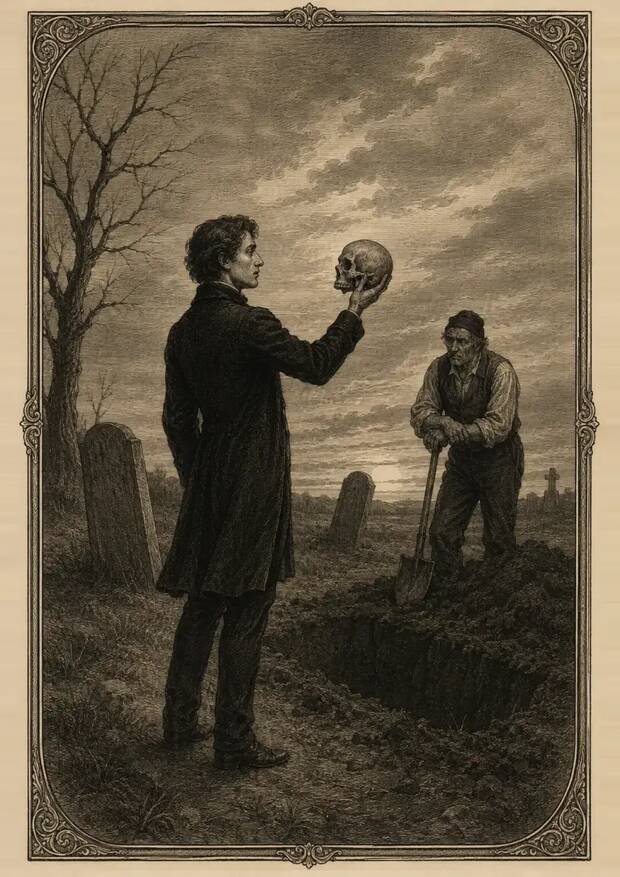
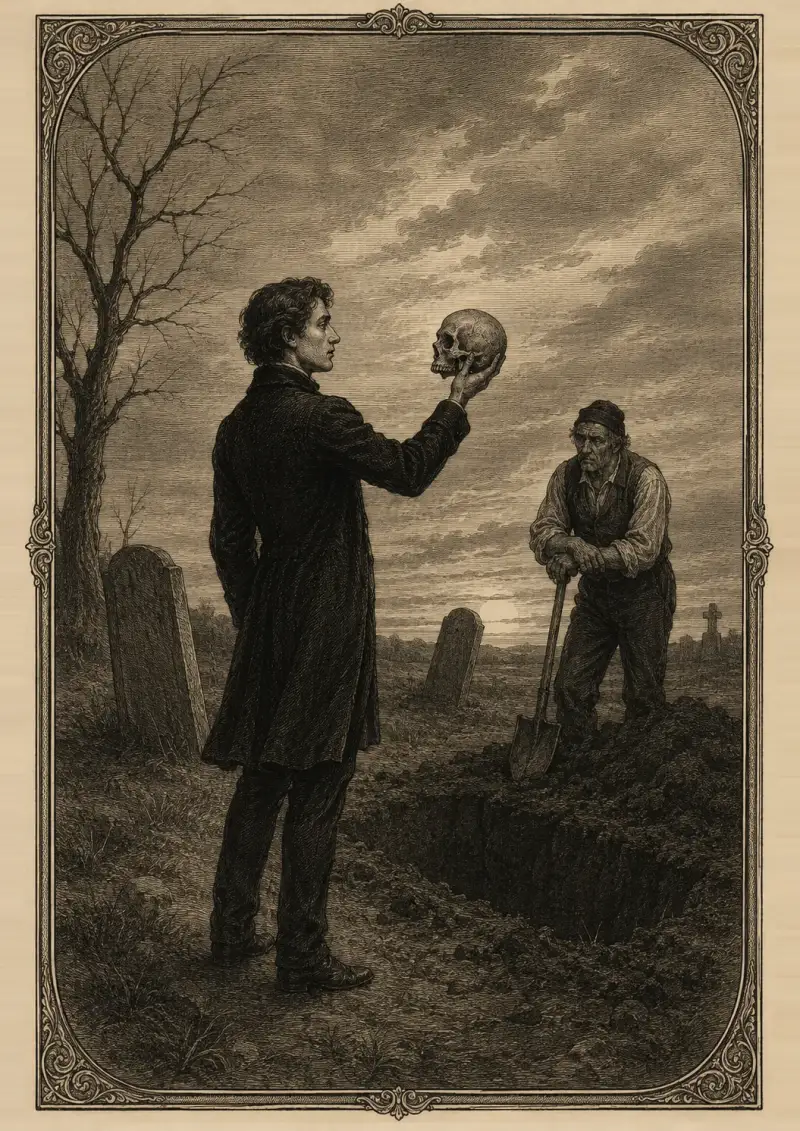
Talking with the Gravedigger, he is shown the skull of Yorick, the King’s jester, who carried him on his back when he was a child and has been dead twenty-three years: Alas, poor Yorick!
A funeral then arrives with maimed rites
, and Hamlet realises it is Ophelia’s. When Laertes leaps into the grave, Hamlet comes forward, the two men grapple, and Hamlet declares, I loved Ophelia.
What has happened to Rosencrantz and Guildenstern?
In Scene 2 Hamlet tells Horatio that on the ship he stole and read the King’s commission, which ordered his beheading. He wrote a replacement telling the English king to put the bearers to death, Not shriving time allowed
, and sealed it with his father’s signet. He feels no guilt: They are not near my conscience.
At the end of the play an English ambassador announces that Rosencrantz and Guildenstern are dead.
What are the terms of the fencing match?
The courtier Osric brings the challenge. Claudius has bet six Barbary horses against six French rapiers and daggers, staked by Laertes, that in twelve bouts Laertes will not beat Hamlet by more than three hits. Hamlet accepts. He tells Horatio he has been practising and expects to win at those odds, yet admits to a sense of dread: how ill all’s here about my heart
. He refuses Horatio’s offer to postpone.
How, and in what order, do the four main characters die in the final scene?
Hamlet wins the first two bouts. Gertrude drinks from the poisoned cup, against Claudius’s warning. Laertes wounds Hamlet with the poisoned sword, the rapiers are exchanged in a scuffle, and Hamlet wounds Laertes with it. Gertrude dies first, crying that the drink is poisoned. Laertes confesses: the King’s to blame.
Hamlet stabs Claudius and forces him to drink, and Claudius dies. Laertes dies after exchanging forgiveness with Hamlet. Hamlet dies last.
Who is left to rule Denmark, and who is left to tell the story?
Young Fortinbras arrives from his Polish campaign as Hamlet is dying. Hamlet predicts he will be elected king and supports him: he has my dying voice.
Fortinbras claims the throne and orders a soldier’s funeral for Hamlet. Horatio, who tried to drink the last of the poison and was stopped by Hamlet, survives to explain to the court How these things came about
.
Analysis
How does the graveyard scene change Hamlet’s thinking about death?
It turns death from an idea into an object. In Act 3 death was The undiscovered country
, a metaphor for the unknown. Here Hamlet holds a skull and speaks in plain prose to a workman who sings as he digs. The skull is a memento mori (a reminder that everyone dies), and Hamlet uses it to level all ranks: a lady may paint an inch thick
, yet to this favor she must come
, and Alexander’s dust may stop a barrel. The jokes are grim but steady. He has stopped asking what comes after death and accepts what is certain about it. Then the general becomes particular, because the grave is Ophelia’s. See more quotations about death.
What does “The readiness is all” show about Hamlet before the duel?
It shows that he has stopped trying to control events. Horatio offers to cancel the match, and Hamlet answers, We defy augury
: he will not act on omens. His reason is a biblical allusion (an indirect reference), There is a special providence in the fall of a sparrow
, the belief that God oversees even the smallest death. The sentences that follow are short and balanced, turning the words “now” and “come” over in three forms, and their calm contrasts with the tangled questions of the soliloquies. The speech ends in two words, Let be
. It can be read as faith, as fatalism or as weariness. In any reading, the man who once planned a perfect revenge now only waits.
Does Hamlet achieve his revenge in the final scene?
He kills Claudius, but not in the way the Ghost’s command implied, and the question is open. The case for: Claudius dies by his own poisons, publicly exposed, and Hamlet names his crimes, calling him incestuous, murd’rous, damned Dane
. The case against: Hamlet acts only when he is already dying, in a plot Claudius designed, and what moves him is the sight of his mother’s death: Follow my mother.
He does not mention his father. The cost is also large: the deaths of Polonius, Ophelia, Rosencrantz, Guildenstern, Gertrude and Laertes lie between the oath and the deed. Horatio’s summary speaks of purposes mistook / Fall’n on th’ inventors’ heads
, which describes accident more than justice.
Whole-text questions
Why does Hamlet delay his revenge?
The play gives several reasons and endorses none, so the best answer weighs them. First, doubt: Hamlet cannot be sure the Ghost is honest, and he waits until the play scene gives him proof. Second, scruple: at the prayer scene he wants a revenge that damns Claudius, and will not take a lesser one. Third, temperament: he accuses himself of thinking too precisely on th’ event
, and the first soliloquy shows a man already sunk in grief and disgust before the task is given. Against the idea that he simply cannot act, remember that he kills Polonius in a moment and sends two men to their deaths. He is able to act. What he puts off is one deliberate killing whose rightness he cannot establish.
Is Hamlet really mad?
The text supports the view that the madness is put on, and also shows him losing control. He tells his friends in advance that he may adopt an antic disposition
, tells Guildenstern he is but mad north-north-west
, and tells his mother he is mad in craft
. His mad speeches are in prose and full of pointed meaning, and he drops them at once with Horatio. Yet his cruelty to Ophelia, the killing of Polonius and his fury at the graveside go beyond any plan. Before the duel he blames his madness for wronging Laertes. Shakespeare sets Ophelia’s real madness beside his, and the contrast suggests that Hamlet is not insane, but that the mask gives licence to feelings he cannot govern. The madness quotations page sets out the evidence.
How does Shakespeare use Laertes and Fortinbras?
Both are sons whose fathers have been killed, so both are foils to Hamlet. Fortinbras wants to recover his father’s lost lands; he is checked by his uncle, redirects his army to Poland, and ends by gaining Denmark without a fight. Laertes wants blood for Polonius; he acts at once, is manipulated by Claudius, and dies justly killed with mine own treachery
. Each shows a path Hamlet does not take. Fortinbras stands for disciplined action whose aims are hollow: he fights for land not worth farming. Laertes stands for passionate action without conscience. Hamlet himself draws the comparison with Laertes: by the image of my cause I see / The portraiture of his.
The structure of three sons lets Shakespeare test revenge from three sides.
Why is soliloquy so important in this play?
A soliloquy is a speech of private thought delivered alone. In a court where everyone is watched and nobody can speak freely, it is the only place where truth is told. Hamlet’s soliloquies do not report decisions. They show a mind in the act of arguing, full of questions, self-interruption and reversals, so the audience follows his reasoning as it happens. Claudius has soliloquies too, and they confirm his guilt and reveal his plan to have Hamlet killed. The effect is dramatic irony: we know what both enemies think, while the court knows neither. Shakespeare also undermines the form’s privacy. During “To be or not to be” two spies are hidden on stage, so even solitary thought is under watch in Elsinore.
How does the religious context of the play shape Hamlet’s situation?
It makes his task morally uncertain at every step. Hamlet is a student at Wittenberg, the university of Luther, and the play was written in Protestant England, which had rejected purgatory. A ghost claiming to come from purgatorial fires is therefore suspect, and Hamlet’s fear that it May be a devil
is sound doctrine, not an excuse. Christian teaching also reserved vengeance to God, while the code of honour demanded it of a son. Suicide is ruled out by God’s canon ’gainst self-slaughter
. Hamlet’s refusal to kill Claudius at prayer depends on beliefs about confession and the state of the soul at death. By Act 5 he speaks of special providence
, placing the outcome in God’s hands.
How does the imagery of poison and disease develop across the play?
It begins as fact, spreads as metaphor and returns as fact. The Ghost describes a real poison that entered through the ear and crusted the King’s body. From that hidden act the language of sickness spreads to the whole state: Marcellus says Something is rotten in the state of Denmark
, Hamlet sees an unweeded garden
, and Claudius calls his own crime rank
. Characters use disease to describe each other. To Claudius, Hamlet is a fever, the hectic in my blood
. Poison also becomes a figure for corrupting words poured into ears, as when Claudius works on Laertes. In the final scene the metaphor turns literal again: poison is on the sword and in the cup, and it kills the poisoner.
Essay questions with outline answers
“Hamlet’s tragedy is that he cannot make up his mind.” How far do you agree?
Thesis: Hamlet makes up his mind several times; his tragedy is that he needs certainty and moral clarity before a deliberate killing, and the world of the play supplies neither.
- Point 1: The soliloquies do show indecision, and Hamlet says so himself. In Act 2, Scene 2 he asks
Am I a coward?
, and in Act 4, Scene 4 he admitsI do not know / Why yet I live to say “This thing’s to do,”
. - Point 2: Much of the delay is a search for knowledge, not a failure to choose. He tests the Ghost with the play because he wants
grounds / More relative than this
, and once the play has convinced him he strikes, that same night, at the figure behind the arras. - Point 3: Elsewhere he is decisive to the point of rashness: he kills Polonius,
Dead for a ducat, dead
, and rewrites the commission at sea. He even praises actingRashly
. - Counter-argument: In Act 3, Scene 3 he has proof and opportunity and still finds a reason to wait. This can be read as a pretext, the strongest evidence for the statement.
Conclusion: The statement describes how Hamlet sees himself more accurately than it describes what he does; the play makes delay a question of conscience as much as of character.
Explore the significance of spying and overhearing in Hamlet.
Thesis: Elsinore is a state run on surveillance, and Shakespeare shows that watching people produces misreading and death, not truth.
- Point 1: Spying is the court’s normal method. Polonius sets Reynaldo on his own son and states the principle:
By indirections find directions out.
Rosencrantz and Guildenstern are friends turned informers. - Point 2: Claudius and Polonius hide twice. In Act 3, Scene 1 they are
lawful espials
, a phrase that tries to make spying respectable. Claudius states the politics:Madness in great ones must not unwatched go.
- Point 3: Hamlet answers with surveillance of his own. The play within the play is a device for watching a face: he and Horatio fix their eyes on the King.
- Counter-argument: Hamlet’s watching does find the truth, so not all observation fails. But the watchers on the other side learn little: Polonius is wrong about the cause of the madness, and his last act of eavesdropping kills him.
Conclusion: The habit of watching corrupts every relationship in the play, including love and friendship, and links to the theme of appearance and reality.
How does Shakespeare present the relationships between fathers and their children in Hamlet?
Thesis: Fathers in the play command and children pay; Shakespeare presents filial duty as a debt that destroys the young.
- Point 1: The Ghost binds his son with love and obligation together:
If thou didst ever thy dear father love
. His final order,Remember me
, governs Hamlet’s life from then on. - Point 2: Polonius controls his children through advice and spying. Ophelia’s
I shall obey, my lord
costs her Hamlet, and her father’s death costs her reason. - Point 3: Three sons, Hamlet, Laertes and Fortinbras, inherit a dead father’s quarrel. Claudius uses the idea to drive Laertes:
was your father dear to you?
- Counter-argument: There is real tenderness too. Polonius blesses Laertes, and the Ghost protects Gertrude. Claudius offers himself
As of a father
, a false version that shows what the true bond means to Hamlet.
Conclusion: By the end every family in the play is extinct except Fortinbras’s, which suggests that the duty of sons to avenge fathers consumes the next generation.
How does Shakespeare present attitudes to death in Hamlet?
Thesis: The play moves from death as a commonplace, through death as a terrifying unknown, to death as a plain fact that can be met calmly.
- Point 1: The court treats death as routine. Gertrude says
all that lives must die
, and Claudius calls prolonged mourningunmanly grief
. Hamlet’s grief exposes how quickly they have moved on. - Point 2: In Act 3 Hamlet fears what follows death:
The undiscovered country
makes people bear their troubles. The Ghost’s account of dying unprepared gives that fear its force. - Point 3: In Act 5 death is physical and equal for all. Yorick’s skull and the couplet on
Imperious Caesar, dead and turned to clay
lead to the calm ofThe readiness is all.
- Counter-argument: The calm is not shared or certain. Ophelia’s death is disputed, Laertes dies in guilt, and Hamlet’s last words,
the rest is silence
, promise nothing beyond.
Conclusion: Shakespeare offers no doctrine about death; he shows one mind learning to live with not knowing. Compare the essay on Macbeth’s “Tomorrow” speech.
“Claudius alone is to blame for the tragedy.” How far do you agree?
Thesis: Claudius’s crime is the first cause and his plots supply the means of the final deaths, but the tragedy needs the choices of others, Hamlet above all.
- Point 1: Everything follows from the murder, which Claudius himself calls
rank
. He then orders Hamlet’s execution and designs the duel, and the dying Laertes names him:the King’s to blame.
- Point 2: Hamlet is responsible for the deaths in the middle of the play. He kills Polonius, drives Ophelia away, and sends Rosencrantz and Guildenstern to die with
Not shriving time allowed
. - Point 3: The court is complicit. Polonius dies spying. Laertes chooses poison and admits he is
justly killed with mine own treachery
. Gertrude’so’erhasty marriage
helps to unbalance her son. - Counter-argument: The Ghost’s demand, and the code of revenge behind it, may be the deepest cause: it asks a son to answer one killing with another. See the revenge quotations.
Conclusion: Claudius begins the tragedy and cannot be excused, but Shakespeare spreads the guilt so that revenge itself, not one man, is on trial.
A page of Shakespeare, every day.
This resource comes from Daily Bard, an app for iPhone and iPad. Each morning it shows one engraved plate and one passage, exactly as Shakespeare wrote it, with a plain-English reading on the back of the leaf.
Free to download. The Full Edition is a one-time US$11.99: no subscription, no account, no ads, no tracking.
Get it on the App Store: apps.apple.com/app/id6792967225
More free study guides, lesson plans and close readings: dailybard.app