
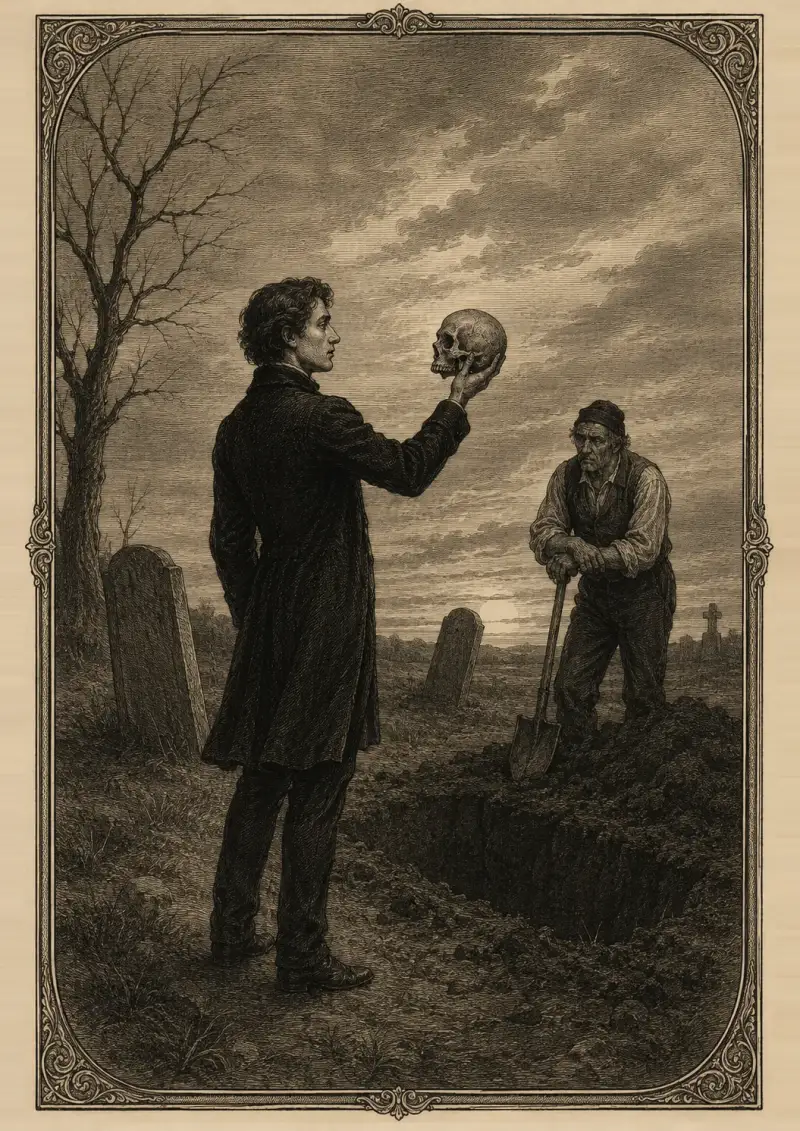
- Role
- King of Denmark; brother and murderer of the late King Hamlet; Gertrude’s second husband; Hamlet’s uncle and stepfather
- First appears
- Act 1, Scene 2
- Last appears
- Act 5, Scene 2
- Key scenes
- 1.2, 3.1, 3.3, 4.3, 4.5, 4.7, 5.2
- Speaks in
- Blank verse almost throughout: the royal "we" in public, "I" in his aside and soliloquies
Hamlet: key quotes and analysis (PDF)
PDF, 11 pages, 794 KB. Free, no sign-up, made to be printed.
The ten core quotations for Hamlet, each with plain English, analysis and a fill-the-gap test. Or read the full study guide.
Who is Claudius?
Claudius is the King of Denmark. Before the play begins he has poisoned his brother, taken the throne and married his brother’s widow, all inside two months. In the design of the play he is the antagonist (the character who opposes the hero) and the object of the revenge. He is also its first cause: the hidden murder is the rotten
thing from which every later death follows. His name is never spoken in the dialogue. To everyone on stage he is simply the King.
The interpretative question is how much of a villain he is. Shakespeare gives him a conscience, a real talent for rule and what looks like real love for Gertrude, and then shows that none of these makes him less dangerous. Claudius is a capable king and a guilty man at once, and the two are not in conflict: his competence is the means by which his guilt survives. He is frightening because he is ordinary. He wants to keep what he has, and each new threat to it pushes him to one more crime.
Claudius across the play
Act 1: the smooth king
Claudius’s first speech is a model of public management. He acknowledges grief, announces his marriage, thanks the council, and disposes of the threat from young Fortinbras with a letter to Norway. He is gracious to Laertes and patient with Hamlet until patience fails, when he calls the prince’s mourning unmanly grief
. Only three scenes later do we learn from the Ghost what lies under the performance: The serpent that did sting thy father’s life / Now wears his crown.
Act 2: the watcher
Hamlet’s transformation
worries him, and his response is to gather information. He summons Rosencrantz and Guildenstern to find out what afflicts him
, and agrees to Polonius’s scheme to hide behind an arras (a wall hanging) while Ophelia is put in Hamlet’s way. He does this politely and through other people. At this stage he may fear only an unstable heir. He has no reason yet to think Hamlet knows.
Act 3: the conscience exposed
A chance remark by Polonius draws out Claudius’s first admission of guilt, in an aside. After overhearing Hamlet he sees through the madness at once: There’s something in his soul / O’er which his melancholy sits on brood
. The play within the play then breaks his composure in public, and he calls for some light
. Alone, he tries to pray and cannot, because he will not give up the crown or the Queen. This is the last time he struggles with himself.
Act 4: the plotter
Polonius’s death shows Claudius that the sword was meant for him: It had been so with us, had we been there.
He ships Hamlet to England with sealed orders for his execution, then faces Laertes at the head of a mob and talks him round by standing still. When Hamlet’s letter announces his return, Claudius turns the young man’s anger into a weapon and designs the fencing match, adding a poisoned cup in case the poisoned sword fails.
Act 5: the poisoner caught
The plot works and destroys its maker. Claudius watches Gertrude lift the wrong cup, says one line to stop her, and lets her drink. When Laertes names him, the King’s to blame
, he still tries to brazen it out: I am but hurt.
Hamlet wounds him with the envenomed blade and forces the wine down his throat. He dies by both of his own poisons, without a word of repentance.
Reading the character
He is good at being king
The play gives Claudius real political successes. Fortinbras’s planned attack is turned aside by diplomacy, without a battle. When Laertes breaks down the doors, Claudius does not call the guard back or bargain: he tells Gertrude to Let him go
and asks questions until the fury has somewhere else to point. He reads people fast, and he is the first to conclude that Hamlet’s behaviour is neither lovesickness nor simple madness. This matters for any essay on him. Denmark is rotten at the top, but it is not badly run, and Shakespeare makes us see that a criminal can be an effective ruler.
His conscience is real and useless
Claudius is not a villain who enjoys evil, as Iago or Richard III seem to. He calls his deed a heavy burden
, knows that it carries the primal eldest curse
of Cain, and understands the theology of repentance better than anyone in the play. What he lacks is the will to act on it. He states the problem with a lawyer’s clarity, May one be pardoned and retain th’ offense?
, answers it honestly, and gets up from his knees to arrange another murder. After Act 3 the conscience is never heard again. The play suggests that guilt felt and not obeyed does not soften a man. It hardens him.
He kills through other people
Claudius murdered his brother by pouring poison into his ear, and the method becomes his habit of rule. He works on ears. Polonius, Ophelia, Rosencrantz, Guildenstern, the King of England and Laertes are all used in turn, and all but one of them die. He never draws a sword. His speech to Laertes in Act 4, Scene 7 is his masterpiece: flattery, a needling question, was your father dear to you?
, and then the plan, in which Laertes will do the killing and even his mother
will call it accident
. Compare the pages on appearance and reality and revenge.
His love for Gertrude has a limit
He tells Laertes that the Queen is so conjunctive to my life and soul
that he cannot move without her, and he lists her among the prizes he will not surrender. There is no reason to doubt the feeling. The test comes in the final scene. Gertrude, do not drink
is all he says. To knock the cup away would be to confess, so he does nothing more, and she dies. In the same way, the man who told Hamlet to think of him As of a father
has signed that son’s death warrant. With Claudius, affection is sincere up to the moment it costs something.
Key quotations
Seven passages in play order: six spoken by Claudius, in public and in private, and one spoken about him. Listen for two voices, the King’s and the man’s.
With an auspicious and a dropping eye,
Claudius · Act 1, Scene 2 1.2.11-14
With mirth in funeral and with dirge in marriage,
In equal scale weighing delight and dole)
Taken to wife.
Plain English: With one eye smiling and one weeping, with joy at a funeral and mourning at a wedding, balancing happiness and sorrow equally, I have married her.
Context: Claudius’s first speech, to the full court. He is explaining why he has married our sometime sister, now our queen
so soon after her husband’s death.
Methods: The lines are built from antithesis (two opposed ideas set in balance): mirth
against funeral
, dirge
against marriage
, delight
against dole
. Each pair is an oxymoron (a contradiction joined in one phrase) made to sound reasonable by the even rhythm and the image of a scale
. The syntax does the same work. The sentence keeps us waiting six lines for its verb, so the fact, Taken to wife
, arrives late and small. The grotesque picture of one eye smiling and one dropping
shows what the balance really is: a face doing two things at once.
In an essay: Use it to show Claudius’s command of public language and his way of hiding an act inside a sentence. The same speech reminds the council that they have freely gone / With this affair along
, which spreads the responsibility.
The serpent that did sting thy father’s life
Ghost · Act 1, Scene 5 1.5.46-47
Now wears his crown.
Plain English: The snake that killed your father is now wearing his crown.
Context: The Ghost tells Hamlet how he died. The official story is that a snake bit the old King as he slept in his orchard.
Methods: The Ghost takes the cover story and turns it into the truth by metaphor: there was a serpent, and it was Claudius. A serpent in an orchard recalls the Garden of Eden, so the murder becomes a second Fall that spoils the whole country. The sentence is brutally short after the long build-up, and its two verbs set the crime beside its reward: sting
, then wears
. The half line that follows is filled by Hamlet’s cry, O, my prophetic soul! My uncle!
In an essay: Remember who is speaking. Much of what we first hear of Claudius comes from a furious ghost and a disgusted nephew, who also call him an adulterate beast
and a satyr
. Set those names against the controlled, courteous man we actually watch.
The harlot’s cheek beautied with plast’ring art
Claudius · Act 3, Scene 1 3.1.59-62
Is not more ugly to the thing that helps it
Than is my deed to my most painted word.
O heavy burden!
Plain English: A prostitute’s face under its thick make-up is no uglier, compared with the make-up, than my crime is compared with my fine words. What a weight this is.
Context: Polonius, handing Ophelia a prayer book as a prop, has remarked that people often sugar o’er / The devil himself
with a show of piety. Claudius responds in an aside (a remark the other characters do not hear).
Methods: This is the first proof from Claudius’s own mouth that the Ghost told the truth, and Shakespeare places it before the play scene, so the audience is certain while Hamlet still doubts. The simile compares his speech to cosmetics: plast’ring
suggests a surface laid on thick, and painted word
turns language itself into make-up. He is criticising exactly the style we heard in Act 1. The broken last line, four syllables long, leaves a silence where the rest of the verse should be.
In an essay: Use it to argue that Claudius is self-aware, not self-deceived. It also links him to Hamlet, who accuses women of the same painting later in this scene: God hath given you one face, and you make yourselves another.
O, my offense is rank, it smells to heaven;
Claudius · Act 3, Scene 3 3.3.40-42
It hath the primal eldest curse upon ’t,
A brother’s murder. Pray can I not,
Plain English: My crime is foul; it stinks all the way to heaven. It carries the first and oldest curse, the murder of a brother. I cannot pray.
Context: The play has just exposed him. Claudius has sent Rosencrantz, Guildenstern and Polonius away and is alone on stage for the first time.
Methods: The speech opens with smell. rank
is a word Hamlet used in Act 1 for the weeds of an unweeded garden
, so the King’s guilt joins the play’s imagery of rot. primal eldest curse
is an allusion (an indirect reference) to Cain, who killed his brother Abel in Genesis. Then the grammar turns round: Pray can I not
puts the verb first and the refusal last, so the line stumbles where the man does. This is a soliloquy, and its questions and reversals sound more like Hamlet than like the public Claudius.
In an essay: The key evidence that Claudius is more than a stage villain. Compare Lady Macbeth’s guilt in “Out, damned spot”: she cannot stop the confession coming, and he cannot make it count.
That cannot be, since I am still possessed
Claudius · Act 3, Scene 3 3.3.57-60
Of those effects for which I did the murder:
My crown, mine own ambition, and my queen.
May one be pardoned and retain th’ offense?
Plain English: That is impossible, because I still hold the things I committed the murder to get: my crown, my ambition and my queen. Can a man be forgiven and keep the profits of the crime?
Context: Later in the same soliloquy. Claudius has asked what form of prayer could serve him, and tried out the words Forgive me my foul murder
.
Methods: The list of three gives his motives in his own order: crown
first, queen
last, with ambition
between them. The possessives pile up, My
, mine own
, my
, and possessed
has a second sense: he owns these things and they own him. The rhetorical question that follows is put in the impersonal one
, as if it were a case in law, and he goes on to contrast earthly courts, where the wicked prize itself / Buys out the law
, with heaven, where There is no shuffling
. He reasons perfectly and changes nothing.
In an essay: Use it for motive and for the limits of conscience. The closing couplet of the scene, My words fly up, my thoughts remain below
, then reveals that Hamlet spared him for a prayer that never happened.
The present death of Hamlet. Do it, England,
Claudius · Act 4, Scene 3 4.3.74-76
For like the hectic in my blood he rages,
And thou must cure me.
Plain English: The immediate death of Hamlet. Do it, King of England, for he burns in my blood like a fever, and you must cure me.
Context: Hamlet has just been led off to the ship. Left alone, Claudius reveals what the sealed letters carried by Rosencrantz and Guildenstern actually say.
Methods: The imperative Do it
is three blunt monosyllables from a man who usually speaks in long, cushioned sentences: alone, he has no one to persuade. The simile makes Hamlet a hectic
, a wasting fever, so that the murderer casts himself as the patient and execution as medicine. It reverses the play’s diagnosis, in which Claudius is the disease in Denmark. Note the method as well as the words. The killing is to happen abroad, by another king’s hand, on paper.
In an essay: This is the turning point of the character. The man who knelt in Act 3 now orders a second murder in the family, and from here his conscience
is a word he uses only to manage Laertes.
There’s such divinity doth hedge a king
Claudius · Act 4, Scene 5 4.5.138-140
That treason can but peep to what it would,
Acts little of his will.
Plain English: A king is fenced round by such divine protection that treason can only peer at what it wants to do, and manages very little of it.
Context: Laertes has burst in with a mob behind him, demanding his father. Gertrude is physically holding him back, and Claudius tells her to let go.
Methods: Claudius appeals to the belief that a monarch is protected by God, an idea Shakespeare’s audience heard preached. The verb hedge
pictures holiness as a fence, and peep
shrinks treason to a child looking through it. The irony is savage. The speaker killed a king and found no hedge in his way, so he knows the doctrine is false while he uses it. Yet the bluff works: his calm is the real protection. The line shows courage and fraud in the same breath.
In an essay: Strong context for a question on kingship or power. Pair it with Rosencrantz’s speech on how the death of a king drags down ten thousand lesser things
, and with the ending, where a king is killed in front of his court.
Relationships
Claudius and Hamlet
Claudius begins by trying to absorb Hamlet: he names him heir, calls him our son
and keeps him at court in the cheer and comfort of our eye
, which is also where he can be watched. He is the first to understand that the madness is purposeful and the first to act on it. After the play scene the two know each other’s secret, and neither can say so in public. Claudius cannot simply arrest him, because the people love the prince, and so he works by indirection. The duel he arranges is the only time he and Hamlet meet in a contest, and even then another man holds the sword.
Claudius and Gertrude
The marriage is the visible sign of the crime, and to Hamlet and the Ghost it is incest. Yet on stage Claudius is consistently tender to Gertrude, confides his fears to her, O Gertrude, Gertrude
, and relies on her in the crisis with Laertes. He also deceives her completely. She is never told of the murder, the English letters or the duel plot, and the plan depends on her calling her son’s death an accident. After the closet scene she keeps Hamlet’s confidence from him. The marriage ends in a line of polite refusal: I will, my lord; I pray you pardon me.
Claudius and Laertes
Laertes is the son Claudius can manage. In Act 1 the King flatters him with his own name four times in nine lines; in Act 4 he converts a rebel into an accomplice within a scene. He does it by treating grief as something that fades unless it is used at once, a cynical view of love from a man who has profited by a court’s short memory. Laertes supplies the poison for the blade, but the design is the King’s, and as he dies Laertes says so.
How the character has been read
An older tradition took Claudius at Hamlet’s valuation: a drunken, lecherous usurper, a vice of kings
. The text gives some support. He drinks deep, and cannon fire answers each cup he empties. But most of the insults come from two witnesses with every reason to hate him, and the man Shakespeare actually wrote is shrewd, hard-working and hard to dislike on first meeting. Some critics have gone so far as to argue that he is the healthier figure in a court that Hamlet’s bitterness disturbs. That goes too far, since it forgets the murder, but it is a useful corrective.
Political readings stress that Claudius holds an elective crown with the council’s consent, so that to the court he is a legitimate king and Hamlet a dangerous subject. Readings that centre on religion treat the prayer scene as the heart of the role: a man who believes in judgement and chooses damnation with his eyes open. On stage the part tilts with the casting. A Claudius who is attractive and plainly in love makes Gertrude’s choice understandable and Hamlet’s disgust excessive. A coarse one makes the Ghost’s portrait true. Either way, the prayer scene is where an audience decides how much sympathy he has earned.
Essay angles and a model paragraph
- Claudius is the play’s most effective politician, and Shakespeare uses that effectiveness to show how a state can run smoothly on top of a crime.
- Claudius’s tragedy is that he understands repentance perfectly and refuses it, which makes him guiltier, not more forgivable.
- Claudius and Hamlet are mirror images: each plots, performs and kills through others, and the play blurs the line between villain and avenger.
Question: How does Shakespeare present Claudius as more than a simple villain?
Practice questions
- Read Claudius’s first speech in Act 1, Scene 2. How does Shakespeare use language to present him as a king in control?
- How does Shakespeare present Claudius’s guilt in Act 3?
- “Claudius is a better king than Hamlet would ever have been.” How far do you agree?
- “In Claudius, Shakespeare shows that evil is a matter of management, not passion.” Discuss, comparing him with one other Shakespearean villain.
Check your answers against the Hamlet questions and answers, and read Claudius beside the pages on Hamlet and Gertrude. The study guide covers the context of kingship and revenge.