
Hamlet: key quotes and analysis (PDF)
PDF, 11 pages, 794 KB. Free, no sign-up, made to be printed.
The ten core quotations for Hamlet, each with plain English, analysis and a fill-the-gap test. Or read the full study guide.
Death in Hamlet
Hamlet begins with death as a mystery about the soul, drags it down to a fact about the body, and ends when its hero stops asking what death is and makes himself ready for it. In the first three acts death is a religious problem. A ghost returns from purging fire, God’s law forbids self-slaughter
, and what stops the suicide’s hand is the dread of something after death
. Hamlet thinks about death constantly, and only as an idea.
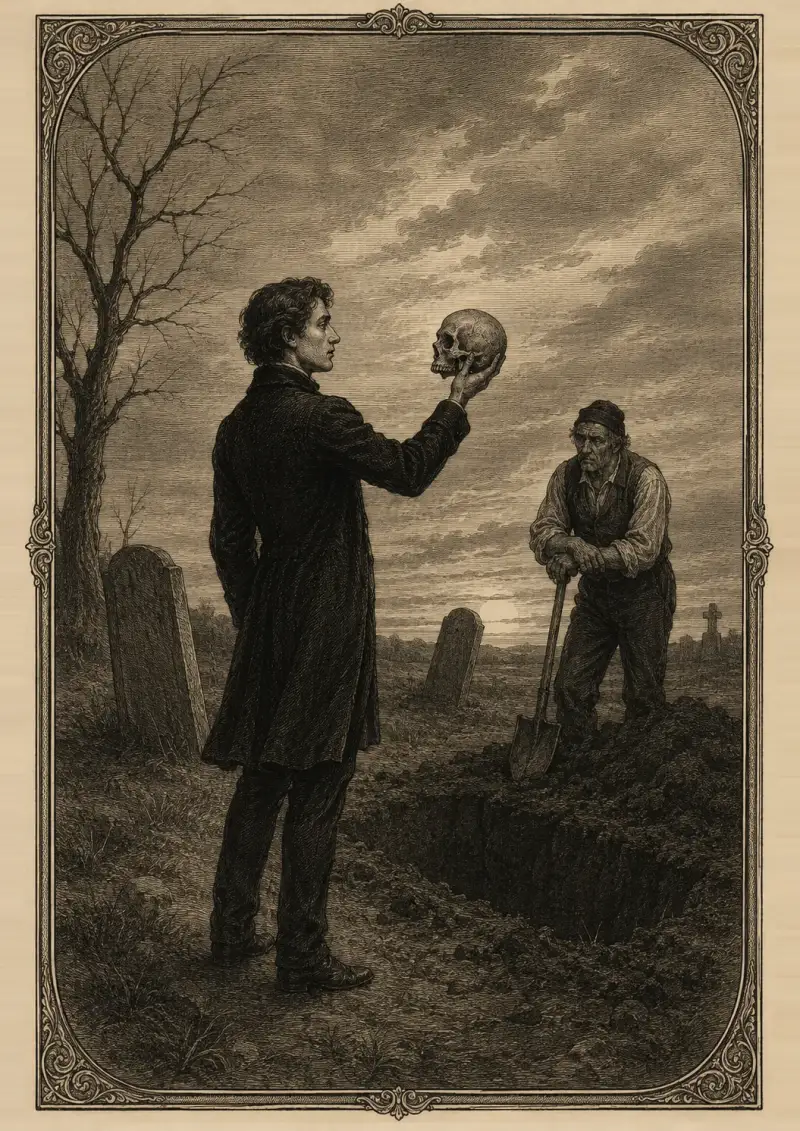
The turn comes when he kills Polonius. From that moment death is physical: a body to be hidden, worms at their meal, a girl pulled under by her wet clothes, a skull lifted out of the earth. The graveyard gives Hamlet no comfort about the soul, only a levelling fact: the jester, the lawyer and Alexander the Great all end as the same dust. With that, the fear of the undiscovered country
loses its grip.
What follows is acceptance without an answer. The readiness is all
does not say what death is. It says that the timing is not his to arrange. Eight characters die in the course of the play, four of them in its last minutes, and the man who has thought hardest about dying meets it in mid-sentence.
Key quotations about death
The quotations are in play order, so they trace the movement from doctrine, through dread and decay, to readiness; use an early one against a late one to show that change.
Thou know’st ’tis common; all that lives must die,
Gertrude · Act 1, Scene 2 1.2.74-75
Passing through nature to eternity.
Plain English: You know it is the ordinary way of things: everything that lives must die, passing through this natural life into eternity.
Context: At court, Hamlet is still in black two months after his father’s death. His mother, already remarried, asks him to stop looking for his father in the dust
.
Methods: Gertrude speaks a maxim (a short general truth), smooth and complete within its two lines. Passing through
turns death into a gentle journey, and the universal all that lives
leaves no room for one man’s grief. Hamlet’s reply, Ay, madam, it is common
, puns on the word: common as universal, and common as cheap. Hindsight adds a deeper irony: this death did not come by nature
at all. It was murder.
In an essay: This is the court’s official view: death is natural, general, and soon got over. Hamlet reaches something close to it in Act 5, but he has to earn what his mother says easily.
Or that the Everlasting had not fixed
Hamlet · Act 1, Scene 2 1.2.135-138
His canon ’gainst self-slaughter! O God, God,
How weary, stale, flat, and unprofitable
Seem to me all the uses of this world!
Plain English: Or I wish God had not set his law against suicide. O God, how tired, stale, flat and pointless all the business of this world seems to me.
Context: Hamlet’s first soliloquy (a speech delivered alone). He has not yet heard of the Ghost or the murder. He has just wished that his flesh would melt
.
Methods: canon
means a law of the Church, and fixed
sets its permanence against the melting and thawing he longs for: death is desired and forbidden in one sentence. The four adjectives slow the line to a trudge. Two of them, stale
and flat
, describe drink that has gone off, and unprofitable
is a merchant’s word, so life has lost both its taste and its value. The repeated cry of God
breaks the regular beat of the verse, as feeling overrides form.
In an essay: The wish to die comes before the Ghost, so it cannot be blamed on the burden of revenge. What holds him back here is a commandment; by Act 3 the barrier will have changed.
Cut off, even in the blossoms of my sin,
Ghost · Act 1, Scene 5 1.5.83-86
Unhouseled, disappointed, unaneled,
No reck’ning made, but sent to my account
With all my imperfections on my head.
Plain English: Cut down in the full flower of my sins, without communion, unprepared, without the last anointing; no settling of accounts, but sent to judgement with all my faults upon me.
Context: The Ghost has described how Claudius poured poison in his ear as he slept. For him the horror is less the dying than the dying unprepared.
Methods: The second line is made of three heavy negatives. Unhouseled
means without the sacrament, disappointed
means unprepared, and unaneled
means without the anointing given to the dying. Death is defined by the rites that were missing. The metaphor then becomes financial: reck’ning
and account
make death an audit that the soul must face with its books unbalanced. blossoms
pictures sin as a plant in flower, cut before it could be cleared.
In an essay: This sets the rule for the first half of the play: how and when a person dies decides the fate of the soul. It explains the prayer scene, where Hamlet spares Claudius because he wants him killed with no relish of salvation
in him. See revenge in Hamlet.
But that the dread of something after death,
Hamlet · Act 3, Scene 1 3.1.86-90
The undiscovered country from whose bourn
No traveler returns, puzzles the will
And makes us rather bear those ills we have
Than fly to others that we know not of?
Plain English: ...if it were not that the fear of something after death, that unexplored land from whose border no traveller comes back, baffles the will and makes us put up with the troubles we have sooner than fly to others we know nothing about?
Context: The centre of the “To be or not to be” soliloquy. Hamlet has asked why anyone carries the burdens of life when a dagger could end them.
Methods: Death becomes geography: a country
with a bourn
(a border), and the dead are travellers who send back no report. The frightening word is the vaguest one, something
. In Act 1 the Ghost spoke of fire and judgement; now the terror is that nothing is known. There is a paradox to use here: Hamlet has met a traveller who returned. Either he doubts the Ghost, or its report has not given him knowledge. puzzles
is stronger than it sounds, meaning to bewilder until one cannot move. The pronouns are us
and we
, which makes his fear everyone’s.
In an essay: Set this against the first soliloquy. There a law stopped him; here ignorance does. The full passage is read closely in the essay on “To be, or not to be”.
Your worm is your only emperor for diet. We fat all creatures else to fat us, and we fat ourselves for maggots. Your fat king and your lean beggar is but variable service - two dishes but to one table. That’s the end.
Hamlet · Act 4, Scene 3 4.3.24-28
Plain English: The worm is the supreme emperor of eating. We fatten every other creature to fatten ourselves, and we fatten ourselves for maggots. A fat king and a thin beggar are only different courses served at the same table. That is how it ends.
Context: Hamlet has killed Polonius and hidden the body. Claudius asks where it is. Hamlet answers that Polonius is at supper, Not where he eats, but where he is eaten
.
Methods: Prose, the register of Hamlet’s “mad” talk, lets him tell a king to his face that kings are meat. The image is a food chain that turns rank upside down: the worm is the emperor
, the monarch a dish. fat
appears four times, as verb and adjective, until a person is nothing but flesh. That’s the end
carries two senses, the finish and the purpose. Hamlet then sharpens the insult: a king may go a progress through the guts of a beggar
, a progress being a royal tour.
In an essay: This is the turning point of the theme: for the first time death has no soul in it and no dread, only matter. Notice the coldness too. He is joking about a man he has just killed.
The imminent death of twenty thousand men
Hamlet · Act 4, Scene 4 4.4.63-65
That for a fantasy and trick of fame
Go to their graves like beds
Plain English: The approaching death of twenty thousand men who, for an illusion and a trifle of reputation, go to their graves as calmly as to their beds.
Context: On his way to England, Hamlet watches the army of Fortinbras march to fight for a piece of ground that its own captain calls worthless.
Methods: The simile graves like beds
returns to the idea of death as sleep, but without the bad dreams that stopped Hamlet in Act 3: these soldiers lie down without thinking. The round number, twenty thousand
, makes death a mass event in a play that otherwise counts its dead singly. Hamlet’s own words belittle the cause, a fantasy
and a trick of fame
, yet he concludes that the soldiers put him to shame. The speech admires what its vocabulary condemns.
In an essay: This complicates the idea that Hamlet grows steadily wiser about death. Here he envies men who die for nothing because they do not reflect, and Shakespeare lets us see the waste that his argument skates over.
Till that her garments, heavy with their drink,
Gertrude · Act 4, Scene 7 4.7.206-208
Pulled the poor wretch from her melodious lay
To muddy death.
Plain English: ...until her clothes, heavy with the water they had drunk, dragged the poor girl down from her sweet song to a muddy death.
Context: Gertrude breaks in on Claudius and Laertes to report that Ophelia fell into a brook while hanging garlands on a willow. Her spreading clothes held her up for a time, and she sang.
Methods: Until this sentence the speech is lyrical, with Ophelia floating mermaid-like
. Then the verse sets melodious lay
(a song) against muddy death
, with the repeated “m” tying the music to the mud that ends it. The final phrase is short and blunt after the long descriptive lines. The grammar matters too: the garments, heavy with their drink
, are what pull. Ophelia does nothing, which matches Gertrude’s account of her as incapable of her own distress
.
In an essay: Ophelia’s death is reported, not shown, and reported as a picture. The play then questions the picture: at the graveside the priest says Her death was doubtful
. Even a death is open to interpretation. See Ophelia.
Alas, poor Yorick! I knew him, Horatio - a fellow of infinite jest, of most excellent fancy. He hath bore me on his back a thousand times, and now how abhorred in my imagination it is! My gorge rises at it.
Hamlet · Act 5, Scene 1 5.1.190-194
Plain English: Poor Yorick. I knew him, Horatio: a man of endless jokes and wonderful imagination. He carried me on his back a thousand times, and now the thought of it revolts me. It turns my stomach.
Context: A gravedigger, digging what Hamlet does not yet know is Ophelia’s grave, throws up skulls. Hamlet jokes about whose they might be. Then one is given a name: Yorick, the King’s jester.
Methods: The prose is plain, and its hinge is I knew him
: death stops being a topic and becomes a person. infinite
is set against the small, finite object in his hand. A bodily memory, bore me on his back
, meets a bodily reaction, My gorge rises
, so the body understands death before the mind does. The skull is a memento mori (an object that reminds us we will die). Hamlet then reasons that Alexander’s dust might stop a beer barrel, and breaks into rhyme: Imperious Caesar, dead and turned to clay, / Might stop a hole to keep the wind away
.
In an essay: Compare Act 3. The undiscovered country
has become an object he can hold, and dread has given way to disgust and then to dry humour. Nothing here tells him about the soul; what changes is that he can look.
If it be now, ’tis not to come; if it be not to come, it will be now; if it be not now, yet it will come. The readiness is all.
Hamlet · Act 5, Scene 2 5.2.234-237
Plain English: If death comes now, it is not still to come; if it is not still to come, it will be now; if it is not now, it will come all the same. Being ready is everything.
Context: Hamlet has accepted the fencing match and admits to a misgiving about it. Horatio offers to call it off. Hamlet refuses: We defy augury
.
Methods: Three balanced conditional clauses turn the same few words around, now
and to come
changing places as in a logic exercise. Almost every word is a monosyllable, and death is never named: it is only it
. The reasoning is circular because there is nothing left to work out. Just before, Hamlet cites a special providence in the fall of a sparrow
, a biblical allusion (an indirect reference). Just after, he says Let be
, which quietly answers “To be or not to be” by dropping the question.
In an essay: This can be read as Christian trust or as tired fatalism, and the short flat sentences support both. Either way, he has given up arranging the hour of a death, which is what he tried to do to Claudius in the prayer scene.
Had I but time (as this fell sergeant, Death,
Hamlet · Act 5, Scene 2 5.2.368-370
Is strict in his arrest), O, I could tell you -
But let it be.
Plain English: If I only had time (but this cruel officer, Death, is strict when he makes an arrest), oh, I could tell you... But let it go.
Context: Hamlet is poisoned. The Queen, Laertes and the King are dead. He turns to the horrified onlookers.
Methods: Death is personified as a sergeant
, an officer who arrests, and he is strict
: there is no bail and no delay. The country and the sleep of Act 3 have given way to the law. The sentence then breaks off, an aposiopesis (a thought left unfinished), so that death interrupts the grammar itself. let it be
echoes Let be
. The play’s greatest talker runs out of time, and his last words are the rest is silence
, where rest
means both what remains and repose.
In an essay: At the end Hamlet’s concern is his story, not his soul: he fears a wounded name
and tells Horatio to report me and my cause aright
. Use this to argue that the play’s final answer to death is memory, which is where it began with the Ghost’s remember me
.
How the theme develops
| Where | What happens to the theme | Quotation to know |
|---|---|---|
| Act 1 | Death is a matter of doctrine: a commonplace at court, a forbidden wish for Hamlet, a judgement for the Ghost. | sent to my account |
| Act 2 | Death is held at a distance. Hamlet fears for his soul if the Ghost is a devil, and delays. | Abuses me to damn me |
| Act 3 | Death is the great unknown that stops the will. Then Hamlet kills Polonius, and it becomes real. | the dread of something after death |
| Act 4 | Death is bodily and cheap: worms, a marching army, a drowned girl. | we fat ourselves for maggots |
| Act 5 | Death is handled, joked with and accepted, and then arrives for four people in a few minutes. | The readiness is all |
The theme has two turns. The first is the killing of Polonius in Act 3, after which Hamlet’s language about death drops from the soul to the stomach. The second is the graveyard, where looking steadily at what death does to a body loosens the fear of what may follow it. The play ends where Gertrude began, with the knowledge that all that lives must die, now spoken by someone who has tested it. Fortinbras, arriving, sees only a heap: so many princes at a shot
.
Model paragraph
Question: How does Shakespeare present Hamlet’s changing attitude to death?
Why it works: It argues for a change and proves it by comparing the language of two moments. Each quotation is a few words long, and the analysis names what a single noun or pronoun is doing. One sentence explains the cause of the change, and the link back to the Ghost is tied to a phrase.
Practice questions
- Read Hamlet’s exchange with Claudius about the body of Polonius in Act 4, Scene 3. How does Shakespeare use humour to present death in this scene?
- How does Shakespeare present different attitudes to death in Hamlet? Consider at least three characters.
- Compare Hamlet’s view of death in the “To be or not to be” soliloquy with his view in Act 5. What has changed, and what has caused the change?
- “Hamlet is less a revenge play than a meditation on how the living remember the dead.” Discuss, with reference to the Ghost, the graveyard and the play’s final speeches.
Test your knowledge of these scenes with the Hamlet questions and answers, return to the Hamlet study guide for the wider picture, and read on to madness in Hamlet. For a bleaker view of mortality, compare the “Tomorrow” speech in Macbeth.